Questions are emerging over a possible milk shortage in Nairobi after some supermarkets began limiting the amount of milk customers can purchase.
At the same time, consumers have reported difficulty finding popular brands such as Brookside, KCC and Tuzo.
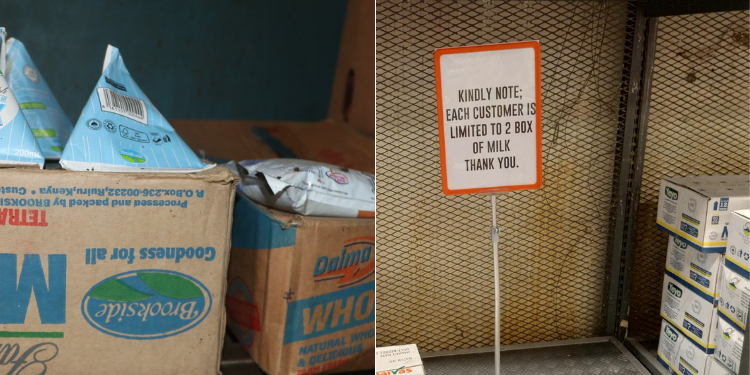
A notice seen by The Kenya Times at Naivas Prestige, along Ngong Road, informed customers they could only buy a maximum of two boxes of milk.
“Kindly note: each customer is limited to 2 boxes of milk. Thank you,” the notice stated.
The development comes amid consumer reports of empty supermarket shelves and rising milk prices in parts of Nairobi.
Brookside, KCC and Tuzo Missing From Shelves as Milk Supply Concerns Grow
A spot check at Waithaka Dairy Centre showed that a litre of fresh unpacketed milk had shot from KSh70 to KSh80.
Brookside, Tuzo and KCC milk were notably unavailable on some supermarket shelves during the checks, including at Naivas Supermarket, raising concerns among consumers who rely on the brand.
The reports have sparked reactions online, with several consumers sharing their experiences with milk prices and availability.
One consumer, posting on X, said they were surprised after buying a packet of Brookside milk at a Total convenience store for KSh90.
“I was sold a packet of Brookside milk earlier today at a Total convenience store for 90 Kenya shillings. My flabber was gasted,” wrote @Kevlan_.
Another consumer questioned the availability and price of Brookside milk after paying KSh80 for a packet.
“Kwani kuna shortage ya Brookside fresh milk ama? Hakuna vile nauziwa a packet 80 kenyatta shillings mahn,” wrote @Kabetes11.
“Is it just me discovering there’s a milk shortage of Tuzo and Brookside since Monday? Been to several Naivas and Quickmart supermarkets and shelves are empty,” @DPepella wrote.
There were also reports of rising prices at the wholesale level. On August 26, a consumer questioned the price of Mount Kenya Milk after observing several increases within a week.
“What’s going on with your 500ml milk box pricing? I’ve watched it climb from KSh640 → 650 → 660 → 690 in just one week. Can you explain these frequent hikes?” the consumer asked.
Another social media user claimed that a supply shortage in major supermarkets had pushed the retail price of 500ml Brookside milk to KSh65 in some local shops.
“A supply shortage in major supermarkets has driven the retail price of 500ml Brookside milk up to KSh65 in local mini-marts and neighborhood kiosks,” the user posted.
A spot check by The Kenya Times at Waithaka shops also confirmed the same.
Also Read: Research Reveals Cockroach Milk Is Three Times More Nutritious Than Cow’s Milk
Kenya’s Milk Production, Demand and Imports
Kenya’s milk production has been rising, although demand continues to put pressure on the dairy supply chain.
According to the Kenya National Bureau of Statistics (KNBS), the country produced 5.5 billion litres of milk in 2025, up 3.5 percent from the previous year. The volume of marketed milk also rose by 11.5 percent to 1.0 billion litres.
In 2024, Kenya produced 5.33 billion litres of milk, up from 5.24 billion litres in 2023. Milk intake by processors increased from 810.7 million litres in 2023 to 908.4 million litres in 2024.
The Agriculture Ministry previously estimated Kenya’s annual milk demand at about 8 billion litres, compared with production of about 5.2 billion litres. The figures pointed to a potential gap of about 2.8 billion litres.
According to the International Livestock Research Institute, cows in Kenya produce over 3.5 billion litres of milk per year. Ten cows produce 200 litres a day, equivalent to 6,000 litres monthly. Goats produce 6.4 million litres and camels 340 litres.
Kenya also supplements local supply through imports, with World Bank trade data showing that the country imported 67.35 million kilogrammes of non-concentrated milk and cream in 2024.
This was worth about $40.8 million, with Uganda accounting for almost all of the imports.
The country also imported 712,067 kilogrammes of milk and cream in solid form with more than 1.5 percent fat, valued at about $2.84 million, during the same year.
Also Read: Kenya Bans Importation of Milk Powder
Government Pushes Quality-Based Milk Payments
The concerns over milk supply and prices come as the government pushes dairy farmers to focus on producing higher-quality milk rather than simply increasing production.
Agriculture Cabinet Secretary Mutahi Kagwe said the government is moving toward quality-based payment systems that will reward farmers with better prices for producing cleaner, safer milk.
Kagwe said farmers who adopt modern dairy practices would be better placed to earn more and access improved markets.
“As quality-based milk payment becomes the new standard, farmers who embrace best dairy practices, invest in herd management and work together through strong cooperatives will be best positioned to benefit from higher earnings, expanded market access and the growing opportunities in value-added dairy products,” Kagwe said.
The CS spoke during the handover of milk coolers to Wakulima Dairy Farmers Limited in Mukurweini, Nyeri County.
The government says the shift towards quality-based payments will encourage farmers to improve milk handling and production practices while strengthening the dairy value chain.
Poor animal nutrition is one of the major challenges facing Kenya’s dairy sector.
Food and Agriculture Organization (FAO) statistics show that inadequate animal nutrition contributes to an annual milk supply deficit of 4.42 billion litres, translating to about KSh169 billion in unrealized revenue for the dairy sector.
Follow our WhatsApp Channel and X Account for real-time news updates.