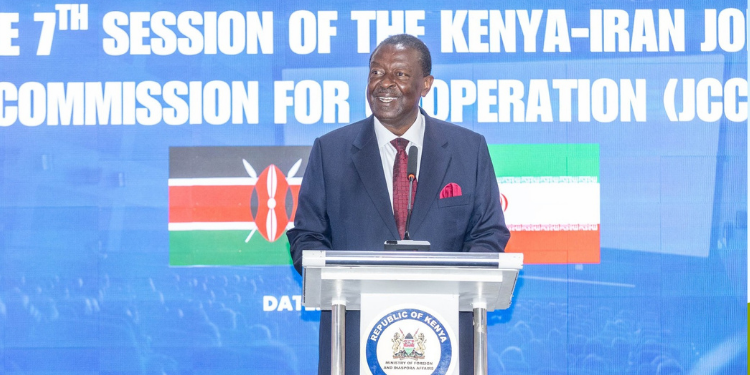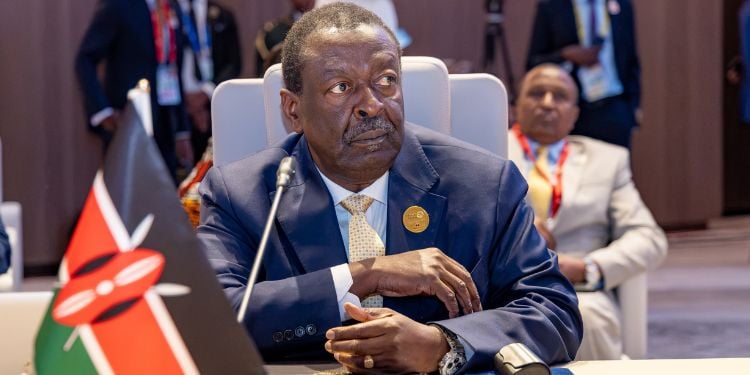
Prime Cabinet Secretary for Foreign and Diaspora Affairs of the Republic of Kenya, Musalia Mudavadi, has outlined a renewed government push to expand Kenya’s value-added exports as part of an economic shift.
Speaking at a diplomatic briefing in Nairobi on Thursday, September 10, 2026, Mudavadi emphasised that Kenya aims to become a manufacturing base and digital Launchpad.
According to Mudavadi, the strategy will increase the value of goods produced and sold in international markets as part of the country’s participation in regional and global markets.
“Like many countries across the continent, we are building on our growing partnerships to diversify and increase value-added exports, expand trade and investments, facilitate technology transfer, advance the digital economy and strengthen local manufacturing,” Musalia Mudavadi said.
Mudavadi also affirmed that Kenya would continue working with international partners to support technology transfer and investment in sectors.
Additionally, the PS reaffirmed that the country is open to trading with foreign nationals, with strict compliance with the law.
Foreign nationals interested in investing in the Kenyan trade will be required to prove their compliance with immigration, work-permit, registration, and licensing requirements.
In addition, the government has introduced initiatives, including the Kenya Development Corporation (KDC) and the National Infrastructure Fund (NIFC), to strengthen investments.
Also Read: Businesses in Kenya Where Foreigners Dominate
Kenya’s Economy
Kenya’s economy grew by 5.3 percent in the first quarter of 2026, as Kenya’s foreign exchange reserves stood at US$14.9 billion in August, equivalent to 6.2 months of import cover, according to the Prime Cabinet Secretary.
At the Nairobi Securities Exchange, market capitalization crossed the KSh4 trillion mark for the first time, another indicator Mudavadi cited while presenting Kenya’s economic outlook to diplomats.
He further pointed to the performance of the NSE in dollar-denominated returns and said the exchange had ranked among Africa’s top-performing markets.
“Kenya’s economy continues to demonstrate resilience. Real Gross Domestic Product grew by 5.3% in the first quarter of 2026, compared with 4.9% in the preceding year. The shilling has remained steady against the dollar over the past year, while foreign exchange reserves stood at USD 14.9 billion as at August, equivalent to 6.2 months of import cover,” Musalia explained.
A warning over food production accompanied the economic outlook presented by Mudavadi.
Kenya is currently experiencing below-average rainfall, and crop failure in cereal-producing regions could reduce food production by 30 to 40 percent this year.
In response to the possible food shortage, the government has also reduced the price of subsidized fertilizer to KSh2,000 for a 50-kilogram bag and is covering half the cost of certified maize seed.
However, the PS argued that the government could resort to maize imports if necessary to address a food deficit, maintain market availability, and prevent price distortions.
Also Read: KRA Tightens Rules on Imported Goods
Musalia Mudavadi on Kenya’s Diaspora Strategy
Beyond investment, Mudavadi said the government is pursuing measures to support diaspora investment, labor mobility, recognition of professional qualifications, and access to consular services.
Additionally, the country is strengthening engagement with its diaspora as part of efforts to expand investment and economic links with Kenyans living abroad.
In an effort to strengthen the ties, Mudavadi announced that Kenya would host the inaugural Global Trust Summit in Nairobi on October 22 to 23.
Kenya will also host an inaugural Diplomatic Conference on privileges and immunities at the Kenyatta International Convention Center from November 23 to 24, 2026.
Follow our WhatsApp Channel and X Account for real-time news updates.