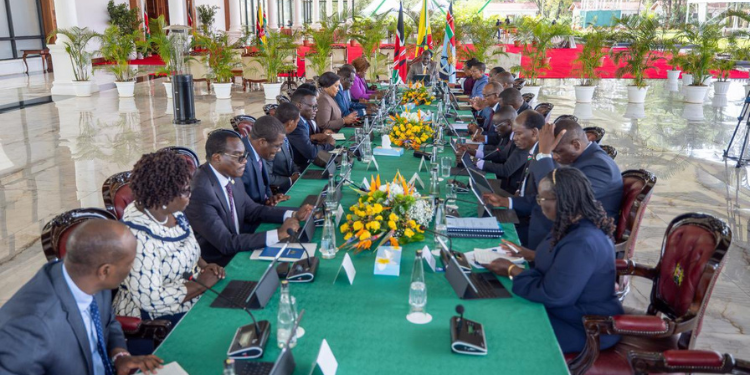
The Court of Appeal has declined to suspend a High Court ruling requiring President William Ruto to reconstitute his Cabinet to comply with Kenya’s constitutional gender rule.
Judges also directed Attorney General Dorcas Oduor to serve court papers in the case challenging the Cabinet’s composition and compliance with the constitutional two-thirds gender rule.
At the centre of the dispute is a June 30, 2026, High Court judgment that declared the Cabinet unconstitutional after finding that men occupied more than two-thirds of the positions. As a result, the Court gave President Ruto 120 days to make appointments that would bring the Cabinet into compliance with the Constitution.
The October 28 deadline has since expired, but the Court of Appeal’s refusal to suspend the ruling means the High Court order remains in force unless a subsequent court decision changes it.
Why the High Court Ordered Ruto to Meet the Two-Thirds Gender Rule
In the June 30 judgment, a three-judge bench comprising Justices Eric Ogola, Jairus Ngaah and Stephen Githinji found that the Cabinet did not meet the constitutional requirement that no more than two-thirds of members of an appointive body should be of the same gender.
Also Read: Court Delivers Landmark Ruling on Police Recruitment
The court found that, for purposes of the assessment, the Cabinet had 25 members, comprising 18 men and seven women. Women therefore accounted for approximately 28 per cent of its membership.
Article 27(8) of the Constitution requires the State to take legislative and other measures to ensure that no more than two-thirds of members of elective or appointive bodies are of the same gender.
In the ruling, Justice Ogola directed the President to make Cabinet appointments that comply with the provision within 120 days.
“The appointing authority, being the President, is hereby directed to make appointments for Cabinet Secretaries in conformity with Article 27(8) within 120 days from the date of this judgement,” the judge ruled on behalf of the bench.
High Court held that at least nine of the 25 Cabinet members needed to be women to meet the constitutional threshold.
The judges held that the Cabinet membership relevant to the constitutional assessment comprised the offices expressly recognised under Article 152(1) of the Constitution: the President, Deputy President, Attorney General and Cabinet Secretaries.
The judges also excluded the Secretary to the Cabinet from the calculation. The judges also assessed the Cabinet’s composition as it stood when they delivered the judgment, rather than when the petition was first filed.
The bench consequently declared that the Cabinet’s composition fell short of the requirements under Articles 27 and 10 of the Constitution.
Also Read: High Court Delivers Verdict on Sending Home CJ Koome and Entire Supreme Court
Why the Cabinet Reappointments Were Also Challenged
The case also examined President Ruto’s decision to return some former Cabinet Secretaries to office after dissolving his Cabinet in July 2024 following nationwide protests.
Petitioners argued that reappointing some of the same officials undermined the reasons given for the dissolution, including concerns about governance, accountability, integrity and public dissatisfaction.
However, the judges rejected arguments that the reappointments were automatically unconstitutional. They held that dismissal from the Cabinet did not, by itself, bar a person from being appointed again.
“The text does not prescribe that dismissal under that article creates a permanent or temporary disqualification from future appointments,” the judges held while interpreting Article 152.
The court distinguished a general Cabinet reorganisation from removal based on constitutional misconduct. It also rejected arguments that the President was constitutionally required to publish reasons for reappointing former Cabinet Secretaries.
The judges said reappointing former Cabinet Secretaries after the Cabinet was dissolved over governance concerns could raise questions, but it was not automatically unconstitutional.
Court’s Position on Opposition Figures in Cabinet
High Court also considered objections to including opposition-affiliated politicians in the Cabinet under the broad-based government arrangement.
The judges held that the Constitution does not prohibit the appointment of people affiliated with political parties outside the governing party, provided the required constitutional procedures are followed.
However, political inclusivity could not excuse non-compliance with constitutional requirements on gender representation and accountability.
Follow our WhatsApp Channel and X Account for real-time news updates and subscribe to our YouTube Channel for in-depth interviews.