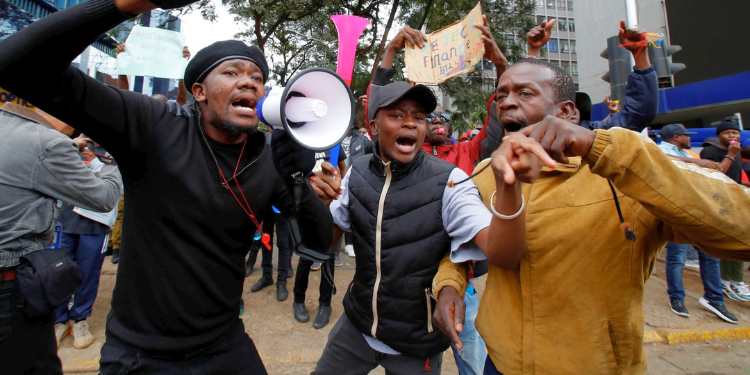
The government has launched a nationwide compensation program for victims of human rights violations linked to protests and demonstrations.
The initiative, backed by a KSh 2 billion parliamentary allocation, covers incidents recorded between 2013 and 2026 and is being implemented under a framework guided by the Kenya National Commission on Human Rights (KNCHR) Reparation Guidelines 2026 and presidential directives.
According to the Panel of Experts, the programme is intended to acknowledge suffering experienced by both civilians and security personnel during protest-related incidents, while also offering compensation for harm.
“The compensation programme is designed to acknowledge the trauma and losses experienced by individuals, including civilians and security personnel who suffered harm while exercising or protecting their constitutional rights. With a parliamentary appropriation of KES 2 billion, the Panel is committed to providing timely, fair, and transparent redress initially to those affected between 2013 and 2025,” read the statement.
Eligibility and Scope of the Programme
According to the panel, the programme covers direct victims, both civilians and security personnel who suffered physical, mental, emotional and economic harm during protests between 2013 and 2026.
Also Read: Full Breakdown of How Govt Will Share KSh 2 Billion Among Protest Victims
Victims from earlier periods may be considered in future phases of the reparations programme.
The framework prioritizes vulnerable groups such as children, persons with disabilities, the elderly, pregnant women, and individuals with life-threatening injuries.
Applications can be submitted by victims themselves or through representatives, including associations acting on behalf of affected members.
Evidence, Verification, and Claims Assessment
The compensation programme applies a “reasonable basis to believe” standard of proof, which is lower than the evidentiary threshold used in formal court proceedings.
Applicants are required to provide supporting information depending on the nature of their claim.
Information required includes the victim’s full name, contact information, and a description of the violation, including the date, time, and location, as well as the names of witnesses, if known.
| Category of Claim | Required Documents |
| Death | Post-mortem report, burial permit, and identification document of the deceased (or birth certificate for a minor |
| Injury | Medical reports, P3 form, hospital receipts, pharmacy receipts, and other related medical documentation |
| Sexual violence | P3 form, medical report, and Police OB number |
| Economic loss | Witness statements, police OB report, and other supporting documentary evidence |
Individuals who have lost required documents can still apply, where the Panel will conduct an independent verification.
The Panel will cross-check submitted claims with records held by relevant state agencies. It has also indicated that review mechanisms will be available for applicants who dispute decisions, particularly in cases involving new evidence, procedural unfairness, or alleged errors in assessment.
Compensation Structure and Implementation Process
The compensation framework is based on the severity of harm suffered.
| Category of Harm | Compensation Amount (KSh) |
| Fatalities | Minimum 3,000,000 |
| Severe injuries | Minimum 1,000,000 |
| Aggravated sexual violence | Minimum 1,000,000 |
| Moderate injuries | Minimum 500,000 |
| Minor injuries | Minimum 50,000 |
| Pending medical bills | Up to 100,000 – contribution |
| Economic loss | Up to 50,000 (depending on verification) |
Also Read: Ruto Reveals How Africa Will Drive Global Economic Growth
How to Apply and Submit the Compensation
Victims may apply in either oral or written form.
Applications is submitted to the Panel of Experts on Compensation of Victims of Human Rights Violations through the email [email protected]
Applicants may also lodge their claims through Kenya National Commission on Human Rights (KNCHR), the Independent Policing Oversight Authority (IPOA), and other state agencies.
Individuals who have already filed complaints or claims with KNCHR or IPOA are not required to submit a new application.
The panel has indicated that the physical application will open on Tuesday, 23rd June 2026.
Follow our WhatsApp Channel and X Account for real-time news updates.