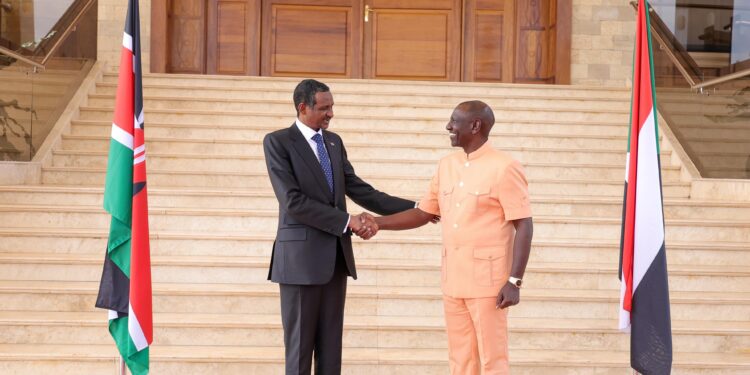

Kenya’s Principal Secretary in the State Department for Foreign Affairs, Korir Sing’oei, has explained the country’s decision to issue passports to Sudanese Generals.
Speaking during an interview on May 14, PS Sing’oei clarified reports on the issuance of Kenyan passports to Sudanese individuals, stating that any facilitation of travel documents is tied to its regional peace mediation role and humanitarian considerations arising from the ongoing Sudan conflict.
“Well, first, I don’t speak for the passport agency. But what I know is that, first, Kenya is committed to supporting peace mediation in Sudan. Sudan is an important country in our region,” PS Sing’oei said.
Sing’oei said Kenya remains committed to supporting peace efforts in Sudan under the Intergovernmental Authority on Development (IGAD) framework, following the outbreak of fighting between the Sudanese Armed Forces (SAF) and the Rapid Support Forces (RSF).
PS Sing’oei Defends Role in Sudan Peace Mediation and Passport Facilitation
The PS noted that the conflict has become prolonged and complex, prompting continued regional diplomatic engagement, led by President William Ruto, alongside other East African heads of state, in search of a political settlement.
Since the war began, he said, several political figures and civil society actors fled Sudan and sought refuge in various countries, including Kenya, where they have been hosted under established refugee support arrangements.
Also Read: PS Korir Sing’oei Apologizes After CNN Blunder
He emphasized that Kenya does not issue passports arbitrarily, rejecting suggestions that travel documents are distributed without due process or oversight by relevant authorities.
“I want to speak quite categorically. Passports are not dished willy-nilly. They are not dished like candy, as you said. That is completely untrue,” he said.
According to him, passport facilitation is considered only in exceptional cases, particularly when individuals in distress lack valid identification documents due to conflict-related displacement.
He explained that such situations are not unique to Kenya, noting that displaced persons in conflict zones often lose or leave behind essential documents, thereby necessitating formal travel arrangements for humanitarian or diplomatic purposes.
PS Sing’oei further stated that any travel facilitation linked to Kenya’s documentation system is strictly limited and intended only to facilitate movement for legitimate and regulated purposes in accordance with international norms.
He added that Kenya’s role in Sudan’s peace process has required engagement with multiple stakeholders, including individuals affected by the conflict who may require temporary assistance for travel or diplomatic coordination.
Also Read: Govt Moves to Rescue Kenyans Trapped in Tanzania
Kenya Defends Travel Documentation Practice
The Principal Secretary further argued that international precedents exist in which individuals in exile or in conflict situations have used alternative travel documentation issued by third countries to facilitate their movement.
He cited historical examples of political leaders who, during periods of exile, relied on foreign-issued documents to travel, noting that such arrangements have occurred in various global contexts under exceptional circumstances.
PS Sing’oei maintained that Kenya’s actions should be understood within the broader framework of conflict mediation and humanitarian responsibility, rather than as a routine issuance of passports.
He reiterated that any documentation support provided is not equivalent to standard passport issuance and is subject to strict conditions related to security, diplomacy, and humanitarian need.