
ESCP defines corporate governance as ‘’ the framework of rules, practices, and processes (and checks and balances) by which a company is directed and controlled’’. The quality of leadership by strong boards of directors and a strong bench of C-Suite executives in banks substantially contributes to the size and scale of the impact that commercial banks have on Kenya’s economy. Banks, like any other company, rise and fall on the quality of non-executive and executive directors.
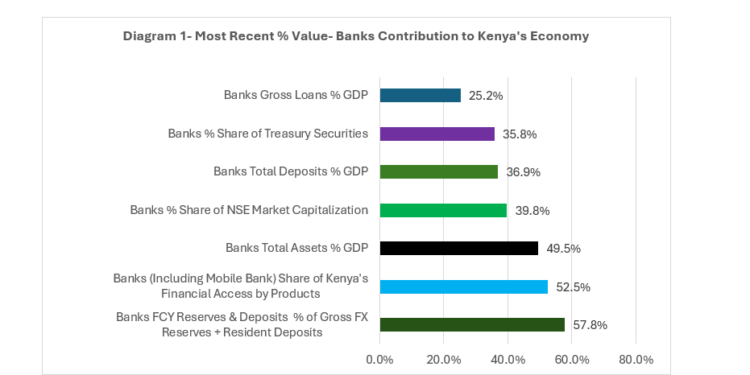
Diagram 1 below shows the impact of banks on Kenya’s economy. The balance sheet of banks (total assets) in March 2026 was 49.5% of Kenya’s GDP in 2025. They contribute 35.8% of treasury bills and bonds lending to the government. The market capitalization of listed banks (Absa, Coop, DTBK, Equity, HF, I&M, KCB, NCBA, Stanbic, Stanchart) accounts for 39.8% of the NSE market capitalization. Banks (including mobile banks) accounted for 52.5% of Kenya’s financial access by product in 2024. Banks’ foreign currency reserves and residents’ deposits comprised 57.8% of gross reserves plus residents’ deposits. The collapse of banks due to poor corporate governance caused or accelerated the 1929-1933 US Great Depression and the 2007-2010 US subprime mortgage Global Financial Crisis (GFC).
The Structure of a Strong Bank Board
The membership composition of a strong board of directors for a bank encompasses Diversity, equity, and Inclusion (DEI) across age by mixing older and younger members, gender with 50% representation of women, high academic qualifications, and professional experience. The diversity of opinions and robust discussions ensure all decisions protect your deposits and grow Kenya’s economy.
The Operations and Controls of a Strong Bank Board
The Code of Corporate Governance, Memorandum and Articles of Association, Code of Ethics and Conduct Policy, Conflict of Interest Policy, Insider Trading and Market Abuse Policy, Corporate Reporting and Accountability Policy specify the operations and controls of the board. They provide for appointment and induction of new board members after they pass CBK’s Fit and Proper Test, Continuous Professional Development (CPD), remuneration of directors, board charter, code of ethics, board meetings calendar, directors term limits, exit or removal.
A strong board sets the tone of the bank’s culture to prevent ‘’the fish from rotting from the head’’ by putting into place mechanisms which protect your savings and transform the economy.
Board Committees, Financial Allocations and Stewardship
The Code of Corporate Governance provides for charters of key board committees in banks. The two must-have Governance, Risk and Compliance (GRC) watchdog committees comprise the Audit Committee plus Enterprise Risk Management (ERM) and Asset and Liability Committee (ALCO). These committees deal with all issues of internal controls, the resolution of internal and external audit issues, and the setting of risk appetites and risk management frameworks. Credit risks (prudent allocation of savings to loans for MSMES or purchase of Treasury Bills and Bonds, non-performing loans, e.g., of not more than 5% of total loans, concentration via Single Obligor Limit- SOL of not more than 25% of core capital or economic sector).
Market risks (liquidity, forex e.g. FX Net Open Position- NOP of not more than 10% of core capital, interest rate risk, Mark to Market (MtM) losses on government bonds, high trade finance Off Balance Sheet (OBS) exposures), operational risks (cybersecurity, frauds, corruption, money laundering, politically connected lending, reputation, staff turnover, conduct, sovereign, strategy. Strong boards protect your savings and foster economic growth by ensuring the bank is well-capitalized to cover all risks, maintaining buffers of core capital and total capital relative to Total Risk Weighted Assets (TRWA) above the minimum regulatory requirements of 10.5% and 14.5%, respectively.
They aim to ensure their banks’ cost-to-income ratio (CIR) is below 40%, meaning only 40% or less of every shilling of earned revenue is spent on expenses.
Also Read: M-PESA or Bank Savings: Which is Actually Giving Better Interest Rates in Kenya Right Now?
They safeguard the bank by guaranteeing the Net Stable Funding Ratio (NSFR) and Liquidity Coverage Ratio (LCR), which require the bank to hold enough High-Quality Liquid Assets (HQLA) to survive a 30-day severe stress scenario, are both above 100% to prevent panic withdrawals and thus loss of your savings and jeopardy to the GDP growth.
The other strong bank board committees include the Governance, Nominations and Compensation; Credit; Tender and Procurement plus Strategy and Investment. All these committees ensure the bank’s culture and core values, preventing the loss of your savings and compromising GDP growth. They ensure the bank protects its Legal License to Operate (LLO) from CBK and other regulators and earns the Moral License to Operate (MLO) from stakeholders.
Board Evaluation, CEO Corporate Performance Management, Appointment and Succession Planning
Strong bank boards ensure that annual performance evaluations of the board chairperson, directors, committees, company secretary, and CEO are conducted by an independent consultant and shared with CBK.
Strong boards have independent-minded directors who are able to oversee a robust selection process for new CEOs and seamless CEO and board member succession planning.
A strong board keeps the CEO and his C-Suite executives on their toes to deliver high bank performance (assets, deposits and profits above 20%, ROA above 5%, ROE above 30% per annum) and thus protect your savings and contribute to economic growth.
Stakeholders Value Maximization
Strong bank boards maximize CEO and staff welfare (learning, insurance, safety, pension, staff loans, benevolent funds, Saccos) and remuneration (salary, bonuses, Employee Share Ownership Program-ESOP) as staff drives the all-important bank’s culture, customer experience and brand.
They maximize returns and the protection of your deposits, as well as shareholders’ value (dividends, retained earnings, and share price appreciation). They maximize government Corporate Income Tax (CIT), ethical procurement for their suppliers, as well as social and environmental impact investments to earn their Social License to Operate (SLO).
Corporate Strategic Planning and Execution
Strong boards provide robust oversight to strategic planning. They also ensure the fanatical execution of strategic plans to deliver transformational high-performance and impact objectives.
They ensure a sufficient balance between the internal environment (strengths and weaknesses of the bank) and the external environment (opportunities and threats – Political, Economic, Social, Technological, Environmental, Legal-Regulatory (PESTEL)).
Strong boards oversee growth in the home market of Kenya and cross-border subsidiaries in host countries by exporting Kenyan financial innovations. They form external board Technology and Innovation Advisory teams to maximize the opportunities and mute the threats from the 4th Industrial Revolution (4IR) and ESG trends. All these protect your savings and grow Kenya’s economy.
Tips to MSMEs and Wananchi
- Banks that outperform and lead their peers in the industry every year indicate they have very strong boards and strong executive management teams.
- Most of the banks that have collapsed with your savings are because of poor corporate governance oversight on audit queries, fraud, risk management, and noncompliance.
Frequently Asked Questions (FAQs)
- Which is the most existential risk that bank boards must manage? The loss of depositors’ trust in a bank, leading to panic withdrawals of savings, is the surest and quickest death of a bank.
- What more can banks do to provide credit for the private sector? They can help Kenya increase its domestic credit to the private sector from 31.8% of GDP to at least over 100%, or China’s 194.2%.
Follow our WhatsApp Channel and X Account for real-time news updates.