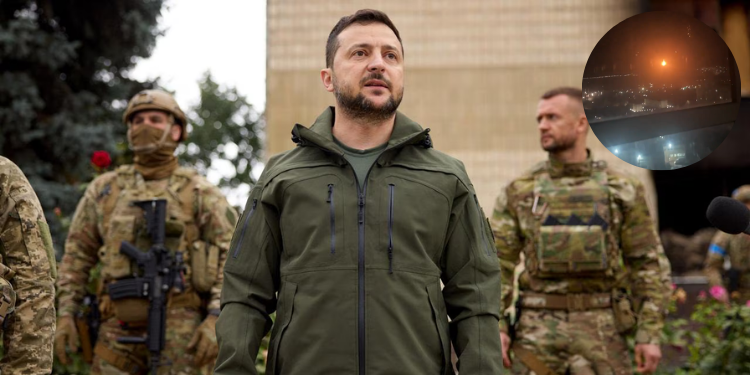
Ukraine launched overnight strikes on critical Russian energy infrastructure, hitting the Astrakhan Gas Processing Plant and igniting fires at sulfur storage and production facilities, according to battlefield reports and satellite data.
The attack targeted the Astrakhan Gas Processing Plant (Astrakhan GPP), the largest sulfur gas producer in Russia and a major natural gas processing hub in southern Russia.
NASA satellite imagery confirmed fires at the sulfur storage area and the “Enersal” granulated sulfur production unit.
The extent of damage remains unverified, but the strike represents another attack very deep into Russian territory in recent months by Ukraine.
Disruption at this facility could severely affect supply chains, though Russian authorities have not issued an official statement.
State media has remained silent on the incident as of Monday, December 15, in the afternoon.
No casualty figures have been reported, and there is no confirmation of whether the strike involved drones or long-range missiles.
Zelenskyy Still Trusted in Ukraine Despite Long War
A recent survey by Ukrainian media on December 5 found that public confidence in President Volodymyr Zelenskyy has fluctuated significantly since the start of Russia’s full-scale invasion. Still, overall trust remains higher than pre-war levels despite growing fatigue after nearly 4 years of conflict.
The data, tracking trust in Zelenskyy from early 2019 through December 2025, reveals three distinct phases:
1. Pre-Invasion Decline (2019–Feb 2022)
Before the beginning of the war, Zelenskyy’s approval eroded steadily.
In February 2019, 80% of respondents expressed trust in the president, while only 9% reported distrust.
By February 2022, on the eve of the invasion, trust had fallen sharply to 37%, and distrust surged to 52%.
2. Post-Invasion Surge (Mar 2022–2024)
The start of the war sparked a sharp surge in national unity and support for Zelenskyy.
In March 2022, trust soared to 77%, reversing the pre-war decline almost overnight.
Also Read: U.S Threatens South Sudan with Funding Cuts for Squandering Trump’s Billions
Throughout 2023 and early 2024, confidence remained strong, fluctuating between 59% and 67%, as Zelenskyy became the face of Ukraine’s resistance and international diplomacy.
3. Gradual Erosion Amid War Fatigue (2025)
According to the report, while trust peaked again at 74% in February 2025, the prolonged conflict and mounting economic strain have begun to erode support.
By December 2025, trust declined to 61%, and distrust climbed to 32%, signaling growing frustration but continued majority backing for Zelenskyy’s leadership.
The share of respondents answering “hard to say” remained low, averaging 7–11%, indicating that most Ukrainians hold explicit opinions on the president’s performance.
Despite the downward trend in late 2025, Zelenskyy’s approval remains significantly higher than pre-war levels.
Peace Talks Enter Critical Stage
Diplomatic efforts to end the nearly four-year war have reached their most advanced point since Russia’s invasion in February 2022.
Also Read: Trump Vows Revenge After Death of Two US Soldiers
Finnish President Alexander Stubb confirmed on December 15 that negotiations are closer to producing a peace agreement than at any time during the conflict.
The talks focus on three key documents:
- A 20-point peace plan outlining steps toward a ceasefire and territorial arrangements.
- Security guarantees for Ukraine, involving commitments from the United States and European partners to strengthen defense and deter future aggression.
- A post-war reconstruction framework aimed at rebuilding infrastructure and stabilizing Ukraine’s economy.
The proposed plan includes demilitarization zones and international monitoring mechanisms.
The U.S. and Belgium have led the way, reiterating support for Ukraine’s sovereignty and welcoming progress toward a diplomatic solution.
Follow our WhatsApp Channel and X Account for real-time news updates.