
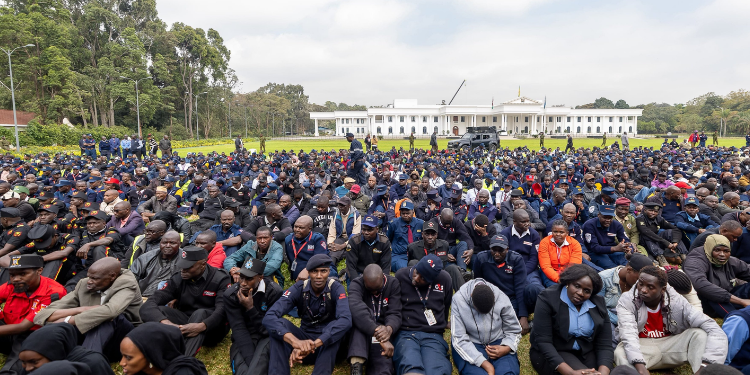
Private security guards in Kenya could face stricter training, vetting and employment requirements under new regulations published for public participation by the Private Security Regulatory Authority (PSRA).
The proposed Private Security (General) Regulations, 2025, set out requirements for the recruitment and training of private security personnel, the uniforms and equipment they use, cooperation with national security agencies and the conduct of security operations.
The regulations are part of a wider set of proposed statutory instruments intended to give effect to the Private Security Regulation Act, Cap. 207.
The PSRA has also invited members of the public, private security providers, communities, users and prospective users of private security services to submit their views on the proposals.
Comments must be submitted within 14 days from the date of publication of the public notice.
Views can be sent by email to [email protected] or delivered by hand to the PSRA offices at Lonrho House, 10th Floor, Standard Street, Nairobi, during official working hours of 8:00 a.m. to 5:00 p.m.
Private Security Guards to Undergo Annual Training
Under the proposed regulations, every private security firm would be required to ensure that its security officers have valid training certificates issued by private security training institutions accredited by the Authority.
Private security guards would also be required to undergo mandatory security training and assessment every year at an institution accredited by the Authority.
Directors and people performing executive or management functions in private security businesses would also be required to undergo training relevant to their areas of operation.
They would have to provide evidence of completing continuous professional development courses annually.
The Authority would have supervisory powers over security training and assessment in the private security industry.
New vetting Requirements for Security Guards
Private security firms would be required to vet prospective employees before hiring them.
The vetting would cover a person’s security training, employment history, character, residence and other relevant information.
Anyone applying for employment as a private security officer would have to provide security training certification and an accurate employment history.
Applicants would also be required to provide the names and contacts of three referees who are not related to them.
One of the referees would have to be a person engaged in security work or a security trainer.
Applicants would further be required to provide their residential physical address, including the street name, estate and house number.
The address would have to be supported by evidence such as a utility bill, rent payment receipt or lease agreement.
Security firms would be required to keep records of information provided by job applicants and could verify the details at any time.
The information would also have to be submitted to the Authority when demanded.
Employers to Check Registration of Security Providers
The proposed regulations would also place an obligation on people and organisations using private security services.
Every user, prospective user or representative of a user would have to ensure that the private security service provider working for them is registered with the Authority.
This would affect businesses, institutions, residential developments and other organisations that hire private security companies.
Also Read: Ruto Directs All Security Companies to Comply With Minimum Wage for Guards
Guards to Wear Registration Numbers
Private security officers would be required to wear a clearly written name plate showing their name and registration number issued by the Authority while on duty.
The proposed rules also set out requirements for private security uniforms.
A security provider would have to use a distinct uniform suitable for the type of service being offered.
The regulations would prohibit private security providers from using camouflage uniforms.
The front of the uniform would have to carry a badge with the words “PRIVATE SECURITY” and the company’s name.
The back would have to display the word “SECURITY” in clearly visible characters.
Security providers would have 12 months from the date the regulations come into force to replace uniforms that do not meet the requirements.
Security Firms to Provide Employment and Salary Details
Companies applying for registration would have to submit their human resource policies, including details of employees’ duties and salary structures.
Corporate applicants would also be required to provide information on directors, members, partners, trustees, administrators and senior management officials.
The application would include details of their experience and security training certificates.
Firms would also have to provide their employee training plans and information on employee certification and accreditation.
Also Read: Ruto Announces New Framework for 1.3 Million Private Security Officers
New Requirements for Security Equipment
The proposed regulations set out equipment that private security companies would be allowed to use, including security alarm systems, satellite tracking devices, CCTV and other surveillance equipment.
Other equipment listed includes intrusion detection systems, access control equipment, bomb and fire detection devices, metal detectors, X-ray inspection equipment, patrol cars and armoured cash and valuables-transit vehicles.
Security firms would have to provide the Authority with a list of equipment in their possession when registering and whenever new equipment is acquired.
Equipment requiring calibration would have to have a valid calibration certificate.
Security officers on duty would also be provided with equipment such as flashlights for night duty, batons, notepads and pens where necessary, mobile phones where appropriate, recording equipment and two-way radios.
Private Security Firms to Work with Police
The proposed regulations would allow the Inspector-General of the National Police Service or the Cabinet Secretary responsible for internal security to require private security providers to cooperate in certain operations.
Such cooperation could involve maintaining law and order, responding to national disasters, sharing security information, incident planning, training and sharing expertise.
A private security officer working under the command of a National Police Service officer would, subject to the limits of the assignment, exercise the powers of a police officer and be subject to the applicable disciplinary measures.
Private security providers would also be required to share with the National Police Service information obtained during their work that could help prevent crime, apprehend suspects or address security threats.
The PSRA said the regulations will provide a framework for licensing private security service providers, set standards for security equipment and improve governance and accountability in the sector.
Follow our WhatsApp Channel and X Account for real-time news updates.