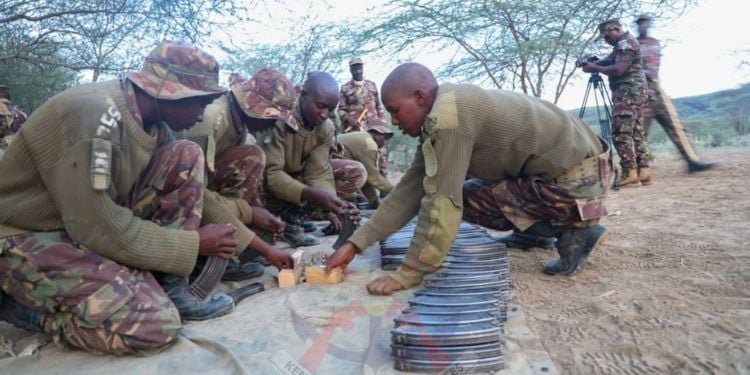
Kenya has sent a team of military specialists to South Africa for specialised training and knowledge exchange on how to respond to chemical, biological, nuclear and explosive threats.
The visit brought together experts from the Kenya Defence Forces (KDF) and South Africa’s 7 Medical Battalion Group, which operates under the South African Military Health Service (SAMHS).
The two teams met at the battalion’s headquarters in Lyttelton, Centurion, where South African military health specialists shared their experience in handling hazardous materials and responding to emergencies involving dangerous substances.
The Kenyan delegation included members of the country’s Chemical, Biological, Nuclear and Explosive Doctrine Development Committee, which develops military procedures for responding to such threats.
Air Force Brigadier Benedetta Margaret Kikechi, who heads research and development at Defence National Security Industries, led the Kenyan team.
South African Military Health Service Deputy Chief Major General Mcebisi Mdutywa received the delegation at the battalion’s headquarters.
Why Kenya Sent KDF Specialists to South Africa
The visit focused on strengthening the ability of both countries to respond to incidents involving chemical, biological, nuclear and explosive hazards.
For Kenya, the engagement provided an opportunity to learn from South Africa’s military health specialists, particularly in identifying dangerous substances, assessing threats and managing areas exposed to hazardous materials.
The cooperation also covers military healthcare and emergency response, areas that require specialised knowledge and equipment for high-risk incidents.
The Kenyan team included specialists involved in developing military doctrine.
Inside South Africa’s Specialised Military Unit
South Africa’s 7 Medical Battalion Group handles some of the military’s specialised medical and emergency response operations.
According to DefenseWeb, its personnel are trained to identify hazardous substances, establish the nature of threats and decontaminate areas exposed to dangerous materials.
The unit also provides medical support during special operations and responds to emergencies involving military personnel in high-risk environments.
These include aviation, diving and combat operations.
Also Read: Who Is David Ketter? Family, Education and Military Career of Kenya Army Commander
Kenya-South Africa Military Cooperation
The latest engagement follows a training exercise held in September at the Ditholo training area, north of Pretoria.
The exercise brought together military representatives from other African countries to learn how to respond to dangerous chemical incidents.
South Africa’s military health service shared its expertise through a capacity-building programme linked to the Organisation for the Prohibition of Chemical Weapons (OPCW).
It also comes as governments step up efforts to prepare for chemical, biological, radiological and nuclear (CBRN) threats, which may result from industrial accidents, deliberate attacks, hazardous material leaks or the use of weapons of mass destruction.
Kenya launched its first unified National Action Plan on CBRN security on November 27, 2025, at the Kenya Police Hazardous Materials (HazMat) Training School in Embakasi.
During the launch, security and policing teams conducted a simulated chlorine gas leak exercise involving three casualties. The drill demonstrated how emergency teams would respond to a chemical release and manage those affected.
Also Read: India Offers to Supply KDF New Armoured Military Vehicles
Eight Killed in Suspected al-Shabaab Attack in Mandera
The focus on preparedness comes amid other security challenges, including attacks targeting security personnel and civilians.
In a separate incident in Mandera County, eight people, including two Kenya Police Reservists (KPRs), were killed after suspected al-Shabaab militants ambushed a vehicle carrying road construction workers along the Mandera-Arabia-Lafey Road.
The attack occurred at Mlima Hagarso, where the victims were travelling in a Toyota double-cabin pickup belonging to a Nairobi-based construction company.
Police said the attackers escaped with the firearms belonging to the two reservists, prompting security agencies to launch an operation to recover the weapons and ammunition.
According to police, all eight occupants of the vehicle died in the ambush, which was carried out by an unknown number of suspected al-Shabaab militants.
A multi-agency security team comprising officers from the Kenya Police Service (KPS), Administration Police Service (APS), Directorate of Criminal Investigations (DCI), General Service Unit (GSU), Rapid Deployment Unit (RDU) and Kenya Defence Forces (KDF) visited the scene after the attack.
Police reported that the two stolen AK-47 rifles had 60 and 90 rounds of ammunition, respectively. Security agencies launched efforts to recover the firearms and ammunition, while investigations into the attack continued.
Follow our WhatsApp Channel and X Account for real-time news updates, and subscribe to our YouTube Channel for in-depth interviews