
Tuesday, June 2, 2026
  • News
    • Latest News
    • Breaking News
    • Fact Check
    • Investigations
    • Explainers
  • Politics
    • Global Politics
    • Elections
    • Government & Policy
    • Diplomacy
    • Conflicts & Security
    • Political Analysis
  • Business
    • Global Economy
    • Markets
    • Technology
    • Startups
    • Energy
    • Finance
  • World News
    • Americas
    • Asia
    • Asia Pacific
    • Africa
    • Europe
    • Middle East
  • Africa
    • Central Africa
    • East Africa
    • West Africa
    • Southern Africa
  • Health
    • Global Health
    • Public Health
    • Health Policy
    • Medical Research
    • Diseases & Conditions
    • Mental Health
    • Nutrition
    • Climate & Health
    • Health Explainers
  • Sports
    • Athletics
    • Basketball
    • Boxing
    • Cricket
    • Football
    • Formula 1
    • Golf
    • Rugby
  • Weather
    • Climate Business
    • Climate Change
    • Climate Solutions
    • Living Green
  • Culture
    • Arts
    • Film & TV
    • Food
    • Music
    • Lifestyle
    • Travel
  • Opinion
    • Editorials
    • Letters
  • Behind The Brand
REGISTER
LOGIN
No Result
View All Result
The Kenya Times
  • News
    • Latest News
    • Breaking News
    • Fact Check
    • Investigations
    • Explainers
  • Politics
    • Global Politics
    • Elections
    • Government & Policy
    • Diplomacy
    • Conflicts & Security
    • Political Analysis
  • Business
    • Global Economy
    • Markets
    • Technology
    • Startups
    • Energy
    • Finance
  • World News
    • Americas
    • Asia
    • Asia Pacific
    • Africa
    • Europe
    • Middle East
  • Africa
    • Central Africa
    • East Africa
    • West Africa
    • Southern Africa
  • Health
    • Global Health
    • Public Health
    • Health Policy
    • Medical Research
    • Diseases & Conditions
    • Mental Health
    • Nutrition
    • Climate & Health
    • Health Explainers
  • Sports
    • Athletics
    • Basketball
    • Boxing
    • Cricket
    • Football
    • Formula 1
    • Golf
    • Rugby
  • Weather
    • Climate Business
    • Climate Change
    • Climate Solutions
    • Living Green
  • Culture
    • Arts
    • Film & TV
    • Food
    • Music
    • Lifestyle
    • Travel
  • Opinion
    • Editorials
    • Letters
  • Behind The Brand
  • News
    • Latest News
    • Breaking News
    • Fact Check
    • Investigations
    • Explainers
  • Politics
    • Global Politics
    • Elections
    • Government & Policy
    • Diplomacy
    • Conflicts & Security
    • Political Analysis
  • Business
    • Global Economy
    • Markets
    • Technology
    • Startups
    • Energy
    • Finance
  • World News
    • Americas
    • Asia
    • Asia Pacific
    • Africa
    • Europe
    • Middle East
  • Africa
    • Central Africa
    • East Africa
    • West Africa
    • Southern Africa
  • Health
    • Global Health
    • Public Health
    • Health Policy
    • Medical Research
    • Diseases & Conditions
    • Mental Health
    • Nutrition
    • Climate & Health
    • Health Explainers
  • Sports
    • Athletics
    • Basketball
    • Boxing
    • Cricket
    • Football
    • Formula 1
    • Golf
    • Rugby
  • Weather
    • Climate Business
    • Climate Change
    • Climate Solutions
    • Living Green
  • Culture
    • Arts
    • Film & TV
    • Food
    • Music
    • Lifestyle
    • Travel
  • Opinion
    • Editorials
    • Letters
  • Behind The Brand
No Result
View All Result
The Kenya Times ~ Trending, Breaking News and Videos
No Result
View All Result
ADVERTISEMENT

Kenyan Police Use Excessive Force Because They’re Serving Political Elites, Not the Public

Kamau WairuribyKamau Wairuri
July 23, 2024
Reading Time: 7 mins read
Kenyan Police

Police officers lobbing teargas to disperse protesters. Photo/Courtesy

FacebookTwitterLinkedInRedditWhatsApp
Advertisement

Public protests in Kenya have often been criminalized, leading to brutal police crackdowns. This played out in recent protests against the cost of living in Kenya, and amid an attempt by the government to introduce new taxes.

The police responded with force, using live bullets and lobbing teargas at protesters. More than a dozen people were reported killed and hundreds injured.

Kamau Wairuri, who has studied the policing of protests in Kenya, explains what contributes to the violence often witnessed during public demonstrations.

What contributes to Kenyan police violence during protests in Kenya?

The use of excessive force is ingrained in the culture of the Kenyan state police. The police treat citizens with suspicion. Everyone, especially the poor and marginalized, is seen as a potential criminal.

Many Kenyans have been killed or maimed by police officers in efforts to disperse public assemblies since colonial times and in the course of the country’s political history. In 1922, for instance, the police killed more than 100 people who were protesting the arrest of African nationalist Harry Thuku in Nairobi. Recent examples abound.

The most crucial factor that explains this persistent use of force in the dispersal of public assemblies in Kenya is that the police have historically served political regimes rather than the citizens. I have explored this in my research, which analyzed the policing of protests in Kenya from 1990 to 2010.
Kenyan Police
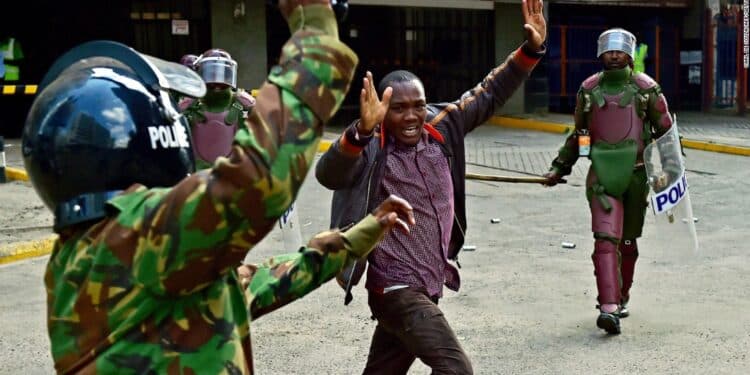
Kenyan police confronting a civilian. Photo/Courtesy

My study showed how regimes have used the police to repress opposition and sustain themselves in power. Order, which the police are charged with maintaining, is whatever the regime of the day defines it to be. Hence, as I argue, the actions and words of political leaders are taken as a signal of the kind of police actions that are expected and may be rewarded by an executive arm of the government that wields immense power.

The policing of protests is often anchored in the profiling of protesters, both by the police and by politicians. Protesters are often termed “looters”, “thugs” and “goons”, thus labelled as criminals who deserve to be dealt with ruthlessly. The issue of profiling was flagged by the Independent Policing Oversight Authority in a report following 2016 protests seeking to disband the country’s electoral commission.

The police often act with impunity because they are protected by the ruling elite. Not only are officers rarely held to account for the use of force in the dispersal of protesters, they are often congratulated for doing so. In his first statements in response to the current anti-tax protests, President William Ruto thanked police officers “for applying themselves to the best of their abilities in the defence of Kenya and its people”. He did not mention the brutal killing of some of the protesters, which was broadcast live on national television.

These failures to hold officers to account build citizen distrust in the police.

What laws regulate the use of force by the authorities?

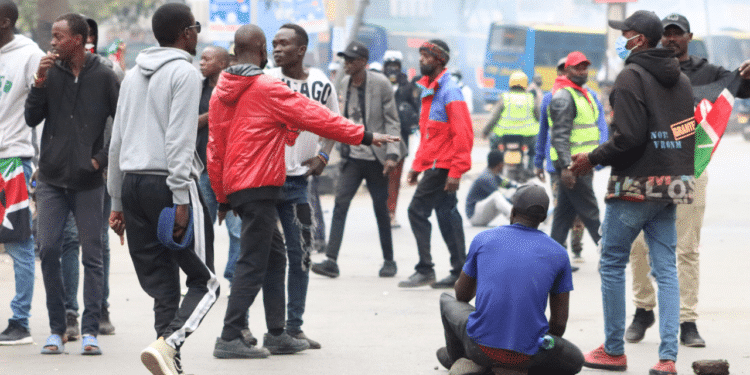
Kenya’s constitution guarantees the right to protest. Since this right is not unlimited, Kenyan laws empower the police to ensure that protests are carried out in a lawful and peaceful manner. The law requires protest organizers to inform the police of their planned demonstrations.

In turn, police actions are guided by various legal instruments. The National Police Service Act of 2011 provides overall guidance on the use of force by police officers. The Public Order Act of 2012 empowers officers to disperse a public assembly where there is a clear or imminent danger of a breach of peace. The Service Standing Orders provide for the lawful use of force to suppress or disperse a riotous mob.

The country’s legal framework seeks to restrict the use of force during protests to exceptional circumstances.
Kenyan Police
Kenyan youths on the streets of Nairobi protesting. Photo/The Kenya Times

What reforms have been proposed or made to mitigate police violence?

The Independent Policing Oversight Authority made important recommendations on improving the policing of public assemblies in line with the constitution.

The authority noted the absence of a policy with guidelines on public order management. This would guide police conduct during protests. This policy would address matters like the training of police officers on public order management.

The policy would also guide intelligence gathering on protests. Infiltration of demonstrations by hired disruptors or criminal elements has been alleged in the current anti-tax protests.

The policy would require police officers to wear uniforms and badges so that they are identifiable, provide medical support for the injured, and operate within the law as they work.

Such a policy has yet to be adopted. As a result, the policing of protests continues to be marked by poor planning and coordination, with officers who are not properly trained, equipped or briefed before entering tense situations.

This not only makes police officers themselves unsafe, but means violence is the only strategy they can use. It’s little wonder that the policing of protests in Kenya continues to be marked by human rights abuses.

Kenya can also draw on international approaches. The most progressive one is the negotiated management model. It emphasizes people’s right to protest and seeks constructive relationships between the police and protesters. It has been used in developed countries, such as the US and the UK.

An evaluation of an attempt to use this approach in Kenya found that it failed because police weren’t willing to engage protesters in constructive ways.The Conversation

Kamau Wairuri, Lecturer in criminology, Edinburgh Napier University

This article is republished from The Conversation under a Creative Commons license. Read the original article.


Kenyan Police
Acting Inspector General (IG) of police Douglas Kanja. PHOTO/Courtesy.
Tags: 2010 Kenya constitutionFinance Bill 2024Gen ZHuman RightsKenyaKenya ProtestsPolice BrutalityWilliam Ruto
Kamau Wairuri

Kamau Wairuri

Dr Kamau Wairuri is a researcher, educator and policy consultant with expertise in the politics of policing, violence and criminal justice in Africa. Presently, he is a lecturer in criminology at Edinburgh Napier University (Edinburgh, United Kingdom) and a Research Fellow at the Institute of Public Policy and Governance at the Strathmore University Business School (Nairobi, Kenya). His research is focussed on three major themes: (1) the discourses and practices of policing, especially relating to the police abuse, police reform and police accountability, (2) the policing of people belonging to marginalised groups — especially poor, young men, sex workers, queer people and people who use drugs — who are over-policed and under-protected by the police, and (3) violence, relating to both violent crime and political violence, including terrorism and riots. He has published some of his work in respected peer-reviewed academic journals, such as African Affairs, and in books. Kamau is an experienced educator in the Higher Education sector having delivered lectures and classroom teaching at Edinburgh Napier University, the University of Edinburgh and Strathmore University. He is an Associate Fellow of the Higher Education Academy (UK). Kamau has extensive experience advising leaders and organisations in the public, private and development sector on matters relating to politics, public policy and governance. Some of the organisations he has worked with include donor agencies such as DANIDA, local NGOs like the Economic and Social Rights Centre (Hakijamii) and government agencies like the Independent Electoral and Boundaries Commission (IEBC), the National Gender and Equality Commission (NGEC), and the Youth Enterprise Development Fund (YEDF). Previously, he worked as a consultant at McKinsey & Co, where he advised senior government leaders in Africa on various areas of development. Kamau has also written for popular audiences in Kenyan newspapers (Daily Nation, The Standard and The East African) and respected blogs such as African Arguments. He is the host of The Kenyanist, a podcast that explores the social and political issues that Kenyans face. Kamau holds a PhD in African Studies from the University of Edinburgh, an MSc in African Studies from the University of Oxford and a Bachelor of Arts degree (Political Science and Sociology) from the University of Nairobi.

Related Posts

Moe Has Vowed To Take Action Against Utumishi Girls School Principal Over School Fire That Killed 16 Learners.

Opinion | How Kenya Failed the Girls of Utumishi Academy

June 2, 2026
Is Kenya Losing Its Morals? Rising Deviant Behavior And Rampant Crime

Opinion | The Mother Who Hates Her Own Children: Kenya’s Moral Collapse

June 2, 2026
Treasury Invites Applications For Board Recruitment Across 39 State-Owned Enterprises

Opinion | How New Taxes on Bank Card Transactions Charges Will Raise the Costs for Ordinary Kenyans if Adopted by Parliament

June 1, 2026
The Kenya National Examinations Council (Knec) Has Announced The Dates For The 2026/2027 Business And Technical Examination.

Opinion | AI Mistakes That Could Destroy Kenya’s Future — Global Lessons Every Leader, Business and Citizen Must See Now

May 31, 2026
ADVERTISEMENT

The Kenya Times Facebook

LATEST ARTICLES

  • How to Send Money Internationally: Cheapest Methods in 2026
  • Where CCTV Cameras Should Not Be Installed Under Kenyan Law
  • Profile of Henry Wooster, Trump’s Nominee for U.S. Ambassador to Kenya
  • Mudavadi Asks Africa to Stop Depending on Aid
  • KeNHA Advances Plans for Mau Summit-Eldoret Road Upgrade After Securing Funding
  • Sasini PLC Appoints New Company Secretary
  • Pressure on Ruto to Allow Atheism in All Schools Countrywide
  • Here Are The 6 Things That Make Certain Sports a Lot More Popular
  • Emotional Utumishi Girls Survivor Recounts Horrific Night That Killed Classmates, Calls for Justice
  • Ruto Recalls How Leaders Warned Him Against Appointing Francis Ogolla
  • Trump Nominates Diplomat Henry Wooster as US Ambassador to Kenya
  • High Court Orders Govt to Disclose All Agreements and Approvals on Ebola Facility
  • Opinion | How Kenya Failed the Girls of Utumishi Academy
  • Lenana School Suspends Learning After Student Unrest
  • Maurice Ogeta Finally Reveals Raila’s Last Moments and How He Died 
ADVERTISEMENT

Company

About Us

Our Authors

Our Experts

Social Media

Policies

Privacy Policy

House Rules

Standards and Policies

Terms and Conditions

Subscription

My Account

Contact Us

Contact Us

Join Our Team

Advertise With Us

© Copyright 2026 | The Kenya Times | All Rights Reserved

Welcome Back!

Sign In with Facebook
Sign In with Google
Sign In with Linked In
OR

Login to your account below

Forgotten Password? Sign Up

Create New Account!

Sign Up with Facebook
Sign Up with Google
Sign Up with Linked In
OR

Fill the forms below to register

All fields are required. Log In

Retrieve your password

Please enter your username or email address to reset your password.

Log In
Your Privacy and Cookies
We use cookies on our website to give you the most relevant experience by remembering your preferences and repeat visits. By clicking “Accept”, you consent to the use of ALL the cookies.
Do not sell my personal information.
Cookie settingsACCEPT
Privacy & Cookies Policy

Privacy Overview

This website uses cookies to improve your experience while you navigate through the website. Out of these cookies, the cookies that are categorized as necessary are stored on your browser as they are essential for the working of basic functionalities of the website. We also use third-party cookies that help us analyze and understand how you use this website. These cookies will be stored in your browser only with your consent. You also have the option to opt-out of these cookies. But opting out of some of these cookies may have an effect on your browsing experience.
Necessary
Always Enabled
Necessary cookies are absolutely essential for the website to function properly. This category only includes cookies that ensures basic functionalities and security features of the website. These cookies do not store any personal information.
Functional
Functional cookies help to perform certain functionalities like sharing the content of the website on social media platforms, collect feedbacks, and other third-party features.
Performance
Performance cookies are used to understand and analyze the key performance indexes of the website which helps in delivering a better user experience for the visitors.
Analytics
Analytical cookies are used to understand how visitors interact with the website. These cookies help provide information on metrics the number of visitors, bounce rate, traffic source, etc.
Advertisement
Advertisement cookies are used to provide visitors with relevant ads and marketing campaigns. These cookies track visitors across websites and collect information to provide customized ads.
Others
Other uncategorized cookies are those that are being analyzed and have not been classified into a category as yet.
SAVE & ACCEPT
LOGIN | REGISTER
  • Login
  • Sign Up
  • Cart
No Result
View All Result
  • News
    • Latest News
    • Breaking News
    • Investigations
    • Explainers
    • Fact Check
  • Politics
    • Global Politics
    • Conflicts & Security
    • Elections
    • Diplomacy
    • Government & Policy
    • Political Analysis
  • Business
    • Global Economy
    • Markets
    • Technology
    • Startups
    • Energy
    • Finance
  • World News
    • Americas
    • Asia
    • Asia Pacific
    • Africa
    • Europe
    • Middle East
  • Africa
    • East Africa
    • West Africa
    • Southern Africa
    • Central Africa
  • Health
    • Global Health
    • Public Health
    • Health Policy
    • Medical Research
    • Diseases & Conditions
    • Mental Health
    • Nutrition
    • Climate & Health
    • Health Explainers
  • Sports
    • Athletics
    • Basketball
    • Boxing
    • Cricket
    • Football
    • Formula 1
    • Golf
    • Rugby
  • Weather
    • Climate Business
    • Climate Change
    • Climate Solutions
    • Living Green
  • Culture
    • Arts
    • Film & TV
    • Food
    • Lifestyle
    • Music
    • Travel
  • Opinion
    • Editorials
    • Letters
  • Behind The Brand
  • Contact Us

Not enough quota to unlock this post
Unlock left : 0
Are you sure want to cancel subscription?