For ten months, the question has been asked in Mogadishu, in the capitals of the region and now in newsrooms around the world: what exactly has the United Arab Emirates built on Somali soil, and on whose authority? This week the Federal Government gave its answer, in stages and on the record. Abu Dhabi has yet to give one.
The facts the government has set out are not vague. On Tuesday night, President Hassan Sheikh Mohamud told the nation that the UAE had signed agreements over the ports of Berbera, Bosaso and Kismayo with regional administrations and without the Federal Government. He said it had established military bases and armed forces outside Somalia’s national command, while the Somali National Army is fighting Al-Shabaab. He said it had funded and politically backed regional administrations in their disputes with Mogadishu, and that Somali territory at Berbera was used in January 2026 to move a militia leader fleeing Yemen, without Somalia’s consent.
On Friday, National Security Advisor Awes Haji Yusuf went further. He said the backing of some Federal Member States against the Federal Government amounts to a proxy war against lawful authority. He said the illegal export of Somali national resources, particularly minerals and gold, together with the use of Berbera, shows that Somali territory has been turned into an unauthorised transit route for resources and smuggling. Somalia, he said, will not allow its land, ports or airspace to be used to project conflict into Yemen, Sudan or any other state.
On the ground in Berbera and Bosaso
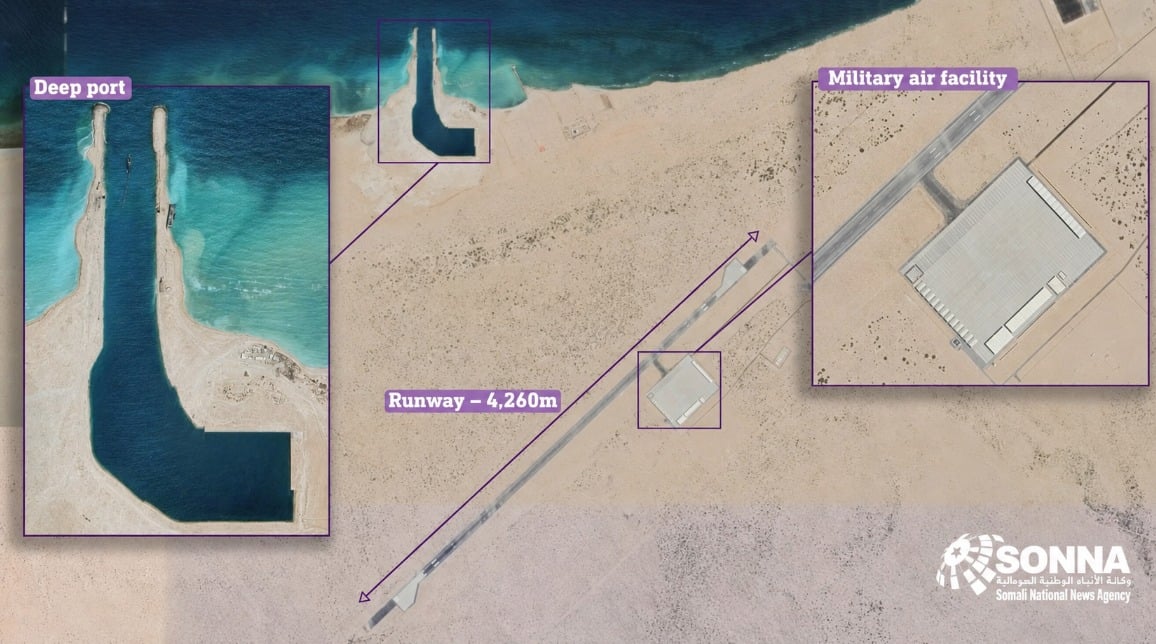
What sources on the ground describe is consistent with that warning. Local witnesses in Berbera describe military construction around the port and airfield, including the digging of trenches and the assembly of new structures. According to those accounts, the buildings could house anti-aircraft systems or store munitions. Whether they are in use yet, and what equipment they hold, remains unconfirmed.
Informants familiar with the arrangements say the UAE uses Berbera’s harbour, airfield, and the military zones around them to move equipment and personnel by air and sea, as part of a wider network that reaches beyond the port itself. In Bosaso, the same sources identify sites that were used by Colombian private military contractors who later joined the Rapid Support Forces in Sudan.
Informants also say the UAE has made agreements with local armed groups that operate outside the authority of the Federal Government, including after Somalia annulled every agreement with the UAE in January. The terms of those arrangements, and who commands the facilities, have not been disclosed. Nor has anyone explained who authorised foreign contractors to pass through Somali territory on their way to another country’s war.
What others have already documented
Nor are these accounts new to anyone who has followed the reporting of the past year. In October 2025, Middle East Eye published an investigation into Bosaso airport in Puntland. It reported frequent heavy cargo flights, including Ilyushin Il-76 aircraft, over about two years, and cited a commander of the Puntland Maritime Police Force who said cargo was moved quickly onto aircraft bound for the Rapid Support Forces in Sudan. The same investigation reported a camp north of the airport said to house Colombian fighters on their way to the RSF, and published satellite imagery of the expanding cargo area. A port manager told the outlet that the UAE had sent more than 500,000 containers marked as hazardous through Bosaso in two years, without describing their contents.
In May 2026, Human Rights Watch published a report, From Bogota to El Fasher, documenting the UAE’s role in the deployment of Colombian fighters to Sudan, where the RSF has been accused of atrocities in Darfur. The UAE has denied supporting the RSF, and neither Abu Dhabi nor the Puntland authorities answered Middle East Eye’s questions.
Read together, these accounts describe a network, not a set of isolated projects: harbours, airstrips and camps on Somali soil, operated under arrangements the Somali state never approved, and connected to a war in another African country. That is precisely the danger the National Security Advisor described.
The question Abu Dhabi will not answer
The UAE’s reply this week has been remarkable for what it leaves out. Its Foreign Ministry called Somalia’s decisions escalatory and hostile, and said the Somali government was dragging the UAE into its internal power disputes. An adviser to the UAE President described the President’s address as an attack. Neither said a word about the ports, the forces, the flights, the camps or the use of Berbera.
The Foreign Ministry did volunteer one fact. It said the UAE closed its embassy in Mogadishu and withdrew its diplomats in January 2026. It said nothing about Berbera or Bosaso. A country that closes its door in the federal capital while its aircraft keep landing in the regions is not stepping back from Somalia. It is choosing which Somalia to deal with. That choice, made again and again over years, is what the Federal Government means by fragmentation.
Also Read: Somalia Orders Immediate Surrender of Kenyan Passports Held by Ministers
Calling all of this an internal power struggle is a convenient way to avoid the substance. Who governs Somalia’s ports, airspace and armed forces is not a matter of domestic politics. It is the definition of sovereignty, and the Constitution settles it. No foreign government, however generous its past support, can decide which Somali authority it will recognise on any given day.
What Somalia is entitled to know
Somalis have a right to know who has used their land, and for what. The Federal Government has made its position clear. What remains is disclosure. The agreements signed for Berbera, Bosaso, and Kismayo should be made public so Somalis can see what was given away and by whom. The facilities built under them should be declared, along with the forces stationed there and the aircraft and cargo that have passed through. If the UAE believes its presence has served Somalia, it has every reason to open those records. Silence will be read for what it is.
Somalia’s international partners also have a part to play. The principle that agreements on strategic infrastructure and security must go through the Federal Government is not a Somali invention. It is how every sovereign state is treated. Partners that respect it in Nairobi, Addis Ababa or Cairo should respect it in Mogadishu.
Somalia is not the first African state to reach this point. Sudan cut relations with the UAE in May 2025, and Algeria severed ties on 10 September 2026. Each was told, as Somalia has been told, that the fault was its own.
The President has been clear that Somalia’s quarrel is with a policy, not with the Emirati people, among whom many thousands of Somalis live and work. He has also been clear about the terms on which the dispute can end. Somalia remains ready for a relationship with the UAE based on equality, respect and full recognition of its territorial unity. Until Abu Dhabi accepts those terms, Somalia will defend its sovereignty, as the President and the National Security Advisor have said, by every means its own laws and international law allow.
This article was written by Somalia’s National News Agency (SONNA).
Follow our WhatsApp Channel and X Account for real-time news updates, and subscribe to our YouTube Channel for in-depth interviews.