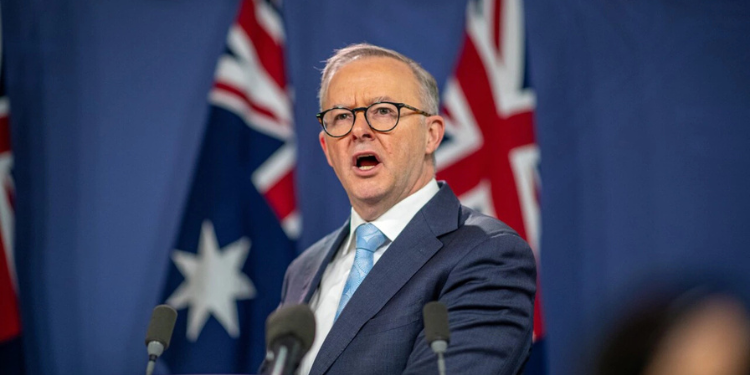
Australian Prime Minister Anthony Albanese announced on March 30 that the government will lower the excise on fuel and diesel.
Speaking to Sky News following a joint press conference in Canberra with Treasurer Jim Chalmers and Energy Minister Chris Bowen, Anthony stated that the government’s reduction in the tax will reduce the cost of fuel from 52.6 to 26.3.
Reports from the Australian Petroleum Institute on March 29 indicated that the average retail price of a liter of diesel rose to more than A$3 in Australia, and petrol to A$2.50.
Treasurer Jim Chalmers, speaking at the joint press conference, stated that the total cost to the government of implementing the tax reduction would be about A$2.55 billion, equivalent to $1.75 billion.
Albanese expressed his understanding that oil prices were affecting the people, as the war intensified, which affected the prices.
“We understand the cost pressures for people are very real as the impact of the war on the other side of the world plays out right here,” Albanese stated.
The Australian government also confirmed that it had adopted a national fuel security plan, with all state governments agreeing to work together to deliver fuel to regional areas where it is most needed.
According to Albanese, there were four levels of action, with the highest level being the maintenance of critical services, and Australia was at level two.
In addition, he noted that despite Australia’s fuel supply outlook remaining secure, prolonging the war will have a great impact on the Australians.
Currently, Australia, which has held the highest fuel stocks in 15 years, is below the International Energy Agency’s (IEA) 90-day recommendation.
The latest Australian government reports indicate that Australia has enough diesel for 30 days, jet fuel for 30 days, and petrol for 39 days.
Also Read: Australia Announces Fully Funded Scholarships For Kenyans: How to Apply
Anthony Albanese on the Government Plans
The prime minister confirmed that the state and territory leaders agreed to ensure their governments will not benefit from elevated prices resulting from the Goods and Services Tax (GST).
According to Albanese, the changes are expected to cost approximately $2.55 billion to the taxpayer over the three months.
He added that the national fuel security plan would become publicly available, allowing the states and territories to respond to changes in fuel security in unison.
Also Read:22-Year-Old Kenyan Arrested Over Alleged Murder of Fellow Kenyan in Australia
Australia Steps in to Maintain the Prices Amid Ongoing War
Energy Minister Chris Bowen, during the joint press conference in Canberra, stated that the new fuel security powers will put Australia in a strong position.
The government’s adoption of the Export Finance and Insurance Corporation Amendment will allow the government to underwrite the purchase of spot cargoes of fuel via the credit agency Export Finance Australia.
Furthermore, Bowen explained that through the amendment, spot cargoes were available but expensive, and smaller industry players were not able to take the risk.
“These new fuel security powers will put Australia in a strong position, securing fuel supply where it may be cost-prohibitive for private suppliers to source on commercial terms, without government support,” Bowen said.
The Australian government’s decision to lower the taxes followed a previous national cabinet meeting held by Anthony Albanese on March 19 in response to fuel supply concerns.
The meeting resulted in the establishment of a fuel supply task force coordinator.