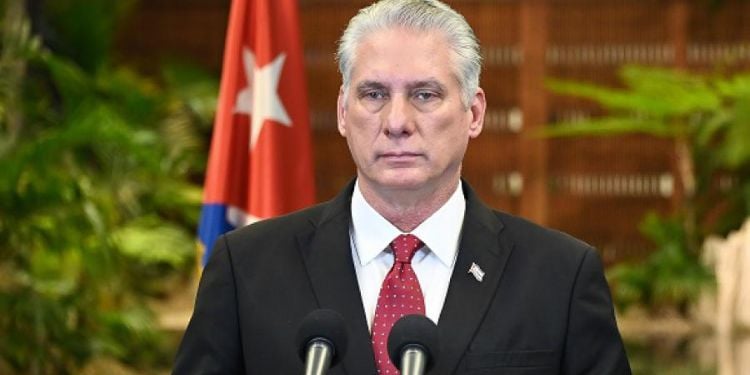
Cuban President Miguel Díaz‑Canel has dismissed pressure from U.S. President Donald Trump, saying his country has survived 67 years of sustained hostility.
Speaking in an interview on April 12, Díaz-Canel questioned the effectiveness of the U.S.’ long-standing policy toward his country, arguing that decades of sanctions, restrictions, and political pressure have failed to achieve their stated goals.
He has said the continued pressure only shows that Cuba has remained standing despite efforts to weaken it.
Díaz‑Canel on U.S Blockades
Díaz‑Canel pointed to the U.S. economic blockade, which has been in place for more than 60 years, saying it has intensified in recent years.
He said the blockade has expanded beyond trade and finance to include energy restrictions, worsening fuel shortages, and power cuts across the island.
The Cuban President asked which other country could withstand sustained pressure from the world’s most powerful nation for nearly seven decades and still remain an organized state.
He said Cuba has not collapsed and has maintained social order despite economic hardship.
Also Read: Putin Turns His Residence into Fortress With 27 Air Defense Systems
The Cuban leader also questioned why the U.S has continued to spend large sums of money on policies aimed at undermining his government.
He said that if Cuba were truly weak or incapable, such efforts would not be necessary.
Díaz‑Canel has challenged the U.S to lift the blockade and allow Cuba to operate without restrictions.
He said the country has achieved progress even while blocked and has asked what it could accomplish if those measures were removed.
He said Cuba has continued to offer international solidarity despite its own difficulties.
Over the years, Cuba has sent medical personnel abroad and supported other countries during crises, even while facing shortages at home.
Trump’s Renewed Interest in Cuba
The remarks come amid renewed hardline statements from President Trump, who has publicly described Cuba as weakened and has said he may take stronger action against the island.
His administration has tightened sanctions and targeted fuel shipments to Cuba, leading to power shortages and transportation disruptions.
Cuba has faced recurring blackouts due to limited fuel supplies, affecting households, hospitals, and industry.
The government has said these problems have been made worse by U.S. measures that restrict access to energy markets and financial systems.
Also Read: Russia Claims Peace is Possible “Today” if Zelensky Takes Required Steps
Díaz‑Canel said such pressure has not broken the country’s political system or institutions.
He described the past 67 years as a period of resistance shaped by constant external hostility.
He also rejected claims that internal collapse is inevitable, saying Cuban society has adapted to difficult conditions over time. He has said the country continues to function with discipline and unity.
The confrontation between Washington and Havana dates back to the Cold War.
After the 1959 revolution, the U.S imposed a trade embargo that has remained in place in various forms under successive administrations.
The policy has been justified by U.S. leaders on political and security grounds.
Cuba has consistently blamed the embargo for limiting its economic growth and access to basic goods.
The United Nations General Assembly has repeatedly voted in favor of resolutions calling for an end to the blockade.
Díaz‑Canel’s latest remarks have framed Trump’s renewed pressure as part of a long‑running conflict rather than a new challenge. He has said Cuba’s survival over nearly seven decades stands as evidence that the strategy has failed.
He has maintained that the country will continue to endure, insisting that external pressure has not achieved the collapse predicted by its critics.