Putin has tightened security around his Valdai residence after satellite images revealed the rapid construction of seven new Pantsir-S1 air defence towers, pushing the total number of protective systems around the compound to 27.
The Valdai residence is located in Russia’s Novgorod region, about 350 kilometers northwest of Moscow.
The area is heavily forested and sparsely populated, with lakes and national parkland nearby.
The residence has long been regarded as one of the most secure sites used by the Russian president and is protected by restricted access zones.
Recent satellite imagery from March shows that construction of the seven new towers began on March 17.
All the towers appeared within weeks, suggesting a coordinated and fast-moving operation.
Several of the new structures are already fitted with Pantsir-S1 air defense systems, while others appear ready for installation.
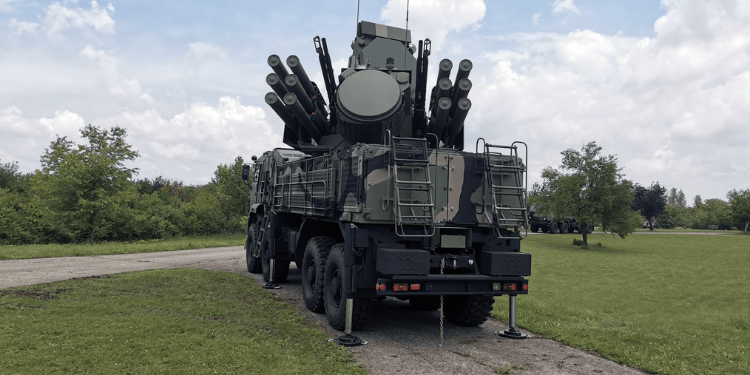
Pantsir-S1 systems are designed to defend against drones, cruise missiles, aircraft, and helicopters at short range.
Each unit combines radar-guided missiles with rapid-fire cannons and can operate in poor weather and low visibility.
The system has been widely deployed throughout Russia since 2022, particularly around strategic locations.
Pantsir-S1 Air Defense Systems Deployed in Two Rings Around Valdai
With the latest additions, analysts have identified two rings of air defense systems around the Valdai residence.
The inner ring is located near the main compound, while the outer ring extends several kilometers into the surrounding forests.
This layered approach allows overlapping radar coverage and multiple interception zones.
Independent researchers using open-source mapping tools have documented the precise locations of the towers.
Also Read: Iran Mulls Over Plans to Seize and Sell Ships Belonging to Select Nations
Many are built on elevated concrete and steel platforms designed to lift the systems above the tree line.
This improves radar range and firing angles in the dense woodland surrounding Valdai.
Earlier satellite images from 2023 showed only a single Pantsir system near the residence.
By 2024, the number had increased to two.
In 2025, investigators counted at least 12 positions.
The jump to 27 units in early 2026 represents the largest expansion in a single period.
In addition to the Pantsir systems, a long-range S-400 air defence system has previously been identified near the Valdai area.
The S-400 can engage targets at much greater distances and altitudes, providing an additional layer of protection beyond the Pantsir network.
Rapid Construction Raises Attention
The speed of construction has drawn attention from military analysts and journalists.
Also Read: Russia Claims Peace is Possible “Today” if Zelensky Takes Required Steps
Satellite images show that heavy equipment was brought in simultaneously to multiple sites, with access roads cleared and reinforced platforms completed in parallel.
Similar air defense towers have appeared around Moscow, major oil refineries, power plants, and defense industry facilities.
The design and placement of the Valdai towers closely match those around the capital, indicating standardized military planning rather than ad hoc deployment.
The Valdai residence is believed to include multiple buildings, secured transport routes and infrastructure designed for extended stays.
The compound is located near the town of Valdai and close to Valdai National Park, an area that already has tight movement controls.
Russian authorities have not issued public statements about the new construction. As with other air defence deployments across the country, official confirmation has been limited or absent. The systems have instead been identified through commercial satellite imagery and open-source analysis.
Since 2022, Russia has expanded domestic air defense coverage in response to repeated drone incidents targeting cities, military bases, and energy facilities.
Air defense systems have been placed on rooftops, towers, and reinforced platforms in several regions.
The concentration of 27 air defense units around Valdai makes it one of the most heavily defended locations in Russia outside of Moscow.
The scale, layout, and permanence of the installations indicate a long-term security arrangement rather than a temporary measure.
The latest construction confirms that Valdai has become a fortified zone, protected by multiple layers of missile and radar systems integrated into Russia’s broader domestic air defense network.