
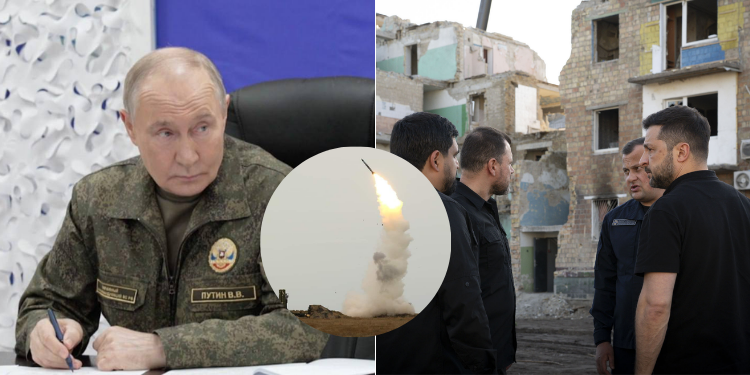
Ukraine’s Defense Minister Mykhailo Fedorov has warned that Russia is overwhelming the country’s air defenses with massive ballistic missile barrages.
Fedorov made the warning on Thursday, February 13, as Kyiv and its allies worked to secure more advanced Patriot interceptors during the Ukraine Defense Contact Group meeting.
Known as the Ramstein format, it was created in March 2022 by the United States to coordinate military assistance from more than 50 countries, convened as Russia intensified large-scale winter attacks targeting Ukraine’s civilian and energy infrastructure, deepening the country’s power crisis.
During the meeting held at NATO Headquarters in Brussels, Fedorov highlighted Russia’s escalating use of ballistic missiles, which he said are straining Ukraine’s defensive capacity.
“You see, Russia launches up to 20 ballistic missiles… that’s about a hundred missiles in one attack. And I don’t think there’s any air defense system in the world that is ready to combat such a large number of missiles.”
Ukrainian Air Force spokesperson Yurii Ihnat has previously acknowledged that ammunition is being depleted faster than aid is arriving, while reports indicated that some Patriot launchers were left without PAC-3 interceptors last month, allowing Russian ballistic missiles to strike power infrastructure.
In response to the mounting missile threat, Germany proposed a coordinated push among Western allies to supply Ukraine with additional Patriot interceptors.
More missiles to counter Russia
German Defence Minister Boris Pistorius said Berlin would contribute more missiles under a joint effort.
“I decided to suggest spontaneously at the end of our session that Germany is going to deliver five additional interceptor missiles called PAC-3 to Ukraine if other supporting countries donate a total of 30 PAC-3,” Pistorius said.
Also Read: Ukraine Downs 112 of 129 Russian Drones in Overnight Assault
He added that Germany has already transferred five of its twelve Patriot systems — more than a third of its inventory — to Ukraine and continues delivering IRIS-T air defence systems, guided missiles, and ammunition.
Pistorius also noted that the FCAS fighter jet programme “has not failed yet, and even if it did, it would not be the end of France-German cooperation.”
Support from allies extended beyond air defence systems. UK Defence Secretary John Healey said the coalition had significantly increased military assistance.
“Together, we pledged a total of 35 billion dollars’ worth of new military aid for Ukraine today,” Healey said.
Reacting to Germany’s proposal, Fedorov confirmed that Ukraine is working with the United States to secure additional Patriot interceptors, noting that current supplies remain insufficient.
“Our colleague Boris showed fantastic initiative today, and I believe this will help us soon receive additional PAC-3 missiles, alongside what we get through the PURL program,” Fedorov said.
$500 million in funding for Ukriane
He added that Ukraine’s partners had announced $500 million in funding for the PURL programme, which will be used in part to purchase PAC-3 missiles from the United States.
Ukrainian forces are also seeking both PAC-2 and PAC-3 interceptors for Patriot systems as they attempt to strengthen protection against large-scale missile attacks.
PAC-2 and PAC-3 represent different generations of Patriot air defense technology, with PAC-3 specifically designed to intercept ballistic missiles using hit-to-kill precision, making them critical for countering Russia’s expanding missile barrages.
Fedorov also highlighted shortages affecting missiles for Europe’s SAMP/T systems, urging increased production across allied countries.
Despite the challenges, Ukraine says defending its skies remains a top priority set by President Volodymyr Zelenskyy.
The minister said organizational changes have already been implemented within the air defense structure and that work is underway to build a multi-level shield combining missile defense, drone interception, and rapid-response systems.
“The whole world must work with Ukraine, and Ukraine with the whole world, to develop more PAC-3 missiles or similar systems to defend against attacks like this,” Fedorov emphasized.
Zelenskyy thanks UK
President Zelenskyy in a statement later highlighted the significance of allied support, thanking the United Kingdom for its timely contributions.
“Thank you to the people of the United Kingdom, @Keir_Starmer and @JohnHealey_MP for the new and timely air defense package worth over £500 million. I am also grateful that the UK has joined the PURL program with a substantial contribution of £150 million, which will allow us to purchase additional American-made weapons, primarily air defenses.”
He further stressed the need to counter Russian missile attacks and their broader strategic impact.
Also Read: Russian Drone Strikes Ravage Ukrainian Communities, Children Among the Dead
Ahead of the Ramstein meeting, Fedorov had outlined Kyiv’s broader wartime strategy: increasing Russian battlefield losses, strengthening air defense, and tightening economic pressure on Moscow to make the war harder for the Kremlin to sustain.
“Ukraine aims to increase Russian battlefield losses, expand air defense, and intensify economic pressure on Moscow to make the war harder for the Kremlin to sustain,” Fedorov said, adding that Kyiv is rolling out a multi-layered “small” air defense system and new interceptors to counter long-range drones, including Shahed-type UAVs.
He also urged partners to increase sanctions pressure and fully block Russia’s so-called shadow fleet.
Follow our WhatsApp Channel and X Account for real-time news updates.