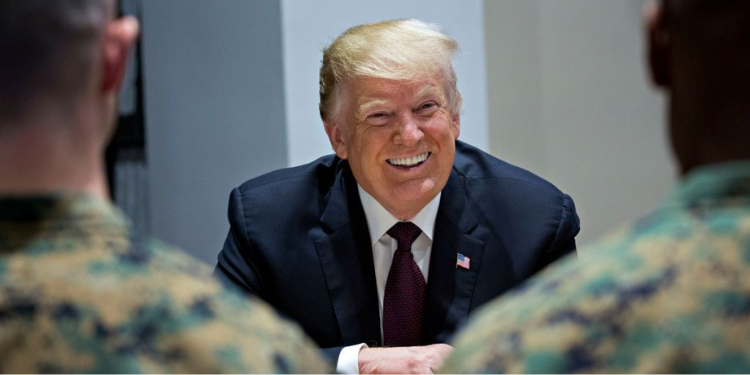
There was a sharp exchange Saturday, April 11, between President Donald Trump and an NBC reporter after the reporter asked why the Strait of Hormuz isn’t fully open, regardless of Trump’s endless threats to Iran.
The confrontation happened during a press availability at the White House when a reporter pointed out that shipping traffic through the narrow waterway, which normally carries about one-fifth of the world’s oil and liquefied natural gas, was still at a near standstill.
“Iran is not listening to your threats about opening the Strait of Hormuz,” the NBC reporter said.
Trump shot back immediately: “How do you know that?”
The reporter replied: “Because it’s still blocked. Are they reopening it?”
Trump pressed again: “Why do you say that? You don’t know anything.”
Trump says U.S. has won the war.
After that, he went further, saying that Iran’s remaining military capabilities and leadership were of no threat to him. Trump then said it didn’t matter to him whether the talks in Pakistan led to a deal. He says that the U.S. has already won, no matter what happens in the talks.
“They have no navy. They have no radar. They have no air force. Their leaders are all dead. Khamenei is gone. For many years, he ruled; he’s gone,” Trump said. “With all of that, let’s see what happens, but from my standpoint, I don’t care.”
The clip spread quickly online after Acyn, a digital editor, shared it.
Trump appeared irritated as he challenged the reporter’s facts and then pivoted to claim broad U.S. success in weakening Iran. Trump has been using his social media handles to hit out at media houses that paint Iran as the winner of this ongoing war. He has, in most cases, branded them as fake news channels.
Also Read: Obama-Era Green Cards Revoked as Rubio Targets Family of Iran Hostage Crisis Figure
The exchange comes as ship-tracking data from firms like Kpler, Lloyd’s List Intelligence, and Signal Ocean show traffic through the strait running well below 10 percent of normal levels in recent days.
On some days this week, only a handful of vessels, as few as seven in a 24-hour period, made the passage, compared to the usual 130 to 140.
Iran has been directing ships to stay closer to its territorial waters and, according to reports, has discussed or imposed high fees on some tankers.
A fragile two-week ceasefire took effect earlier in the week after Trump had issued ultimatums, including profane social media posts warning that Iran would face strikes on power plants and bridges if the strait stayed closed.
Ceasefire agreement between the U.S. and Iran.
The agreement was meant to include the safe reopening of the waterway, but Iran has continued to assert control over passage.
U.S. and Iranian negotiators began rare high-level talks in Pakistan on Saturday aimed at a longer-term deal
Trump has also posted on social media claiming U.S. forces have begun “clearing” the strait and sunk Iranian mine-laying vessels. Iran has pushed back on those claims, calling some of them false.
Also Read: US Ceasefire with Iran: What’s Next? A Former Diplomat Explains 3 Possible Scenarios
On Friday, Trump told reporters the strait would open “fairly soon,” though he added it would not be easy.
He has repeatedly said the United States itself does not rely heavily on the route and that the problem is more Europe’s and other nations that import oil through it.
“We will open up the Strait even though we do not use it because we have a lot of other countries in the world that do use it that are either afraid, or weak, or cheap. We were not helped by NATO,” Trump said on Saturday.
Trump’s “I don’t care” remark drew immediate attention because it came right after he listed what he sees as Iran’s losses.