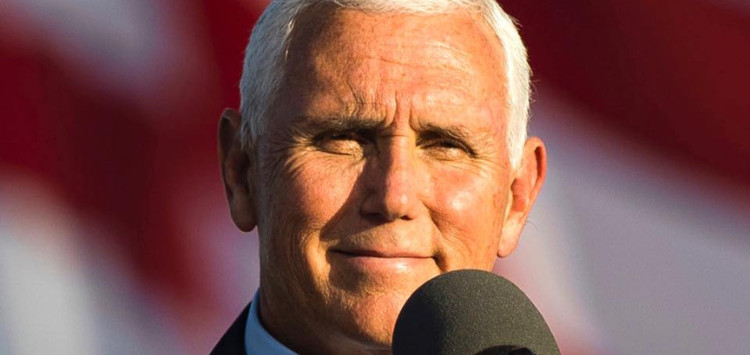
Former U.S. Vice President Mike Pence has publicly criticized President Donald Trump over recent religious imagery, trade policy, and foreign policy decisions, marking one of his clearest breaks yet with the administration in Washington.
In an interview with MS NOW, Pence said he found Trump’s recent depictions of himself in religious terms inappropriate and warned that tariffs and foreign policy uncertainty are affecting the U.S. economy and global standing.
Pence criticizes Trump’s religious imagery
Pence said he was uncomfortable with Trump’s recent portrayal of himself using religious symbolism, which included imagery that drew criticism from faith leaders.
“I think the language and images the president has used are offensive,” Pence said, referring to Trump’s depiction of himself in a Jesus-like manner.
He also addressed Trump’s tensions with Pope Leo XIV, noting the importance of separating political leadership from religious authority.
“I think the Pope has every right to express himself in a manner that he believes is consistent with the gospel of Jesus Christ,” Pence said. “Let the pope be the pope, and you be the president.”
Also Read: Who Formally Declares the Winner of the US Presidential Election?
Pence added that Trump’s decision to remove one controversial image was appropriate, noting that tensions between the White House and the Vatican appeared to have eased slightly.
Economic concerns over tariffs
Pence also broke with Trump on economic policy, particularly the administration’s use of broad tariffs on imports. He said these measures have created uncertainty for businesses and workers across the country.
“I think the economy has been impacted by the uncertainty around the president’s broad-based tariffs,” Pence said.
He added that if tax cuts had not been extended while tariffs were increasing, the economy would be under even more pressure.
Pence also emphasized that under the U.S. Constitution, trade taxes should originate in Congress, not through presidential action.
“The Constitution is quite clear that taxes originate in the Congress, not by the president,” he said.
The White House, through spokesperson Davis Ingle, dismissed Pence’s criticism, saying his influence within the Republican Party had diminished significantly following his failed presidential bid.
Ukraine and foreign policy divide
Pence also differed with Trump on U.S. support for Ukraine, saying continued assistance is necessary to counter Russian military aggression.
“I truly do believe free nations in the world need to continue to give Ukraine what they need to defeat and repel that Russian invasion,” Pence said, referring to the war in Ukraine.
When asked whether the U.S. is doing enough, Pence replied, “I think that’s an open question.”
He also said he was disappointed by remarks suggesting reduced U.S. support for Ukraine, adding that strong American backing remains essential for global stability.
Pence on JD Vance and political shifts
Pence noted that he has never spoken directly with Vice President JD Vance, though he acknowledged Vance’s past criticism of the Trump administration during Pence’s own tenure in office.
Also Read: Trump Ally Floats Bold Plan to Counter Virginia Gerrymander
“I remember the vice president was a pretty strong critic of our administration,” Pence said. “People change their opinions, and he’s changed his views.”
He added that political positions may shift ahead of the 2028 election cycle, and that Republicans should focus on principles rather than personalities.
Why this matters now
The public split between Pence and Trump highlights growing ideological divisions within the Republican Party. It also gives insights on ongoing debate over the limits of executive power in trade policy, as well as the U.S. role in supporting Ukraine during its war with Russia.
With the 2026 midterm political landscape approaching and discussions already beginning around 2028 leadership, internal party disagreements like these could shape voter sentiment and influence future policy direction.