
The Missouri Supreme Court has ruled that Republican lawmakers did not violate the state constitution by approving a new congressional map mid-decade, delivering a significant legal win for allies of President Donald Trump ahead of the 2026 midterm elections.
In a narrow 4-3 decision issued Tuesday, March 24, the court held that Missouri’s constitution does not prevent lawmakers from redrawing congressional districts outside the once-a-decade census cycle.
“The obligation to legislate congressional districts once a decade does not limit the General Assembly’s power to redistrict more frequently than once a decade,” Judge Zel Fischer wrote in the majority opinion.
Missouri map fight tied to Trump-backed redistricting push
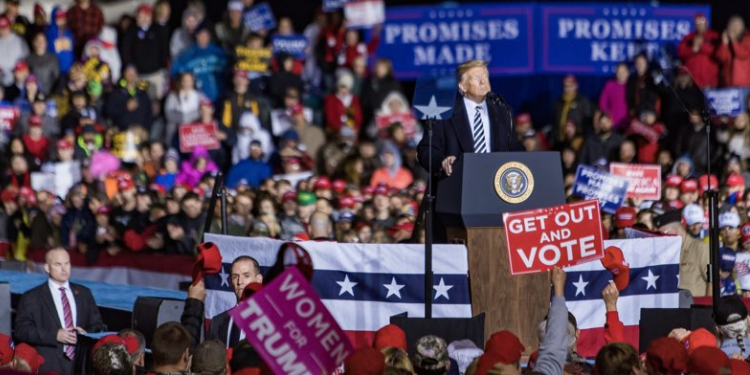
The ruling follows a broader push by President Trump and Republican allies urging states with GOP-controlled legislatures to redraw maps to create additional Republican-leaning seats.
Missouri Republicans moved quickly last year to pass a new map aimed at reshaping the Kansas City-based district held by Democratic Representative Emanuel Cleaver, with the changes expected to net the GOP one additional seat.
Republican Governor Mike Kehoe approved the plan and has since faced multiple legal challenges and a coordinated referendum campaign seeking to block its implementation.
Also Read: Pentagon Returns Press Badges but Boots Media Offices After Court Loss
At the center of the case was the interpretation of a constitutional clause requiring lawmakers to redraw districts following each census.
Writing in dissent, Judge Paul Wilson argued the provision was intended to limit redistricting to that period, describing the wording as central to the dispute.
But the majority rejected that view, stating the constitution outlines when lawmakers must act, not when they are prohibited from doing so.
Separate rulings shape election rules
In parallel decisions, the court also left in place Missouri’s voter photo ID requirement while striking down several restrictions on voter registration and absentee ballot outreach.
The voter ID law, passed in 2022, requires in-person voters to present government-issued identification. The court’s majority ruled that the challengers had not demonstrated that they were prevented from voting, thereby allowing the law to stand.
At the same time, judges invalidated provisions that restricted civic groups from assisting with voter registration and absentee ballot applications, ruling that the measures went too far in limiting political speech.
Also Read: New DHS Chief Signals Hardline Shift on Voting, Claims 80% Support for SAVE America Act
A campaign group, People Not Politicians, had earlier said it had gathered enough signatures to force a referendum that could overturn the map before the midterms. Missouri Secretary of State Denny Hoskins has yet to determine whether the measure will appear on the ballot.
Separately, the Democratic-aligned National Redistricting Foundation pursued another legal challenge, arguing the map violates constitutional requirements on district compactness.
The Missouri case is part of a wider national battle over congressional maps, with both Republicans and Democrats investing heavily in legal and political efforts to secure an advantage in 2026.
Republican groups, including Trump-aligned political action committees, have poured millions into defending the map, while Democratic-backed organizations have funded referendum and legal challenges.
Donald Trump Jr., in December 2025, urged his social media followers to support the effort to block the referendum.