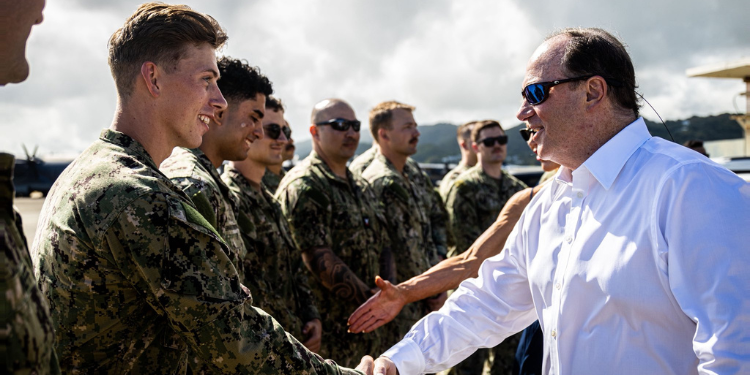
The Pentagon announced Wednesday that Navy Secretary John C. Phelan is leaving the Trump administration effective immediately, with no reason given for the sudden move.
Under Secretary Hung Cao, a retired Navy captain and combat veteran, will step in as acting secretary of the Navy right away.
Pentagon spokesman Sean Parnell released the short statement on behalf of Secretary of War Pete Hegseth and the deputy secretary.
“On behalf of the Secretary of War and Deputy Secretary of War, we are grateful to Secretary Phelan for his service to the Department and the United States Navy,” the April 22 statement said. “We wish him well in his forthcoming endeavors.”
John C. Phelan joins the Navy
Phelan, a businessman and political donor with no prior military service, took office in March 2025 after Senate confirmation.
He pushed for faster shipbuilding, a new “Golden Fleet” plan, and changes to Navy operations under President Trump’s direction.
The ouster comes one day after Phelan gave the keynote speech at the Sea-Air-Space 2026 conference near Washington. In recent months, he had spoken often about Navy readiness and the need to fix fleet problems.
The timing prompts questions because the Navy plays a central role in the current conflict with Iran, particularly the U.S. blockade near the the Strait of Hormuz.
The blockage was imposed after the Iran-U.S. talks aimed at reaching a deal and ending the war failed to yield fruit.
Also Read: Iran Goes Silent on U.S. Proposal as Trump Team Presses Pakistan for Response
On February 28, 2026, U.S. and Israeli forces attacked Iran, which started the war. Attacks on Iranian military sites, missile bases, and leaders were part of the fighting.
Earlier this month, a temporary ceasefire took effect, but tensions remain high in the Strait of Hormuz amid the U.S. blockade.
The Navy has helped maintain the blockade and keep the sea lanes in the area safe. Any change at the top during active operations can affect planning and command chains.
Hung Cao brings direct military experience to the job. He served 32 years in the Navy, including time as a special operations officer.
Cao retired as a captain in 2021. Trump nominated him as under secretary in early 2025, and the Senate confirmed him in October 2025.
Cao has overseen daily Navy operations and the management of a budget exceeding $250 billion. He also visited fleet units this month to discuss readiness with sailors.
The Department of the Navy includes the Navy and Marine Corps and employs nearly one million people. It handles everything from aircraft carriers and submarines to shipyard repairs and Marine deployments.
Also Read: CENTCOM Breaks the Silence After Reports of Ships Evading U.S. Blockade Surfaced
Phelan’s departure signifies another shift in Pentagon civilian leadership under Trump and Hegseth. Earlier moves included changes to other senior Navy posts and efforts to reshape policy on contracts, recruiting, and warfighting focus.
No details emerged about why Phelan was removed or whether he resigned or was fired. The statement offered only thanks and best wishes.
Cao’s background as a veteran who served in special operations might signal a push to place greater emphasis on combat readiness.
What awaits Cao as the acting Secretary
Cao is expected to solve the Navy’s long-standing issues: aging ships, delays in new construction, and the need to counter China’s threats in the Pacific while managing crises in the Middle East.
Phelan had discussed closing some offices and creating a rapid-capabilities office to accelerate the development of new technologies for the fleet.
He also backed Trump’s calls to name new battleships after the president and speed up submarine deliveries under the AUKUS deal with Australia and Britain.
The Pentagon gave no timeline for a permanent replacement. Cao will serve as acting secretary until the president nominates someone and the Senate confirms them.
This change comes as U.S. forces remain on high alert in the region. Iran has fired missiles and seized ships in the Strait of Hormuz in recent days. The U.S. Navy helps keep oil shipments moving despite the risks.