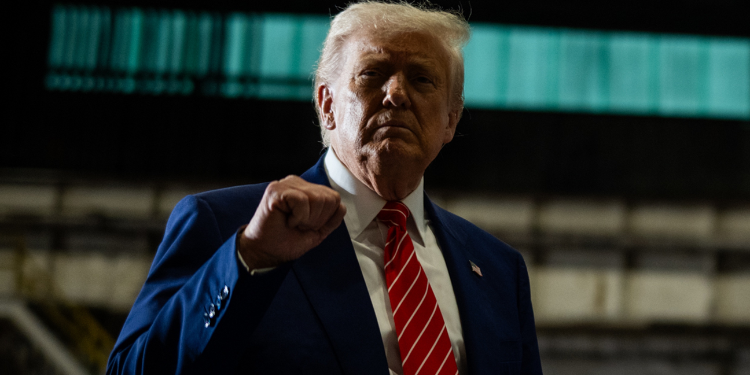
Questions have emerged online over whether allies of U.S. President Donald Trump were involved in planning an attack for political gain ahead of the midterm elections, following an attempted security breach at the White House Correspondents’ Association Dinner.
The suspect, identified as Cole Tomas Allen, 31, from California, was stopped by law enforcement after allegedly rushing the event while armed. Officials have not linked the suspect to any political group, and available information, including an alleged manifesto, points to anti-Trump motivations.
However, social media discussions quickly shifted toward speculation about whether the incident could have been staged.
According to reporting by HuffPost, some online users began suggesting that the event may have been orchestrated for political gain.
Experts warn against early conclusions
Nathan Walter, a professor of media psychology at Northwestern University, said such reactions are common in politically tense environments where trust in information is low.
“In a highly polarized media landscape, people are not always seeking the most accurate account. They are often trying to make sense of events through what they already believe,” Walter told HuffPost.
He added that fast-developing events with limited verified information create space for speculation. According to him, early uncertainty allows narratives to form quickly, even before facts are confirmed.
Walter noted that once these interpretations spread, corrections tend to arrive later and struggle to change initial beliefs.
Joseph Uscinski, a political science professor at the University of Miami, said conspiracy thinking is not new in American politics. He pointed to past cases, including long-running debates over historical political assassinations.
Also Read: Trump Reveals What He Told Melania Before Chaotic White House Correspondents’ Dinner
“We continue to see that many Americans are open to alternative explanations of major events,” he said, noting that similar patterns have appeared after other politically charged incidents.
Social media fuels competing narratives
The incident has also drawn attention to how quickly online platforms shape public perception. Within hours of the event, users shared competing claims about what happened, ranging from suggestions of staged security lapses to accusations of political manipulation.
Some posts questioned why security personnel reacted in certain ways during the event, while others focused on unrelated remarks officials made before the dinner. None of these claims has been verified by law enforcement or independent investigators.
Claire Robertson, an assistant professor of psychology at Colby College, said people often try to impose order on confusing events.
“When we see something chaotic, we want a clear explanation. If one is not immediately available, people sometimes fill the gap with theories that feel consistent or simple,” she said.
Also Read: Trump Reveals What He Told Melania Before Chaotic White House Correspondents’ Dinner
She added that this tendency increases during periods of political tension, when trust in institutions is already weakened.
Why this matters
The spread of competing narratives around the White House Correspondents’ Dinner incident reflects a broader challenge facing the United States as it approaches the midterm elections. Experts say misinformation can shape public understanding of major events before verified facts are released.
With President Donald Trump in office and political divisions deepening, there is a warning that rapid online speculation may continue to influence how Americans interpret security incidents and political violence.
Walter said the gap between fast information sharing and slower fact verification creates lasting effects.
“Once a narrative takes hold, it becomes difficult to correct,” he said.