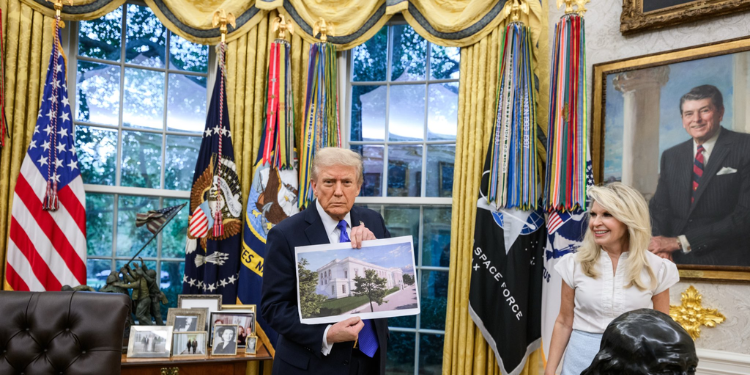

Senate Republicans have dealt a rare political setback to President Donald Trump by stripping a controversial $1 billion Secret Service funding request tied to the president’s White House ballroom project from a major immigration enforcement bill amid rising tensions within the GOP conference.
The decision was announced on Wednesday, May 20, after Republican senators revolted, both privately and publicly, against the proposal, which critics branded the “billion-dollar ballroom” plan.
“We were told that the ballroom money is out,” Sen. John Kennedy told reporters after a closed-door GOP lunch meeting, signaling that Senate Republicans no longer had the votes to keep the provision alive.
The funding had been inserted into a roughly $70 billion immigration enforcement package designed to boost Immigration and Customs Enforcement (ICE) and Border Patrol operations through 2029.
Senate Republicans strip Trump ballroom funding
Draft language explicitly referenced security upgrades linked to Trump’s planned East Wing ballroom expansion project at the White House complex.
Also Read: Americans to Be Hit With $130 Annual Fee on Electric Cars as Gas Tax Funding Falls Short
Several Republican senators questioned why Congress should approve funding for a lavish White House construction project while Americans continue to struggle with inflation and rising living costs.
“People can’t afford groceries and gasoline and healthcare, and we’re going to do a billion dollars for a ballroom?” Sen. Bill Cassidy said bluntly.
Sen. Thom Tillis called the effort a “bad idea,” arguing the White House had failed to properly explain why taxpayers should finance the project after Trump previously suggested private money would cover it.
“They need to explain to me why we need this,” Tillis said.
The internal backlash intensified after Senate Parliamentarian Elizabeth MacDonough ruled that portions of the funding package violated Senate reconciliation rules because the proposal fell outside the Judiciary Committee’s jurisdiction.
The ruling threatened Republicans’ ability to pass the bill through the filibuster-proof budget reconciliation process.
Senate Majority Leader John Thune acknowledged Republicans were facing both “ongoing parliamentarian issues” and “ongoing vote issues” as party leaders scrambled to salvage the broader immigration package.
Behind the scenes, however, the ballroom fight exposed deeper fractures within the Republican conference.
Multiple reports indicate senators were already frustrated with Trump after he endorsed Texas Attorney General Ken Paxton over incumbent Sen. John Cornyn in the upcoming GOP primary runoff — a move many Senate Republicans privately viewed as politically reckless.
“There’s always a consequence with taking on United States senators,” Thune said when asked about the growing tensions.
The White House had reportedly pushed hard for inclusion of the ballroom-linked funding, viewing congressional approval as critical. At the same time, the administration remains tied up in court battles over whether the project was legally authorized.
Revolt behind closed doors
Administration officials argued that only about $220 million of the $1 billion request would directly support ballroom-related security enhancements, with the remainder allocated toward broader Secret Service upgrades, including a new visitor screening center and hardened security infrastructure around the White House complex.
Sen. Jim Justice defended the security rationale but admitted the optics were politically damaging.
“We’ve got people out there who are worried about how in the world they’re going to have enough gas to get home,” Justice said.
Also Read: Congress Split as Trump Defends Massive White House Ballroom Project
The setback is especially notable because Republicans have largely remained aligned with Trump throughout his second term, even as he repeatedly pressures lawmakers publicly on Truth Social and through campaign endorsements.
Trump responded furiously to the parliamentarian’s ruling earlier this week, calling for MacDonough’s firing and renewing demands for Republicans to abolish the Senate filibuster.
Even with the ballroom provision likely dead, Republicans still face major political headaches surrounding the immigration bill.
Democrats are preparing amendments targeting a separate Justice Department “anti-weaponization” compensation fund linked to a Trump settlement agreement — a proposal several Republicans have also criticized as a potential slush fund that could theoretically benefit Trump allies, including individuals tied to the January 6 Capitol riot.
Sen. Cassidy called the fund a “slush fund,” while Tillis warned it would be “absurd” if Jan. 6 rioters ultimately became eligible for compensation.
The broader immigration enforcement package nevertheless advanced Wednesday through the Senate Budget Committee in an 11-10 party-line vote, setting up a marathon amendment battle on the Senate floor in the coming days.