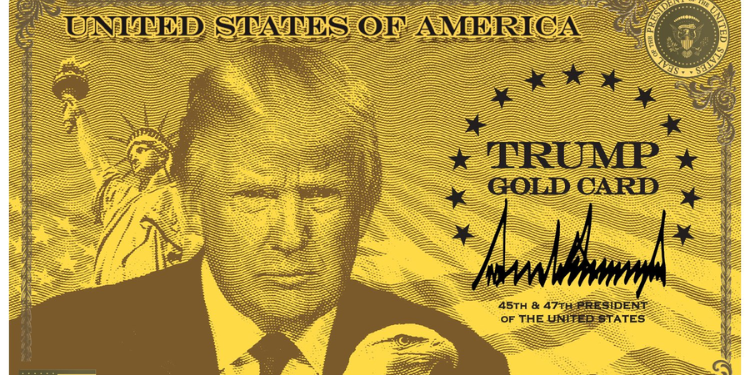
President Donald Trump’s new $1 million “Gold Card” visa program has recorded a slow start, with just 338 applicants since its launch, according to a Department of Homeland Security (DHS) court filing reviewed by CNBC.
The program, introduced in 2025 as a premium pathway to U.S. residency for wealthy foreign nationals, has fallen short of early expectations to attract large numbers of high-net-worth investors.
The visa scheme requires a $1 million payment to the U.S. government, along with a $15,000 processing fee, in exchange for a pathway to permanent residency and potential citizenship.
It was promoted by the Trump administration as a streamlined alternative to traditional employment-based immigration routes.
Despite that pitch, internal data cited in the court filing suggests limited interest in the program during its initial months.
Low Uptake Raises Questions on Demand
According to DHS figures included in ongoing litigation, only 165 applicants have paid the required processing fee. Officials had previously projected far higher participation, with the program expected to generate significant revenue and attract global investors seeking U.S. residency.
The Gold Card program was formally launched in December 2025 with an online application system and a dedicated U.S. Citizenship and Immigration Services (USCIS) form.
Commerce Secretary Howard Lutnick, who helped unveil the initiative, previously claimed that $1.3 billion worth of Gold Cards had been sold shortly after launch. However, the new filing presents a more modest picture of early demand.
Administration officials have maintained that the initiative is part of a broader effort to modernize legal immigration pathways and draw investment into the United States.
But the gap between projections and actual applications has raised early questions about whether the pricing model and eligibility criteria are aligned with global investor expectations.
Claims of Fast-Track Processing Under Scrutiny
One of the key selling points of the Gold Card visa was expedited processing for applicants willing to make the required financial contribution.
However, DHS filings cited in the ongoing court case state that applicants “will not necessarily have their petitions adjudicated faster than any non-gold-card applicant.”
That disclosure has fueled criticism from immigration experts and advocacy groups, who argue the program’s benefits are unclear and potentially overstated.
Legal challenges have also emerged. The Democracy Defenders Fund and other organizations have filed lawsuits in Washington, D.C., accusing federal agencies of failing to provide adequate public records on how the program was developed and implemented. The case names DHS, the Department of State, the Department of Commerce, and USCIS as defendants.
Also Read: Trump-Endorsed Candidate Ed Gallrein’s AI-Generated Social Media Posts Spark Mockery
Critics argue that the Gold Card may overlap with existing visa categories such as EB-1 and EB-2, which already provide pathways for individuals with extraordinary ability or national interest qualifications. They claim the program risks allowing wealth to substitute for merit-based criteria.
The Trump administration has defended the initiative as lawful and within executive authority, stating that it builds on existing immigration frameworks while encouraging foreign investment.
Why This Matters
The weak early uptake of the Gold Card visa raises broader concerns about the effectiveness of high-fee immigration programs in attracting global talent and capital. While the Trump administration has positioned the scheme as a major innovation in legal immigration policy, the limited response suggests that wealthy investors may not see sufficient value in the offer.
For the Trump administration, the program’s early performance is likely to intensify scrutiny of its immigration agenda, particularly its reliance on financial entry pathways alongside tighter restrictions on other forms of legal migration.