The United States is preparing to expand its military presence in the Middle East with the deployment of a third aircraft carrier strike group, even as President Donald Trump says the ongoing Iran war could conclude within “two to three weeks.”
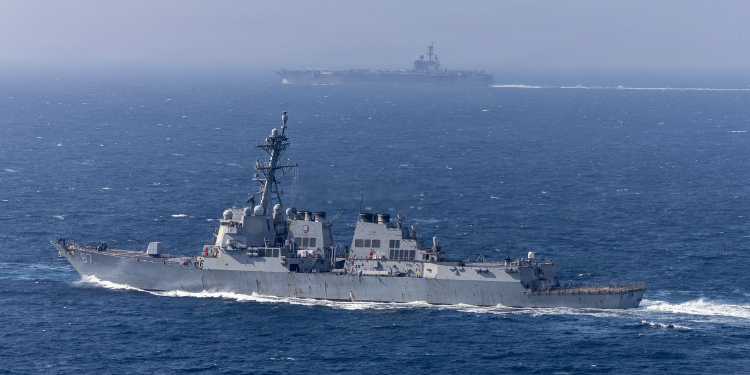
On Tuesday, March 31, the USS George H.W. Bush reportedly departed Naval Station Norfolk and is expected to reach the region within several weeks, according to U.S. Navy statements and U.S. officials cited in multiple reports.
The Bush Carrier Strike Group, which includes Carrier Air Wing 7 and more than 5,000 sailors and personnel, departed amid broader Pentagon deliberations over future force posture and potential ground operations.
Third carrier deploys
According to U.S. officials cited by The Wall Street Journal, the carrier will join existing U.S. naval forces operating across the Mediterranean and Arabian Sea.
The USS Abraham Lincoln is currently in the Arabian Sea, while the USS Gerald R. Ford remains in Croatia undergoing repairs after a fire aboard the ship.
The deployment of the Bush may bring the number of U.S. aircraft carriers positioned for operations related to the Iran conflict to three.
However, the Pentagon has not specified whether the Bush will remain in the eastern Mediterranean or take station farther into the Middle East as part of Operation Epic Fury, now in its fifth week.
Additional U.S. forces have been moving toward the region. Thousands of soldiers from the 82nd Airborne Division have begun arriving, including paratroopers part of a surge authorized last week.
Also Read: Trump Scrambles Another Aircraft Carrier as Iran War Escalates
The 82nd Airborne is trained for rapid parachute insertion into contested territory to secure airfields and strategic terrain. The Pentagon has not publicly detailed whether these troops are intended for potential ground combat against Iran.
A U.S. Navy ship carrying about 2,500 Marines recently arrived in the Middle East waters, with another 2,500 Marines deploying from California.
The Tripoli Amphibious Ready Group, including the 31st Marine Expeditionary Unit and roughly 3,500 sailors and Marines, is also positioned in the region, according to U.S. Central Command (CENTCOM).
Trump says U.S. will “be leaving very soon”
President Trump on Tuesday said the United States could end its campaign against Iran within “two to three weeks,” marking his strongest public indication that the conflict’s end may be imminent.
Speaking to reporters in the Oval Office, Trump said withdrawal could occur “within two weeks, maybe two weeks, maybe three.” He emphasized that Iran “doesn’t have to make a deal” with Washington for the U.S. drawdown to proceed.
The president said the condition for concluding U.S. operations was that Iran be “put into the stone ages,” referring to degrading its nuclear and military capabilities to prevent future weapons development. “Then we’ll leave,” he said.
Trump also told reporters that oil prices would fall sharply once the U.S. withdrew from Iran, stating that “all I have to do is leave Iran—and we’ll be doing that very soon—then prices will come tumbling down.”
He has repeated claims that the U.S. has “decimated” Iran’s military capabilities and said the conflict is “coming to an end.”
At the same time, Trump criticized U.S. allies for not contributing more to military operations in the Strait of Hormuz, saying the U.S. “will not have anything to do with” securing the vital waterway in the future. “That’s for France. That’ll be for whoever’s using the strait,” he said.
B-52 bombers begin overland missions over Iran
Senior U.S. defense officials said Tuesday that B‑52 Stratofortress bombers have begun flying over Iranian territory for the first time since the war began in late February.
According to Gen. Dan Caine, chairman of the Joint Chiefs of Staff, the missions were enabled by what he called an “increase in air superiority” over Iran.
Caine told reporters that the U.S. has struck more than 11,000 targets over the past 30 days, and that American forces have “systematically degraded and destroyed” Iran’s naval capacity, including more than 150 ships.
The operations have focused heavily on disrupting Iran’s logistics networks, missile production, drone capabilities, and naval assets.
The decision to send B‑52s—aircraft considered vulnerable to advanced air defenses—directly over Iran reflects, Caine said, U.S. confidence that it has destroyed much of Iran’s anti‑aircraft capability.
He added that U.S. forces have increasingly integrated attack helicopters and close‑air-support assets into maritime operations targeting mine‑laying platforms and naval vessels.
Central Command chief Adm. Brad Cooper said Iran’s air force and navy have been “severely degraded” and its capacity to launch missiles “largely destroyed.”
He said diminishing numbers of Iranian missile and drone launches in the last 24 hours indicate the conflict’s shifting momentum.
According to Pentagon briefings, U.S. forces continue operations that focus on turning off Iran’s industrial infrastructure, including facilities tied to nuclear research and weapons development.
Gen. Caine said airstrikes have targeted factories, warehouses, research labs, and associated logistics hubs needed for Iran to rebuild its combat power.
U.S. officials also reiterated that maintaining operational secrecy is essential to protecting deployed forces.
Defense Secretary Pete Hegseth said on Tuesday that American troops remain prepared for a broad range of options and that revealing limits, such as whether the United States will use ground troops, could undermine military effectiveness.