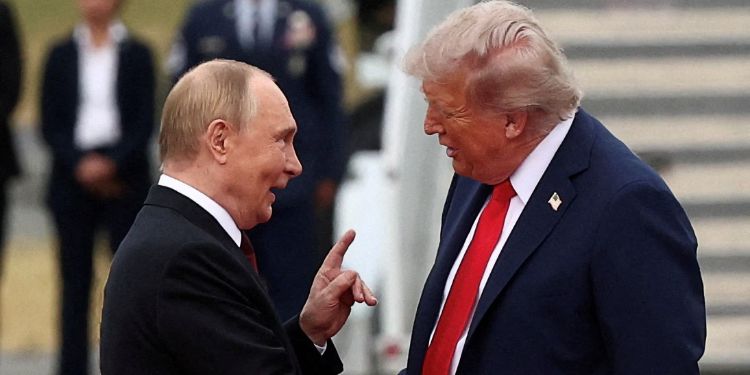
President Donald Trump has reportedly rejected an offer from Russian President Vladimir Putin to move Iran’s enriched uranium to Russia as part of a potential deal aimed at ending the war involving the United States, Israel and Iran.
According to a report by Axios, the proposal was discussed during a phone call between the two leaders earlier this week but was ultimately declined by the U.S. president.
The reported offer came amid ongoing diplomatic efforts to prevent further escalation in the Middle East conflict.
Trump raises possibility of Russian assistance to Iran
President Trump’s decision follows comments suggesting that Moscow could be providing some level of assistance to Tehran.
In an interview with Fox News host Brian Kilmeade, Trump acknowledged the possibility that Russia may be helping Iran during the conflict.
“I think he might be helping them a little bit, yeah, I guess, and he probably thinks we’re helping Ukraine,” Trump said.
“Yeah, we’re helping them also.”
Also Read: Trump Temporarily Allows Russian Oil Sales Amid Reports Russia Is Assisting Iran
The remarks marked a shift from earlier statements by Trump administration officials who had said Russia denied sharing intelligence with Iran.
U.S. Special Envoy to the Middle East Steve Witkoff said Russian officials had rejected claims that Moscow was providing intelligence support to Tehran.
Witkoff said he spoke with Russian representatives after holding discussions with Trump earlier in the week.
He also confirmed that he and the president’s son-in-law Jared Kushner had held a separate call with Putin’s foreign policy adviser Yuri Ushakov.
According to Witkoff, Ushakov told them that Russia was not sharing intelligence with Iran.
White House press secretary Karoline Leavitt later said the administration had made clear to Moscow that any intelligence cooperation with Tehran would be unacceptable.
“If intelligence sharing was taking place, it’s not something they would be happy with, and they hope that it is not taking place,” Leavitt said.
The Kenya Times reached out to the White House for clarification regarding the reported discussions between President Trump and President Putin, but no response had been received at the time of publication.
Russian oil policy
The Trump administration on Thursday, March 12 took steps to ease global energy supply pressures by allowing Russian oil stranded at sea to re-enter international markets.
The measure was formalized through General License 134, issued by the Office of Foreign Assets Control under the U.S. Department of the Treasury.
The authorization permits transactions involving Russian crude oil and petroleum products that were loaded onto vessels before March 12, 2026.
Under the policy, those cargoes can now be delivered and sold globally despite existing sanctions restrictions. The authorization is scheduled to remain in effect until April 11, 2026.
Also Read: Trump Confirms US to Escort Tankers Through Strait of Hormuz After Strikes on Iran’s “Oil Lifeline”
Treasury Secretary Scott Bessent said the measure was designed to prevent disruptions to global oil supplies as geopolitical tensions continue to intensify.
According to Bessent, the policy allows shipments already in transit to reach markets rather than remain stranded due to sanctions.
“To increase the global reach of existing supply, the Treasury Department is providing a temporary authorization to permit countries to purchase Russian oil currently stranded at sea,” he said.
He described the policy as a “narrowly tailored, short-term measure” that would not significantly increase Russian government revenue.
Bessent said most of Russia’s energy income is generated through taxes on extraction rather than the sale of oil cargoes already in transit.
Global energy implications
The temporary authorization follows a similar waiver issued earlier allowing refiners in India to purchase Russian oil shipments that had already left ports before sanctions restrictions took effect.
Officials said the measure was intended as a stopgap to stabilize global energy markets while geopolitical tensions continue to disrupt supply chains.