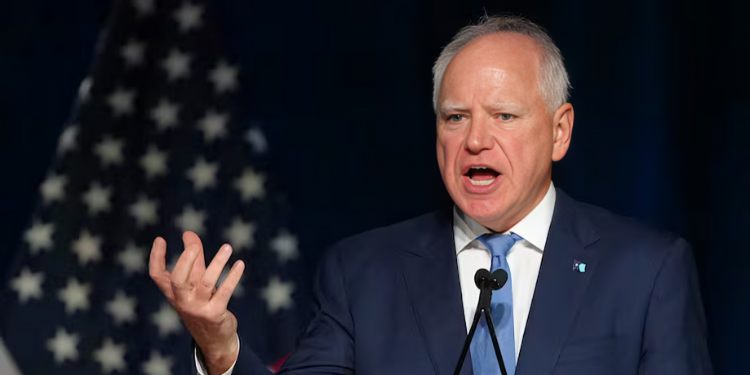
Minnesota Governor Tim Walz has shed more light on one of the bolder ideas in his just-unveiled supplemental budget, a targeted tax on big social media companies to help workers hit hard by artificial intelligence.
The governor, in a statement X on Wednesday, March 18, said that many workers in his state have lost jobs and are still losing them due to the effects of AI, so the need for the government to step in and help them is clear: simply make giant social media companies pay tax.
“Tech companies are causing disruptions to jobs and our economy, and middle-class families are bearing the consequences,” Walz posted.
“To ensure they pay their fair share, I’m proposing a tax on social media companies that will support Minnesota workers impacted by artificial intelligence,” he added.
His post on X echoes what he laid out a day earlier when he rolled out his mid-session budget priorities at a St. Paul YMCA.
According to the proposal, platforms such as Facebook, X, TikTok, Instagram, and the like that have more than 100,000 monthly users in the state would be slapped with a levy tied directly to their collection and monetisation of user data.
Also Read: Trump Administration Initiates $3,676 Tax Refund Drive
Revenue would then be channeled into a dedicated fund for workforce training, retraining, and other support for people who lose jobs or face wage pressure due to AI automation.
Walz has framed the idea as progressive preparation for what’s coming.
During his Tuesday announcement, he stressed that large tech firms have built enormous wealth by harvesting Minnesotans’ data.
“We’re asking them to pay their fair share,” he said, “and most importantly, using those revenues… to start building for what is going to be disruptions from AI, disruptions to the workforce, and to start putting Minnesota at the forefront of planning ‘What does the AI revolution look like?’”
Minnesota revenue
Estimates from the Department of Revenue and Minnesota Management and Budget peg the tax at possibly generating around $100 million annually in the near term, rising to nearly $200 million in later fiscal years, such as 2028-2029.
That money would help fund programs to cushion the blow for workers in sectors such as customer service, content creation, data entry, and other fields already affected by AI.
The social media tax revives a concept Democrats pushed last year without success — it failed to win bipartisan backing amid Republican opposition to new levies.
This time, Walz is pairing it with more broadly appealing elements, such as a major expansion of the state’s Child Tax Credit.
The current max credit of $1,050 for one child and $2,100 for two or more would jump to $3,000 and $6,000, respectively, with eligibility stretched to families earning up to $120,000 a year.
That change alone would deliver about $150 million in annual tax relief to roughly 105,000 households.
Overall, the supplemental plan boosts spending by $113 million in the current two-year cycle while generating $50 million in revenue.
The math improves in the next biennium, with spending up by $189 million and revenue climbing by $246 million, thanks to the new streams.
Also Read: Tim Walz Prepares National Guard Deployment as Tensions Rise With Federal Agents
Walz is also proposing some cuts — trimming spending on nursing home and disability services, which he says have ballooned — while insisting Minnesota will remain the nation’s most generous state in those areas, just more efficient.
Opposition hurdles
However, Republicans aren’t buying it yet. Senate Minority Leader Mark Johnson called the package a tough sell, estimating it could result in a net $868 million tax hike for Minnesotans.
He questioned the way forward, especially on tax increases, though he left the door open to tweaks to the child credit.
Walz’s Wednesday post on social media hints he plans to keep pressing the case publicly as lawmakers debate it.