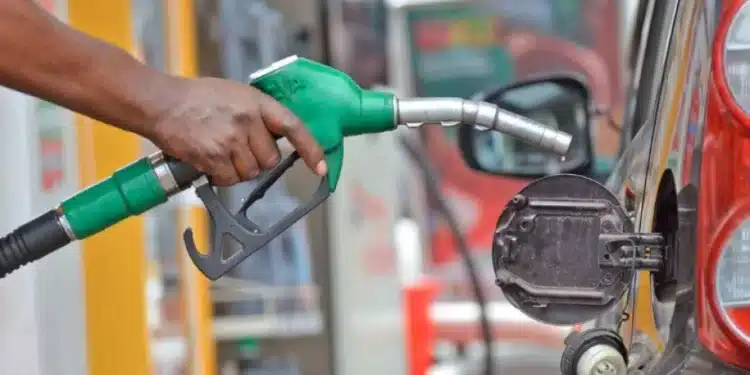

The Energy and Petroleum Regulatory Authority (EPRA) has announced the maximum retail prices for petroleum products, effective from March 15, 2025, to April 14, 2026.
In a review released on Saturday, March 14, EPRA stated that the prices of Super Petrol, Kerosene, and Diesel would remain unchanged.
Retail prices now stand at KShs. 178.28 for Super Petrol, KShs. 166.54 for Diesel, and KShs. 152.78 for Kerosene in Nairobi, effective at midnight for the next 30 days.
“In the period under review, the maximum allowed petroleum pump prices for Super Petrol, Diesel and Kerosene remain unchanged. In Nairobi, Super Petrol, Diesel and Kerosene now retail at Kshs.178.28, Kshs.166.54 and Kshs.152.78 effective midnight for the next 30 days,” EPRA announced.
In other cities, Super Petrol, Diesel, and Kerosene will retail at KSh178.16, KSh166.76, and KSh153.03 per litre in Kisumu, KSh175.00, KSh163.26, and KSh149.49 per litre in Mombasa, and KSh178.16, KSh166.77, and KSh153.03 per litre in Eldoret, respectively.
EPRA Stated that that the average landed cost of imported Super Petrol rose by 1.00%, increasing from US$576.34 per cubic metre in January 2026 to US$582.11 per cubic metre in February 2026.
Over the same period, the average landed cost of Diesel also increased by 8.46%, rising from US$586.80 per cubic metre to US$636.45 per cubic metre.
Meanwhile, Kerosene recorded a 6.79% increase, moving from US$598.82 per cubic metre in January to US$639.48 per cubic metre in February 2026.
EPRA Assures Kenyans on Supply of Oil
On March 5, EPRA Director General Daniel Kiptoo assured Kenyans that the country’s fuel supply remains stable, citing the government-to-government fuel import agreement between Kenya and Saudi Arabia as a safeguard.
He said that the government is closely monitoring developments in the global oil market, particularly concerns surrounding the possible disruption of shipments through the Strait of Hormuz, a strategic waterway that handles nearly 20 percent of the world’s oil supply.
However, he noted that EPRA and other stakeholders working with suppliers to explore alternative loading points and different ports should be in place, should disruptions occur at specific locations, meaning any closure or operational challenges along the Strait may not directly affect Kenya’s fuel imports.
The surety came after Cabinet Secretary for Energy and Petroleum, Opiyo Wandayi, also assured Kenyans that the country has sufficient petroleum supplies amid escalating tensions in the Middle East.
Also Read: Global Oil Price Rise: What Kenyans Should Expect Ahead of the EPRA Review
Global Oil Prices Continue to Rise
Global oil prices rose more than 2% on Friday, approaching $98 a barrel, as the ongoing blockade of the Strait of Hormuz continues to disrupt roughly 20% of the world’s daily oil shipments.
Brent crude rose by more than 9% in Asian trading to surpass $100 per barrel, while West Texas Intermediate (WTI) crude futures jumped toward $95 per barrel on Thursday, March 12, marking a second straight session of gains.
This comes despite an announcement by the International Energy Agency (IEA) that its 32 member countries would release 400 million barrels of oil from emergency reserves, marking the biggest coordinated drawdown since the agency was created in the aftermath of the 1973 oil embargo.
Also Read: EPRA Signals Potential Shift in Oil Loading Ports Amid Worsening Strait of Hormuz Tensions
The surge in prices comes as persistent concerns over the ongoing tensions involving Iran continue to overshadow efforts by major economies to stabilize the market through a coordinated release of oil reserves.
Iraq halted operations at its oil terminals after two oil tankers were targeted in Iraqi waters.
Iran has also reportedly told intermediaries that the United States must guarantee that neither it nor Israel will strike the country in the future for a ceasefire to be considered—conditions Washington is unlikely to accept.
Earlier, Iran warned that oil prices could surge to $200 per barrel as its attacks on ships intensify in the Strait of Hormuz, a critical waterway through which a significant portion of the world’s oil supply passes.