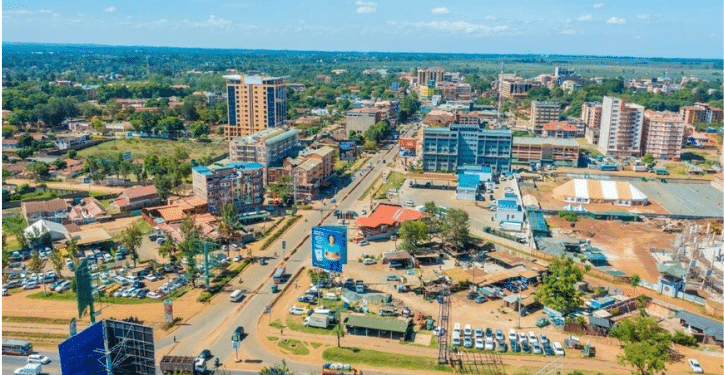
Thika town is on the verge of becoming the next City in Kenya as the Senate Standing Committee on Devolution and Intergovernmental Relations is considering an application for the municipality to be conferred city status under the Urban Areas and Cities Act, Cap 275.
In a public notice dated February 23, the Clerk of the Senate, Jeremiah Nyegenye, announced that a public hearing will be held on 6 March 2026 at 10:00 a.m. at Thika Municipal Chambers.
“The Committee on Devolution and Intergovernmental Relations now invites interested members of the public to submit any representations that they may have on the matter by way of memoranda,” read the notice in part.
Additionally, the notice indicated that the memoranda may be submitted to the Clerk of the Senate, P. O. Box 41842–00100, Nairobi, hand-delivered to the Office of the Clerk of the Senate, Main Parliament Buildings, Nairobi or emailed to [email protected] and copied to [email protected], to be received on or before Monday, 9th March, 2026 at 5:00 p.m.
How the Cost of Doing Business Will Change
If approved, Thika will become the sixth city in Kenya, joining Nairobi, Mombasa, Kisumu, Nakuru and Eldoret.
Thika, once a thriving hub for agro-processing and manufacturing, has long been seen as a key driver of economic growth within the Mt. Kenya region.
The push for city status is expected to attract more investment, boost infrastructure development, and expand job opportunities.
In Kenya, gaining city status elevates a town’s administrative standing but does not inherently alter core business taxes or national regulations. It often leads to indirect cost shifts through enhanced local governance and infrastructure demands.
The City Review report details that upgraded status attracts central government funding for roads, water, and utilities, which can lower logistics costs long-term by improving efficiency in trade hubs.
However, it cites that rapid urbanisation post-status often drives up land rates, utilities, and labour wages, for example, Meru town’s city bid sparked concerns over higher rents squeezing small traders.
“Rapid urbanisation post-status often drives up land rates, utilities, and labour wages,” it reads.
This prestige boosts investor appeal and tourism, fostering economies of scale that may reduce input costs via better supply chains, as seen in Nairobi’s dominance.
Also Read: Ruto Announces Plans to Confer City Status on County in Mt. Kenya Region
How Thika Rent Rates Will Be Affected
Rents in Kenyan towns gaining city status typically rise due to increased demand and prestige, though the effect varies by location and market forces.
City status attracts more businesses, investors, and residents, boosting demand for commercial and residential spaces, which pushes up rental rates.
According to the Cytonn Nairobi Metropolitan Area Commercial Office Report 2024, themed ‘Persisting Tenant’s Market’, limited new supply amid rapid urbanisation exacerbates shortages, allowing landlords to hike rates.
Nairobi’s CBD and Westlands exemplify this with rents at KSh 100-185/SQFT, far above towns. Local councils may also raise property rates to fund city-level services, indirectly inflating landlord charges by 2-5%.
“Local councils may also raise property rates to fund city-level services, indirectly inflating landlord charges by 2-5%,” the report noted.
Kiambu Governor Kimani Wamatangi, speaking in earlier events on the proposal, expressed strong support, noting that granting Thika special city status would be a major step toward restoring its former industrial prominence.
“Elevating Thika to city status will revive its lost industrial glory and position it as the country’s biggest employer in the manufacturing sector,” said Governor Wamatang,” he said.
Also Read: Ruto Announces Plan to Confer City Status to Western Kenya Town
Process of Changing to a City Status
The process for a municipality to change to city status follows several legal and administrative steps under the Urban Areas and Cities Act:
- The County Government ensured that Thika Municipality met all the required criteria for city status, including population, infrastructure, and revenue thresholds.
- The Board of the municipality submitted an application to the County Executive Committee for consideration of city status.
- The County Executive Committee reviewed the application and constituted a committee to assess the municipality’s readiness and provide recommendations.
- The recommendations were forwarded to the County Assembly for review and approval.
- Once approved by the County Assembly, the application was sent to the Senate for discussion and resolution.
- The Senate is currently reviewing the application and inviting public submissions as part of its consideration.
- If the Senate passes the resolution, it will be forwarded to the President for final approval.
- The President may then confer city status officially, following all legal and procedural requirements.
Follow our WhatsApp Channel and X Account for real-time news updates.