Comparing tokenized stocks vs traditional shares starts with a practical question: what rights come with each investment? For readers in Kenya considering overseas equities, the answer depends on the product’s structure and applicable law.
Traditional shares offer a conventional ownership route, while tokenized products can take several forms. Stock-linked futures provide price exposure without share ownership.
How do tokenized shares work?
A tokenized security is a financial instrument represented by a crypto asset recorded on a blockchain or similar distributed ledger. The technology alone does not tell a buyer what rights come with the holding.
Investor.gov, the investor education website of the U.S. Securities and Exchange Commission (SEC), describes several tokenization models.
An issuer-sponsored tokenized share can carry the same ownership, voting and dividend rights as a traditional share of the same class. That comparison depends on the share class and legal structure.
In the custodial model described by Investor.gov, the token represents an indirect interest in the underlying security held through an intermediary, such as a broker.
This arrangement can preserve the rights and benefits of holding conventional shares through an intermediary. For any specific product, check how those rights are provided under its terms and applicable law.
A synthetic token may provide exposure linked to a security without giving its holder rights against the company that issued the referenced security. These distinctions matter when a reader expects a vote, a dividend or a direct ownership relationship.
Tokenized shares comparison: what does the holder receive?
| Instrument | What the holder receives | Rights to examine |
| Traditional share | A share in a company | Voting and dividend rights associated with the share class |
| Issuer-sponsored tokenized share | A share issued in tokenized form | Whether it carries the same ownership, voting and dividend rights as a traditional share of the same class |
| Custodial tokenized security | An indirect interest in an underlying security held through an intermediary | How ownership, voting and dividends are handled under the legal arrangement |
| Synthetic token | Exposure linked to a referenced security | Claims under the product terms, without rights against the referenced security’s issuer |
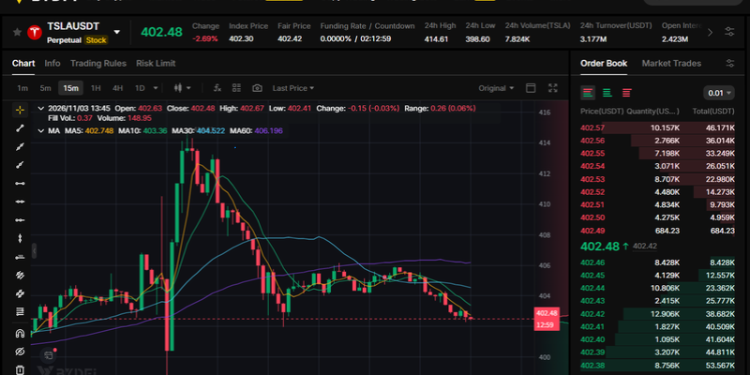
| BYDFi Stock Futures | A USDT-margined perpetual futures position linked to a U.S.-listed stock | Contract terms; the position does not confer ownership of the underlying share |
A familiar company name in a product description does not answer what the buyer actually holds. To understand tokenized stock ownership rights, start with the product documents and identify which model applies. Then check the rights attached to that particular instrument.
For traditional shareholder rights, look at the relevant share class too. If voting or dividends are central to your decision, check how the holding is described and how those rights apply before comparing it with an alternative.
Tokenized stock settlement and trading hours
Settlement concerns completion of a transaction, while trading hours describe when a venue allows trading. Neither can be assumed from the word “tokenized” alone.
As a U.S. market example, most applicable securities transactions, including stock transactions, moved to a T+1 settlement cycle on May 28, 2024, according to Investor.gov. T+1 means one business day after the trade.
This is not a universal timetable: investors comparing shares in other markets should check the relevant market’s settlement rules.
When examining a tokenized product, look for its own settlement process and timing. A blockchain record does not, by itself, establish that every transaction settles immediately.
Check what the product terms say about transferring or redeeming the token, since those details shape what the holder can do after a purchase.
Check tokenized stock trading hours with the venue offering the product. Find out when orders can be placed and executed, rather than assuming that a digital token can always be traded.
Separately, check the schedule for the traditional share you want to compare; the two instruments need not follow the same timetable.
Where do BYDFi Stock Futures fit?
BYDFi Stock Futures are USDT-margined perpetual futures linked to U.S.-listed stocks. A futures position provides exposure to stock-price movements without ownership of the underlying share. It is a separate product category from issuer-sponsored tokenized shares and custodial tokenized securities.
According to BYDFi’s product documentation, these contracts support 24-hour weekday trading. During market closures, users can cancel unfilled orders and add margin, but cannot place new orders or close existing positions. That schedule describes BYDFi Stock Futures specifically.
The contracts support isolated margin only. Leverage magnifies both gains and losses, and a position can be liquidated if its margin falls below the required maintenance level. Isolated margin does not eliminate that risk.
BYDFi also initiates early settlement of open positions in the event of a stock split, reverse split or dividend adjustment. That early settlement should not be confused with receiving a dividend as a shareholder.
What should you check before choosing?
Use the same checks for each instrument on your shortlist:
- Identify the instrument. Determine whether it is a traditional share, an issuer-sponsored tokenized share, a custodial interest, a synthetic token or a futures contract. Note the issuer and any intermediary involved.
- Read the rights. Check the share class where relevant, and look for the terms covering ownership, voting and dividends. For a custodial or synthetic product, establish what claim the holder has and against whom.
- Check access and mechanics. Confirm whether the product is available to residents of your country, then review its trading schedule and settlement, transfer and redemption terms. Keep trading availability separate from the time and process for completing a transaction.
- Match the choice to your goal. If shareholder rights are the priority, compare the specific rights offered by traditional shares and tokenized securities, including any intermediary arrangements. If stock-price exposure through a futures contract is the goal, examine the contract’s conditions and risks.
Follow our WhatsApp Channel and X Account for real-time news updates and subscribe to our YouTube Channel for in-depth interviews.