Wednesday, June 3, 2026
  • News
    • Latest News
    • Breaking News
    • Fact Check
    • Investigations
    • Explainers
  • Politics
    • Global Politics
    • Elections
    • Government & Policy
    • Diplomacy
    • Conflicts & Security
    • Political Analysis
  • Business
    • Global Economy
    • Markets
    • Technology
    • Startups
    • Energy
    • Finance
  • World News
    • Americas
    • Asia
    • Asia Pacific
    • Africa
    • Europe
    • Middle East
  • Africa
    • Central Africa
    • East Africa
    • West Africa
    • Southern Africa
  • Health
    • Global Health
    • Public Health
    • Health Policy
    • Medical Research
    • Diseases & Conditions
    • Mental Health
    • Nutrition
    • Climate & Health
    • Health Explainers
  • Sports
    • Athletics
    • Basketball
    • Boxing
    • Cricket
    • Football
    • Formula 1
    • Golf
    • Rugby
  • Weather
    • Climate Business
    • Climate Change
    • Climate Solutions
    • Living Green
  • Culture
    • Arts
    • Film & TV
    • Food
    • Music
    • Lifestyle
    • Travel
  • Opinion
    • Editorials
    • Letters
  • Behind The Brand
REGISTER
LOGIN
No Result
View All Result
The Kenya Times
  • News
    • Latest News
    • Breaking News
    • Fact Check
    • Investigations
    • Explainers
  • Politics
    • Global Politics
    • Elections
    • Government & Policy
    • Diplomacy
    • Conflicts & Security
    • Political Analysis
  • Business
    • Global Economy
    • Markets
    • Technology
    • Startups
    • Energy
    • Finance
  • World News
    • Americas
    • Asia
    • Asia Pacific
    • Africa
    • Europe
    • Middle East
  • Africa
    • Central Africa
    • East Africa
    • West Africa
    • Southern Africa
  • Health
    • Global Health
    • Public Health
    • Health Policy
    • Medical Research
    • Diseases & Conditions
    • Mental Health
    • Nutrition
    • Climate & Health
    • Health Explainers
  • Sports
    • Athletics
    • Basketball
    • Boxing
    • Cricket
    • Football
    • Formula 1
    • Golf
    • Rugby
  • Weather
    • Climate Business
    • Climate Change
    • Climate Solutions
    • Living Green
  • Culture
    • Arts
    • Film & TV
    • Food
    • Music
    • Lifestyle
    • Travel
  • Opinion
    • Editorials
    • Letters
  • Behind The Brand
  • News
    • Latest News
    • Breaking News
    • Fact Check
    • Investigations
    • Explainers
  • Politics
    • Global Politics
    • Elections
    • Government & Policy
    • Diplomacy
    • Conflicts & Security
    • Political Analysis
  • Business
    • Global Economy
    • Markets
    • Technology
    • Startups
    • Energy
    • Finance
  • World News
    • Americas
    • Asia
    • Asia Pacific
    • Africa
    • Europe
    • Middle East
  • Africa
    • Central Africa
    • East Africa
    • West Africa
    • Southern Africa
  • Health
    • Global Health
    • Public Health
    • Health Policy
    • Medical Research
    • Diseases & Conditions
    • Mental Health
    • Nutrition
    • Climate & Health
    • Health Explainers
  • Sports
    • Athletics
    • Basketball
    • Boxing
    • Cricket
    • Football
    • Formula 1
    • Golf
    • Rugby
  • Weather
    • Climate Business
    • Climate Change
    • Climate Solutions
    • Living Green
  • Culture
    • Arts
    • Film & TV
    • Food
    • Music
    • Lifestyle
    • Travel
  • Opinion
    • Editorials
    • Letters
  • Behind The Brand
No Result
View All Result
The Kenya Times ~ Trending, Breaking News and Videos
No Result
View All Result
ADVERTISEMENT

Strait of Hormuz: Why the US and Iran Are Sailing in Very Different Legal Waters

The ConversationbyThe Conversation
April 15, 2026
Reading Time: 8 mins read
Iranian Officials Have Yet To Make An Official Response And Clarification On The Fabrication Of The Launching Of Missile Attack On Us Navy Vessels.

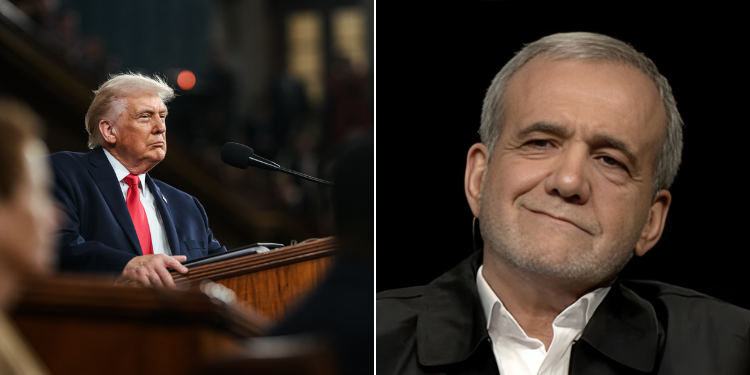
A collage of US President Donald Trump and President Masoud Pezeshkian of Iran. PHOTOS-White House and Masoud Pezeshkian (X)

FacebookTwitterLinkedInRedditWhatsApp
Advertisement

The Strait of Hormuz exists in the eye of the beholder.

While everyone agrees that, geographically speaking, it is a strait – a narrow sea passage connecting two places that ships want to go – its political and legal status is rather more complicated.

The United States and Iran both eye the strait – a choke point through which 20% of the world’s oil passes – very differently. Washington sees the Strait of Hormuz as exclusively an international waterway, whereas Tehran sees it as part of its territorial waters.

It follows that Iran’s toll-charging of ships is seen by the U.S. as illegal. Similarly, U.S. President Donald Trump’s blockade of the passage is a “grave violation” of sovereignty to Iran.

As an expert in the law of the sea, I know part of the problem is that the U.S. and Iran are living in two different worlds when it comes to the international laws governing the strait. Further complicating matters, both are in a different legal universe than most of the rest of the world.

The law of the sea

The “law of the sea” is a network of international laws, customs, and agreements that set out the foundation for rights of access and control in the ocean. The framework sits apart from the laws of warfare, which are also relevant to the Persian Gulf situation.

The United Nations Convention on the Law of the Sea, or UNCLOS, is a major plank of the law of the sea. Completed in 1982 and in force since 1994, it aims to create a stable set of zones and places – like international straits – where everyone agrees on who can do what. It has been ratified by 171 countries and the European Union, but not Iran or the United States. Iran has signed it but has yet to ratify; the U.S. has done neither.

This means that the rules which almost every country in the world has consented to can’t serve as a basis of agreement over how the U.S. and Iran should govern their actions in the strait during the current war.

The view from Iran

Both Iran and the U.S. agree that under the law of the sea, the Strait of Hormuz is an international strait, but not on what kind of international strait it is. Moreover, they disagree on the relevant laws that exist, and how they apply.

For Iran, the Strait of Hormuz is an international strait as set out under international law predating UNCLOS – notably the International Court of Justice’s ruling in the 1949 Corfu Channel case and the 1958 Territorial Seas Convention.

These older standards state that foreign ships have a right of “innocent passage” through international straits. Put in other terms, this means that if a ship is simply passing through, without doing anything else and without harming the security of the coastal countries, it must be allowed passage.

This gives Iran – and Oman, the strait’s other bordering country – power to make and enforce some rules over passage, such as rules for safety and the environment. They also have wide discretion to decide if passage is “non-innocent” and therefore not allowed. But it does not give them the right to impede innocent passage.

Contrary to the older standard, however, Tehran claims the right to “suspend” passage through its half of the strait, citing the waters as its territorial sea. This is a violation of the 1958 Territorial Seas Convention that Iran relies on for legal support, which says that when a territorial sea is also an international strait, innocent passage cannot be suspended.

The US interpretation of Strait of Hormuz

For the U.S., the Strait of Hormuz is an international strait requiring “transit passage,” as per UNCLOS. Although the United States is not a member of UNCLOS, it argues that the agreement’s updated concept of an “international strait” should apply.

Understanding a waterway as the newer type of “international strait,” which requires transit passage, shifts the balance against a coastal country’s control and toward free navigation.

Under this standard, countries bordering straits – like Iran and Oman in the case of Hormuz – must also allow overflight and submarines below the surface. Passage must be allowed so long as it is “continuous and expeditious.”

The U.S. has forcefully asserted this position at sea through regular “Freedom of Navigation” patrols through the Strait of Hormuz and other straits around the world. The patrols are a visible rejection of claims over the ocean that the U.S. deems illegal or excessive.

The basic U.S. argument is supported by some leading legal scholars, such as James Kraska, a professor of international maritime law at the U.S. Naval War College, who decries the Iranian position as “lawfare” and argues that Iran must abide by the compromises made in UNCLOS.

A ‘persistent objector’

But the U.S. is a global outlier here, and one of only a handful of countries – alongside the United Kingdom, France, Australia, Thailand and Papua New Guinea – which argue that “transit passage” is required by custom.

Custom, in this sense, is established if a practice at sea is seen as consistent and is backed by wide agreement over its legality. If something is seen as customary law, it applies to everyone. The only way to prevent a custom from applying to you is through the “persistent objection rule,” which gives a country an exemption to newly emerging standards if it has shown itself to be consistently against it.

Legal scholars are split on whether transit passage is customary law – although law of the sea specialists tend to say it is not.

Tehran argues that even if transit passage were customary international law, Iran is a “persistent objector,” and therefore, the rule doesn’t apply to them.

And it is true that Iran’s objection has been consistent. Both Iran and Oman argued in favor of innocent passage, and against transit passage, at the UNCLOS negotiations.

Iran reaffirmed its perspective upon signing UNCLOS in 1982. Tehran argues that because transit passage is tied up in the compromises made by UNCLOS, only countries that ratify the treaty can claim the right to transit passage – and neither the U.S. nor Iran has ratified it.

Navigating troubled waters

The complex military situation and economic disruption are only part of the story of the Strait of Hormuz.

What lies beneath is a complicated legal situation. Not only do the U.S. and Iran disagree about the legal status of the strait, but the countries that flag oil tankers – and which are therefore responsible for them – must also navigate their own commitments and perspectives under the law of the sea.

Every nation wants to avoid a legal precedent that is contrary to its long-term interests. But for international law to function – to reduce conflict and enable trade – what is needed is an agreement about what rules exist, and a shared commitment to abide by them.

Only that would achieve a stable post-war status for the Strait of Hormuz. How we get there, however, requires navigating some very tricky waters.The Conversation

Elizabeth Mendenhall, Associate Professor of Marine Affairs, University of Rhode Island

This article is republished from The Conversation under a Creative Commons license. Read the original article.

Tags: Donald TrumpStrait of Hormuz
The Conversation

The Conversation

The Conversation is an independent news organization that publishes evidence-based articles written by experts to help readers understand diverse topics. We cover a wide range of areas including arts, culture, education, health, politics, science, and more¹. Their content is characterized by in-depth analysis, research, news, and ideas from leading academics and researchers. The Conversation aims to provide academic rigor with journalistic flair.

Related Posts

A Collage Of A Tortoise And The Jackson’s Three-Horned Chameleon At The Wild Photo/Arcadia Safaris

List of Most Exported Reptiles in Kenya

May 15, 2026
A Family Celebrating Christmas.

Family Time: How to Survive – and Even Thrive – Over the Holidays

December 25, 2025
Truphena Muthoni

Truphena Muthoni Responds to Speculation Over Status of Guinness World Record Attempt

December 18, 2025
Uproar As Lewis Pugh Plans Mount Kenya Glacier Swim

Uproar as UNEP Patron Lewis Pugh Plans to Swim in Mt Kenya Glacier Before UNEA-7 Address

December 8, 2025

Leave a Reply Cancel reply

Your email address will not be published. Required fields are marked *

ADVERTISEMENT

The Kenya Times Facebook

LATEST ARTICLES

  • Trump’s DOJ Scraps $1.776B Anti-weaponization Fund
  • CBS News Pays $2.5 Million to Inexperienced Producer to Lead 60 Minutes
  • Neto Agostinho Profile: Educational Background, Career, Political Journey and Net Worth
  • Trump Admin Says There Are Many Places to Send Americans After Kenya Blocks Ebola Facility
  • Jill Biden Reveals What “Could Have Killed” Biden While He Was in Office
  • Trump Admits: ‘No One Knows Where the Iran Conversations Lead’
  • Trump AG Todd Blanche Says Trump Would Have Gone to Prison if He Lost 2024 Election
  • Raila Odinga Junior Unveils His Late Father’s Restored Hummer
  • COFEK Turns Up Pressure on Commission in Bid to Remove Education PS Julius Bitok
  • UoN the Only Kenyan University Ranked Among the World’s Top 2,000 Universities
  • Details of US Travel Advisory to Its Citizens Amid Controversy Over Ebola
  • Marco Rubio Confesses Secret on Iran Talks as He Hints at Rare Breakthrough
  • From Seminary Expulsion to the Cabinet: The Story of Rt. Major General Kahinda Otafiire
  • High Court Rejects Bia Tosha Bid to Halt KSh297 Billion EABL Stake Sale to Asahi Group
  • Who Is Bill Pulte? Meet the 38-Year-Old Trump Pick Replacing Tulsi Gabbard as Acting DNI
ADVERTISEMENT

Company

About Us

Our Authors

Our Experts

Social Media

Policies

Privacy Policy

House Rules

Standards and Policies

Terms and Conditions

Subscription

My Account

Contact Us

Contact Us

Join Our Team

Advertise With Us

© Copyright 2026 | The Kenya Times | All Rights Reserved

Welcome Back!

Sign In with Facebook
Sign In with Google
Sign In with Linked In
OR

Login to your account below

Forgotten Password? Sign Up

Create New Account!

Sign Up with Facebook
Sign Up with Google
Sign Up with Linked In
OR

Fill the forms below to register

All fields are required. Log In

Retrieve your password

Please enter your username or email address to reset your password.

Log In
Your Privacy and Cookies
We use cookies on our website to give you the most relevant experience by remembering your preferences and repeat visits. By clicking “Accept”, you consent to the use of ALL the cookies.
Do not sell my personal information.
Cookie settingsACCEPT
Privacy & Cookies Policy

Privacy Overview

This website uses cookies to improve your experience while you navigate through the website. Out of these cookies, the cookies that are categorized as necessary are stored on your browser as they are essential for the working of basic functionalities of the website. We also use third-party cookies that help us analyze and understand how you use this website. These cookies will be stored in your browser only with your consent. You also have the option to opt-out of these cookies. But opting out of some of these cookies may have an effect on your browsing experience.
Necessary
Always Enabled
Necessary cookies are absolutely essential for the website to function properly. This category only includes cookies that ensures basic functionalities and security features of the website. These cookies do not store any personal information.
Functional
Functional cookies help to perform certain functionalities like sharing the content of the website on social media platforms, collect feedbacks, and other third-party features.
Performance
Performance cookies are used to understand and analyze the key performance indexes of the website which helps in delivering a better user experience for the visitors.
Analytics
Analytical cookies are used to understand how visitors interact with the website. These cookies help provide information on metrics the number of visitors, bounce rate, traffic source, etc.
Advertisement
Advertisement cookies are used to provide visitors with relevant ads and marketing campaigns. These cookies track visitors across websites and collect information to provide customized ads.
Others
Other uncategorized cookies are those that are being analyzed and have not been classified into a category as yet.
SAVE & ACCEPT
LOGIN | REGISTER
  • Login
  • Sign Up
  • Cart
No Result
View All Result
  • News
    • Latest News
    • Breaking News
    • Investigations
    • Explainers
    • Fact Check
  • Politics
    • Global Politics
    • Conflicts & Security
    • Elections
    • Diplomacy
    • Government & Policy
    • Political Analysis
  • Business
    • Global Economy
    • Markets
    • Technology
    • Startups
    • Energy
    • Finance
  • World News
    • Americas
    • Asia
    • Asia Pacific
    • Africa
    • Europe
    • Middle East
  • Africa
    • East Africa
    • West Africa
    • Southern Africa
    • Central Africa
  • Health
    • Global Health
    • Public Health
    • Health Policy
    • Medical Research
    • Diseases & Conditions
    • Mental Health
    • Nutrition
    • Climate & Health
    • Health Explainers
  • Sports
    • Athletics
    • Basketball
    • Boxing
    • Cricket
    • Football
    • Formula 1
    • Golf
    • Rugby
  • Weather
    • Climate Business
    • Climate Change
    • Climate Solutions
    • Living Green
  • Culture
    • Arts
    • Film & TV
    • Food
    • Lifestyle
    • Music
    • Travel
  • Opinion
    • Editorials
    • Letters
  • Behind The Brand
  • Contact Us

Not enough quota to unlock this post
Unlock left : 0
Are you sure want to cancel subscription?