
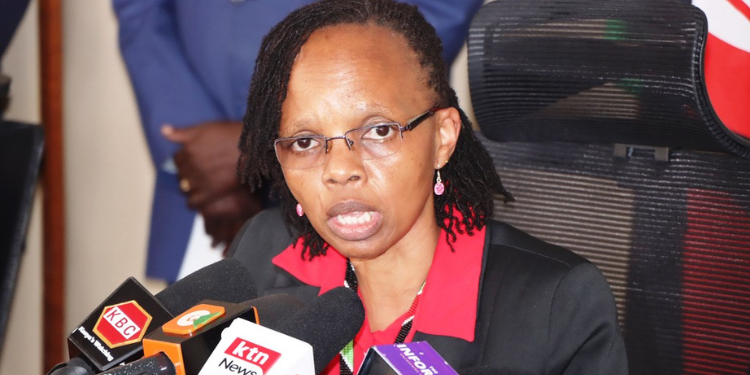
The Kenya Universities and Colleges Central Placement Service (KUCCPS) is considering revising the long‑standing C+ minimum university entry requirement, a move driven by declining qualification numbers and shifting priorities within the country’s education system.
According to KUCCPS CEO Agnes Wahome, discussions around the relevance of the C+ threshold are ongoing as officials reassess how the current grading structure aligns with the competency‑based curriculum and Kenya’s evolving labour needs.
Speaking during an interview on January 27, Wahome said the C+ entry grade has been glorified for decades, creating the false impression that learners who do not meet it have limited chances.
“This is a conversation that, in terms of measuring performance based on those that go to university, is a conversation that needs to start dying off as we get into CBC, because I think we have overemphasized the grades,” Wahome stated.
KUCCPS on C+ University Entry Grade
KUCCPS CEO Agnes Wahome stressed that thousands of students who fall below the C+ threshold still progress to higher learning institutions through alternative routes, starting with certificate programmes, advancing to diploma studies, and eventually securing university admission.
She argued that these pathways must be recognised as legitimate and essential components of the education system rather than overlooked parts of national performance.
“Those who don’t get a C+ and they take another pathway in life, they start off with a certificate, they go to a diploma, and they still end up in the university. But nobody talks about them.”
Out of 993,000 students expected in the 2025 cohort, only around 270,000 will qualify for public university placement, leaving more than 700,000 outside the public university system.
Also Read: KUCCPS Lists 30 Universities Ineligible for Govt Scholarships
Wahome stated that KUCCPS is happy that not everyone who qualified for placement in degree programs applied for admission in universities.
This trend, Wahome explained, means Kenyans are starting to realize that success is not solely defined by university admission alone.
She added that Kenya lacks centralized national data to accurately track student pathways, especially those outside the traditional KCSE-to-university route.
New Format to be Introduced
To fix the longstanding data gaps in the education sector, the Ministry of Education and KUCCPS are developing an integrated national education information system designed to unify records from primary schools, TVET institutions, and universities.
The goal is to create a single platform capable of tracking every learner throughout their academic journey and ensuring that all institutions feed consistent data into one central source.
Once complete, the system will allow the country to account for all students, including those who follow alternative pathways not currently captured in existing databases.
Also Read: TSC Swings Into Action After Teacher was Gunned Down by Terrorists
Wahome noted that Kenya cannot effectively plan for workforce needs without understanding learner distribution after KCSE.
She highlighted that the country lacks reliable data on critical trades needed for national development, including those required for large‑scale projects such as affordable housing, manufacturing, and infrastructure.
The lack of centralised information on training output and labour demand limits the government’s ability to establish the number of technicians, artisans, and professionals across key sectors.
This has forced some authorities to rely on foreign labour to fill shortages—an outcome Kenya aims to avoid by improving its data systems.
She also explained that Kenya is studying international models such as Singapore’s long‑term education reforms, which aligned learning pathways with national economic priorities.
The objective is to create an education system that matches learners’ abilities and interests with Kenya’s economic needs while supporting diverse routes into higher learning and employment.
Follow our WhatsApp Channel and X Account for real-time news updates.


![Tsc Jss Teacher Qualifications 2026: Kcse Grades, Degrees And Subjects Required [Full List]](https://cdn.thekenyatimes.com/2026/07/Stakeholders-TSC-X-2026-06-09-36.png "Tsc Addresses Circular On Deployment Of Degree And Diploma Teachers To Junior School")