Education Cabinet Secretary Julius Ogamba has announced adjustments to the 2027 school calendar following weeks of student unrest in senior schools.
Speaking to the press on June 6th, 2026, at Jogoo House, Ogamba directed that the second term be shortened through an early mid-term break and a series of administrative interventions to stabilize learning institutions across the country.
“Starting next academic year, the Ministry shall rationalize the school calendar to ensure balanced terms across the school year,” said Ogamba
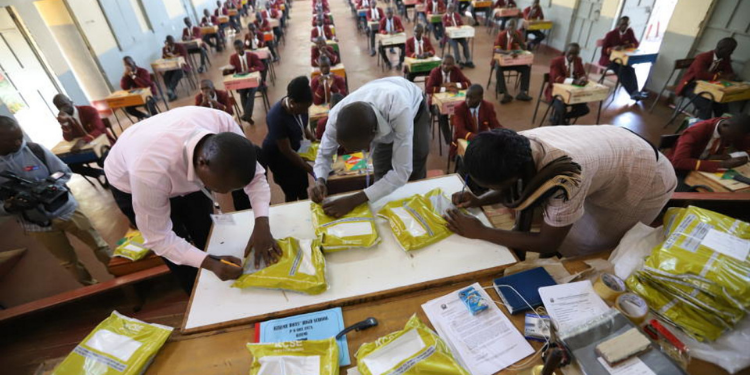
The directives come after widespread strikes that have led to school closures, property destruction, and growing concern among education stakeholders. The situation has rapidly spread, affecting institutions nationwide and forcing urgent government intervention.
To address the crisis, the Ministry announced the formation of a multi-stakeholder team to investigate the root causes and recommend long-term solutions.
Earlier, on 9th June 2026, President William Ruto reshuffled the Principal Secretaries for Basic Education and the State Department of Tourism.
Also Read: Ruto Transfers Julius Bitok in Fresh Govt Reshuffle
Early Mid-Term Break and Calendar Adjustment
In his statement, Ogamba confirmed that the mid-term break for Term Two of the 2026 school year will proceed as scheduled from 24th to 28th June 2026. However, the Ministry’s broader approach signals a practical shortening of the term’s effective learning period, as schools are also directed to implement immediate interventions to manage unrest and prevent further disruption.
“To establish and address underlying causes of this perennial challenge of student unrest, we shall be forming a multi- stakeholder team to review the causes of unrest and make recommendations on strategies for stemming the challenge. The mid-term break for the Second Term of the 2026 School Year will take place as scheduled, from 24th June 2026 to 28th June 2026,” the statement read.
The CS indicated that the move is part of a wider effort to de-escalate tensions in affected institutions while giving parents and guardians an opportunity to engage more closely with learners. He urged families to use the break to provide guidance and support, while schools intensify counseling and grievance-handling mechanisms to address underlying student concerns.
Schools Affected and Government Assessment
According to Ogamba, at least 204 senior schools have been affected by unrest, most of them boarding institutions. However, the government emphasized that the scale of disruption remains relatively limited compared to the national education system.
The Ministry further reported that learners in 59 affected schools have already returned to class, with more expected to resume learning as conditions stabilize. Ogamba also clarified that basic education from Grades 1 to 9 has not been significantly disrupted, noting that the unrest is largely concentrated in senior boarding schools.
The government has linked the disturbances to a mix of factors, including leadership challenges within institutions, learner anxiety related to examinations, poor boarding conditions, substance abuse, and peer influence. The Ministry warned that while grievances exist, they must be addressed through lawful and structured channels.
Also Read: From Assistant Teacher to PS Education: Meet the Man Taking Over from Bitok Amid Student Unrest
Multi-stakeholder response and safety reforms
To address the recurring nature of school unrest, the government has announced the formation of a multi-stakeholder team to investigate the root causes and recommend long-term reforms including:
- A multi-stakeholder team will be formed to review the causes of student unrest and recommend strategies to address the challenge.
- Parents and guardians are urged to spend time with their children during the break, offering guidance and support, and to properly channel any grievances or concerns through schools and relevant authorities.
- Schools are required to urgently convene consultative Parents Association meetings to review school conditions and learner welfare.
- Schools must strengthen safety measures, address learner concerns, intensify guidance and counseling programs, and improve grievance-handling mechanisms.
- County and Sub-County Education Offices will conduct targeted safety assessments and audits, and closely monitor institutions considered at risk.
- Ministry will rationalize the school calendar to ensure a more balanced distribution of academic terms starting the next academic year.
Follow our WhatsApp Channel and X Account for real-time news updates.