
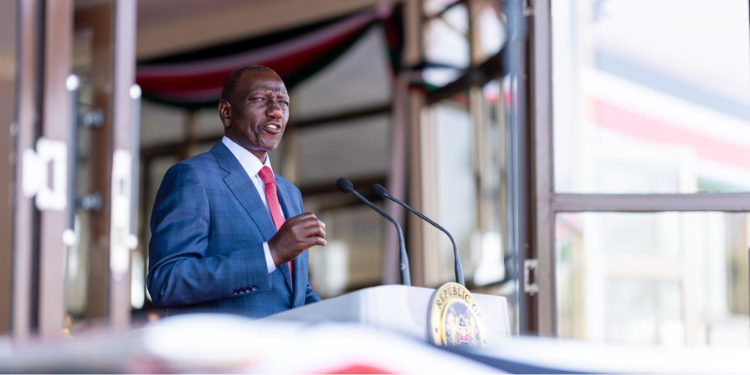
President William Ruto has issued a new directive on the way students pursuing technical and vocational courses are assessed, calling for greater emphasis on the skills they acquire during training.
Speaking during a National Industrial Training Authority (NITA) graduation ceremony on Thursday, October 8, Ruto said Kenya had changed the examination approach used in technical training to ensure students are assessed according to the skills relevant to their chosen careers.
He said the previous system could result in technically skilled trainees being considered failures because of their performance in subjects that were not directly related to their areas of specialization.
Ruto Says TVET Students Should Not Fail Exams Because of English
Ruto used the case of a trainee pursuing carpentry who performs well in the practical subject but fails overall after scoring poorly in English.
“Somebody has come to study to be a carpenter. Then you give him an examination, and he gets an A in carpentry; he gets a D in English. When it comes to the total, he has failed,” Ruto said.
He questioned whether language proficiency should determine the success of a trainee whose main responsibility is to produce quality work.
“Now I ask you, is there making a bed or a chair in English?” he said.
Ruto said the examination approach should change to give practical demonstrations a greater role in determining whether a trainee had acquired the required skills.
He explained that a carpentry student should be given timber and the tools used in the trade and asked to produce an item as part of the assessment.
“For this examination of carpentry, you are given wood, you are given a hammer, you are given a plane, you are given a nail, make something,” Ruto said.
He said the finished product would then be assessed on the quality of the work, including whether the joints were properly made and whether the furniture was correctly assembled.
Also Read: Full List of Registered Public and Private TVET Institutions in Kenya
Focus on Practical Skills
Ruto said the language used by a trainee should not determine whether they demonstrate competence in a practical trade, arguing that the focus should remain on the skill being assessed.
The President said the same principle should apply to other technical courses, including electrical training, where students could demonstrate their ability by working with wires, sockets and other equipment.
He said technically skilled trainees should not be regarded as failures simply because they struggle with English or Kiswahili.
“You find somebody is a very good electrician. But because he doesn’t understand Kiswahili or English, that is not his skill; you say he has failed the examination. He has not failed the examination; he has failed English,” he said.
Ruto said the approach was part of wider efforts to recognize that young Kenyans have different talents and abilities.
He pointed to the Competency-Based Education system, saying learners should be supported according to their strengths and career pathways.
“We have young people; they are gifted differently,” Ruto said.
He said some learners were gifted in science, mathematics and technology, while others had strengths in engineering, arts, sports and other areas.
Also Read: Ruto Rallies Kenya Behind Raila’s Statesmanship and Legacy in Full Bondo Address
Ruto also said Kenya had established a separate examining body for technical and vocational education to assess skills.
“We now have an examining body, independent, that examines skills,” he said.
Changing Perceptions of Technical Careers
The President said the reforms are also intended to change the perception that technical careers are less important than university education.
He recalled that when he started attending technical training college graduation ceremonies, university graduations were generally considered more prestigious.
Ruto said that attitude had contributed to shortages of skilled workers in areas such as plumbing and electrical work.
He stressed that skilled workers play an important role in everyday life regardless of their academic qualifications, noting that even highly educated professionals depend on plumbers, electricians and other technicians when they need specialized work done.
“Every skill matters,” Ruto said.
He said the government would continue supporting technical training and certification to give young people formal recognition for the skills they acquire.
Ruto added that issuing certificates to skilled trainees would also help change public attitudes towards technical careers.
Follow our WhatsApp Channel and X Account for real-time news updates.