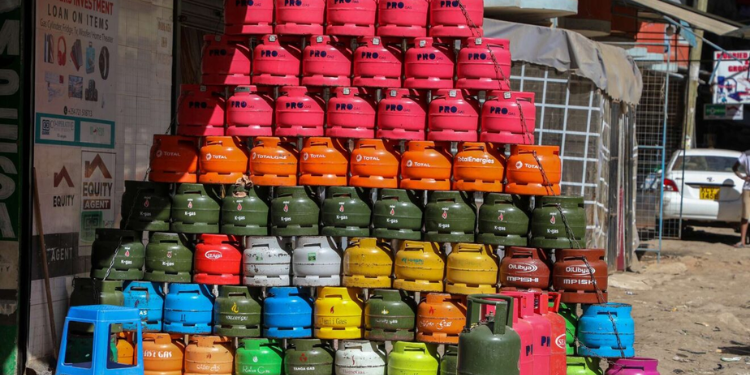
A new report has revealed why demand for cooking gas has increased in Kenya, with the use of liquefied petroleum gas (LPG) continuing to grow as the country promotes cleaner cooking solutions and expands infrastructure for the fuel.
The Energy & Petroleum Statistics Report 2026 by the Energy and Petroleum Regulatory Authority (EPRA) shows that LPG demand increased by 14.72 percent during the 2025/26 financial year to 475,943 metric tonnes.
The report covers the performance of Kenya’s electricity, petroleum and renewable energy subsectors during the financial year ended June 30, 2026.
Per capita LPG consumption also increased during the period, rising from 7.9 kilogrammes to 8.9 kilogrammes.
“The continued growth in LPG consumption has been supported by the expansion of importation, storage, and distribution infrastructure, improved product availability, and government policy interventions aimed at promoting clean cooking solutions,”the EPRA report states.
LPG Consumption Continues to Grow
EPRA’s statistics show that LPG demand has continued to rise over the past several years.
During the 2024/25 financial year, LPG demand increased by 15 per cent to 414,861 metric tonnes, up from 360,594 metric tonnes in 2023/24.
Per capita consumption also rose from 7.0 kilogrammes to 7.9 kilogrammes during that period.
The increase recorded in 2025/26 means that demand rose further to 475,943 metric tonnes, while per capita consumption crossed the eight-kilogramme mark.
EPRA’s findings come as Kenya continues to implement measures to increase access to cleaner cooking fuels.
Also Read: Electricity and Water Tariffs Revised as New Charges Take Effect
Clean Cooking Drives LPG Uptake
The report links the continued growth in LPG demand to efforts to promote clean cooking and the implementation of the Government-led LPG Growth Strategy, which aims the increase LPG adoption among households and public institutions while improving access to the fuel.
“Demand is expected to continue growing with the implementation of the National LPG Growth Strategy, which seeks to accelerate LPG adoption through initiatives such as promoting LPG use in public learning institutions, encouraging LPG reticulation in residential developments, and implementing targeted cylinder distribution programmes for low-income households,” said EPRA.
The trend was also evident in EPRA’s earlier biannual statistics report for the 2025/26 financial year. That report recorded a 14.59 per cent increase in LPG demand to 251,425 metric tonnes during the first half of the financial year, attributing the growth largely to sustained clean-cooking promotion initiatives and the Government-led LPG growth strategy.
The full-year figures show that the increase continued during the second half of the financial year and the increase in LPG consumption has also been accompanied by developments in the infrastructure used to receive and store the fuel.
EPRA identified the Taifa Gas Terminal at the Dongo Kundu Special Economic Zone and the Asharami Synergy storage facility at Kenya Petroleum Refineries Limited (KPRL) among the new LPG import and receiving facilities.
According to the report, the facilities are expected to increase Kenya’s LPG handling capacity by 60,000 metric tonnes.
The additional capacity is expected to support the implementation of the Open Tender System (OTS) for LPG, increase competition in the LPG market, and improve supply reliability.
Also Read: New 30,000 Tonne LPG Terminal Nears Completion, What It Could Mean for Cooking Gas Prices in Kenya
How LPG Reaches the Kenyan Market
Kenya’s LPG market is also heavily dependent on imports, with the EPRA’s statistics showing that LPG is primarily imported through the country’s coastal entry points, with Mombasa and Kilifi among the routes used to bring the fuel into the country.
The regulator has continued to monitor LPG imports, storage, distribution and consumption as part of its oversight of the petroleum sector, and the expansion of receiving and storage infrastructure is consequently expected to provide additional capacity as demand for LPG grows.
The increase in LPG demand formed part of broader growth in petroleum consumption during the 2025/26 financial year.
EPRA reported that domestic petroleum consumption increased by 8.41 per cent to 6.33 million cubic metres.
Petroleum product imports also increased during the period, rising by 11.52 percent to 10.88 million cubic meters.
The figures indicate that demand across Kenya’s petroleum market increased during the year, even as LPG recorded particularly strong growth.
Electricity Demand Hits New Peak
The report also recorded a significant increase in electricity demand during the financial year, showing that Kenya registered a new peak electricity demand of 2,514.28 megawatts on June 29, 2026.
Total electricity generation increased by 8.44 per cent to 15,692.81 gigawatt-hours during the year and the increase in electricity demand and generation adds to the wider picture presented by EPRA of rising energy requirements across the country.
Despite the increase in overall electricity demand, renewable energy continued to provide the largest share of Kenya’s electricity generation.
According to EPRA, renewable energy sources accounted for 81.13 per cent of total electricity generated during the 2025/26 financial year.
Geothermal power remained the single largest source of electricity generation, maintaining its central role in Kenya’s electricity supply.
Follow our WhatsApp Channel and X Account for real-time news updates