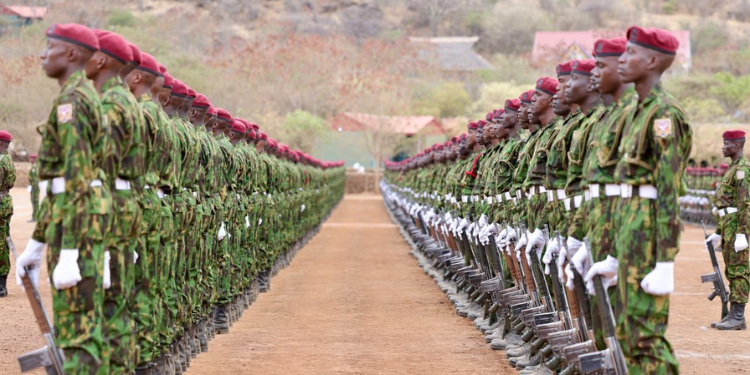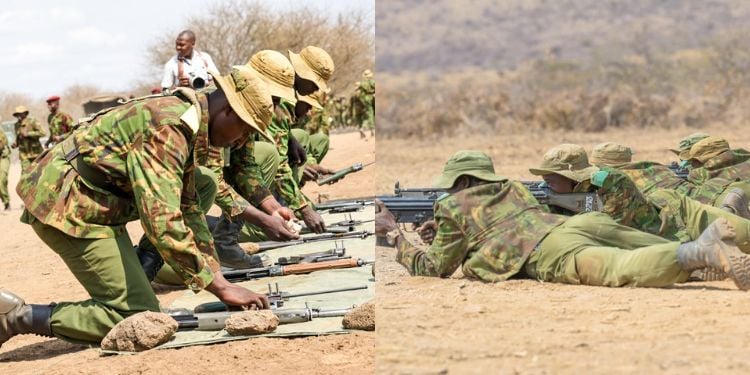
The National Police Service College (NPS) Magadi Field Campus in Kajiado County is used for officers’ field and practical training, with the area’s demanding terrain shaping the environment that prepares officers for operational duties.
According to Chief Inspector Joseph Muhuro, who oversees the Magadi Field Campus, the training ground is a unique environment that helps officers build endurance, skills, and confidence.
Speaking on October 5, Muhuro explained that more than 90 percent of the vegetation around the training area is thorny, while hills surrounding the camp create a basin-like setting.
The combination of the terrain and training exercises provides conditions that can help officers adapt to difficult operational environments, according to Muhuro.
“Over 90% of the vegetation here is thorny. The ground is surrounded by hills that are raised and make the camp appear within a basin. Therefore, I believe that this ground, in a special way, is a special way in that it can make a soldier become a good fighter to face our enemies within the borders or even outside the country,” Joseph Muhuro explained.
Also Read: NPS Introduces New Training Modules for Police Officers
NPS Magadi Gradual Training Approach
According to Muhuro, trainers do not immediately expose officers to the demanding exercises; however, the trainees first undergo a period of acclimatization, beginning with simpler exercises and gradually progressing to more vigorous activities.
The intensity is increased after trainers establish that an officer has adapted to the environment.
Muhuro emphasized that the approach is intended to prevent trainees from being overwhelmed while allowing them to develop the physical and mental capacity required for more complex exercises.
Additionaly during training, Muhuro noted that confidence is another major component of the training conducted at the NPS Magadi training ground.
Trainers assess individual officers’ skills and abilities before progressively introducing more complex tasks, ensuring officers complete their training with the confidence to approach difficult situations.
“The first thing we normally do as trainers here is encourage this officer to acclimatize, whereby we start with a low tone, give simple exercises before we embark on vigorous exercise, and immediately we realize that this soldier has acclimatized. That is when we gradually proceed from one level to another to make this soldier at least adapt and not scare this young soldier,” Joseph Muhuro stated.
The official mandate of the Magadi Field Campus includes paramilitary training for GSU recruits, range work, advanced combat and tactical training, operational command and leadership training, teamwork and multi-agency approaches to policing.
It can also provide specialized training to other security agencies.
Also Read: Inside Kiganjo Police College, Where Kenya Police Officers Are Trained Before Deployment
History and Location of Magadi Training Camp
The Magadi facility’s history is linked to the General Service Unit’s search for a suitable field-training environment.
According to the GSU, specialized training was conducted at Kawap in Samburu County between 1973 and 1978, before the camp moved to Ol Pejeta in Laikipia County in 1978.
It was subsequently moved to Kajiado County at the foot of the Ngong Hills in 1979, then to Kora in Magadi in 1980, before reaching its current location in 1981.
The facility was formerly known as the GSU Field Training Center, Magadi, before the NPS renamed its training institutions in 2018.
Currently, the campus is located about 86 kilometers southeast of Nairobi, with Embalbal Osalei Hill, also known as Mt. Wambua, to the southeast, Olentonai Hill to the southwest, and Olmakati Hill to the north.
Temperatures in the area can reach 42°C, with lows of about 28°C.
Follow our WhatsApp Channel and X Account for real-time news updates