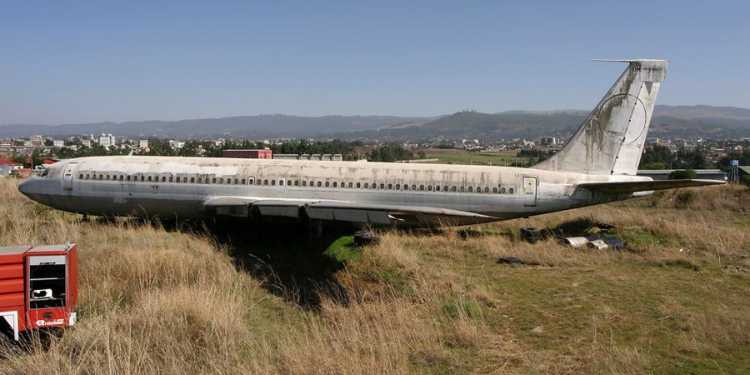
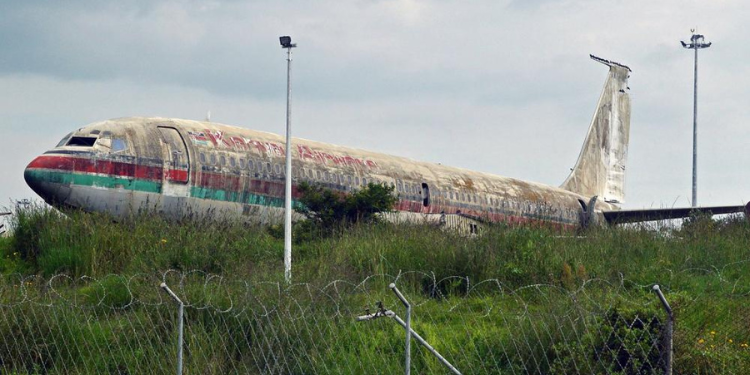
A Kenya Airways aircraft with registration number 5Y-BBK has remained at Bole International Airport in Ethiopia for 37 years after it was involved in a runway accident on July 11, 1989.
The aircraft was written off following a landing accident that left it damaged beyond economic repair. During the accident, all 66 passengers and 10 crew members survived.
The Boeing 707 was operating a scheduled passenger flight from Addis Ababa to Nairobi when it encountered technical complications shortly after departure.
The aircraft was forced to return to its departure airport before the situation escalated into a runway overrun.
Technical Failure, Return to Base, and Runway Overrun
According to the Aviation Safety Network (ASN) and the Bureau of Aircraft Accidents Archives (B3A), the Kenya Airways Boeing 707, registration 5Y-BBK, was operating a scheduled passenger flight from Addis Ababa to Nairobi on July 11, 1989.
The plane encountered a technical malfunction shortly after takeoff. The crew identified a landing gear failure, with the system failing to retract properly after departure.
Also Read: KAA Clarifies JKIA Incident Was a Routine Emergency Drill
Following standard emergency procedures, the flight was diverted back to Bole International Airport for safety procedures.
During the approach and landing phase, the situation was further complicated by hydraulic system issues, which affected the braking system. Upon touchdown, conditions were worsened by the wet runway surface of Bole International Airport, which reduced friction and increased the aircraft’s stopping distance.
As a result, the Boeing 707 was unable to decelerate effectively and overran the runway, sustaining severe damage, including collapse of the undercarriage.
B3A records classify the event as a hull loss accident, meaning the aircraft was damaged beyond economic repair.
Following damage assessment and insurance evaluation, the aircraft was written off from Kenya Airways’ fleet, marking the end of its operational life since it was beyond repair.
In aviation practice, aircraft that suffer structural failure of this magnitude are classified as “hull loss,” meaning the cost of repair and restoration exceeds the value of repair or replacement.
| Field | Details |
| Type | Boeing 707-351B |
| Operator | Kenya Airways |
| Registration | 5Y-BBK |
| MSN | 19872 / 742 |
| Year of Manufacture | 1968 |
| Engine Model | Pratt & Whitney JT3D-3B |
| Occupants | 76 |
| Fatalities | 0 |
| Aircraft Damage | Destroyed, written off (hull loss) |
| Category | Accident |
| Nature | Passenger – Scheduled flight |
| Location | Bole International Airport |
| Phase of Flight | Landing |
| Departure Airport | Bole International Airport |
| Destination Airport | Jomo Kenyatta International Airport |
Protocols for Handling Grounded Aircraft
Grounding an aircraft follows strict adherence to aviation safety and maintenance protocols to ensure the aircraft remains secure and properly documented.
Also Read: KQ Flight to Tanzania Forced Back to JKIA After Leakage of Hazardous Material
Procedures for grounding planes vary depending on the aircraft type, airline policies, and national aviation authority requirements, in accordance with internationally accepted standards set by civil aviation regulations.
Once an aircraft is grounded, wheel chocks are placed under the main landing gear to immobilize the aircraft and prevent movement.
Flight control locks are installed to protect critical surfaces from wind gusts or jet blast movement.
Ground Power Units (GPUs) or Auxiliary Power Units (APUs) are disconnected or maintained if diagnostics are required.
The grounding is formally recorded and communicated to relevant aviation authorities and operational control teams. The airline operator notifies Air Traffic Control (ATC) and the national civil aviation authority, such as the Kenya Civil Aviation Authority (KCAA).
It is then recorded in the aircraft’s Technical Logbook (TLB), detailing the nature of the fault, the time of occurrence, and the aircraft’s operational status.
The engineers then conduct a detailed inspection in accordance with the Aircraft Maintenance Manual (AMM). Identified faults are then repaired or faulty components replaced using approved procedures.
Once repairs are completed, the aircraft must be signed off by an authorized licensed engineer. An airworthiness release certificate is issued before the aircraft can be cleared for return to service.
Before resuming operations, a final safety inspection is conducted, including a Foreign Object Debris (FOD) walkaround to ensure no hazards remain near the aircraft.
Follow our WhatsApp Channel and X Account for real-time news updates.