

The practice of breaking a pen after delivering a death sentence is an old judicial tradition associated with the history of capital punishment in Europe and former British colonies.
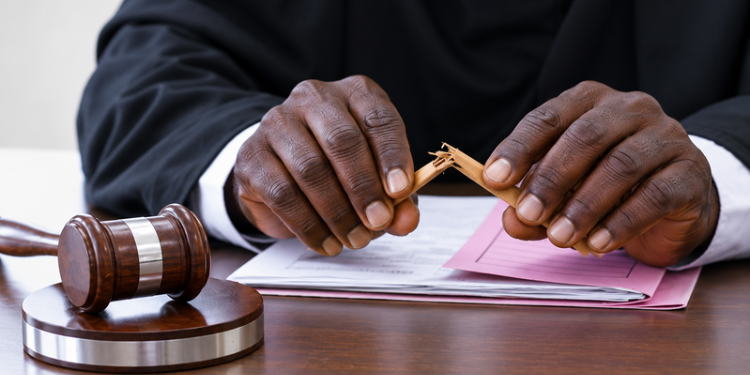
The gesture involves a judge breaking the nib or the entire pen used to sign a death sentence immediately after pronouncing the punishment.
It is not required by law but is performed symbolically to mark the gravity of the decision.
The tradition attracted attention in Kenya on Thursday, February 19, 2026, when Nyeri High Court Judge Kizito Magare broke his pen after sentencing Nicholas Macharia to death for the murder of seven-year-old Tamara Blessing Kabura.
Macharia was convicted of murdering the child after she disappeared from Nyeri Town open-air market on May 24, 2025. The court heard that he took her to his house in Witemere, sexually assaulted her, killed her, and buried her body beneath his bed.
The judge’s gesture prompted questions about why judicial officers break their pens after imposing the death penalty and whether the practice has any legal significance.
Origin of the Tradition of Breaking a Pen
The historical practice of breaking an instrument after delivering a death sentence predates the modern pen-breaking ceremony.
Also Read: Story Behind President Ruto’s Adoption of His Youngest Daughter, Nadia Cherono
Research published in the Journal on European History of Law in 2012 by legal historian Antonín Lojek traces an earlier judicial custom to 13th-century England.
According to the research, judges traditionally carried wooden sticks as symbols of their judicial authority.
The sticks were used in different judicial ceremonies and represented the power exercised by the court.
When a judge pronounced a death sentence, the tradition involved breaking the stick and throwing its pieces at the feet of the condemned person.
The custom spread across Europe during the 15th century and was recorded in different jurisdictions. Historical accounts cited in the research include examples from Germany and Weimar.
The breaking of the stick symbolized the conclusion of the judicial proceedings and marked the end of the judge’s role in determining the case at that stage.
The wooden stick was therefore an earlier instrument associated with the ceremony, rather than the pen used in modern courtrooms.
Why Judges Break Their Pens After a Death Sentence
The modern ceremony carries several symbolic meanings.
One explanation is that the pen used to sign a death sentence should not be used again to sign another death sentence. Breaking its nib signifies that the instrument has completed its purpose.
The gesture also represents the gravity of imposing capital punishment. A death sentence is the most severe punishment available under laws that retain the death penalty, and the ceremony distinguishes it from ordinary sentencing decisions.
Another interpretation associates the broken pen with the finality of the judgment at the trial court. Once the judge has signed and delivered the sentence, the pen is symbolically retired from that particular purpose.
In India, the practice was documented on September 13, 2013, when Additional Sessions Judge Yogesh Khanna broke the nib of his pen after signing the death sentences of four men convicted in the December 16, 2012 gang rape and murder case.
A Press Trust of India report published by Business Standard stated that breaking the nib after signing a death sentence was a tradition dating back to British rule in India.
Also Read: Kamiti Maximum Prison: Location, Visiting Hours and Entry Rules
A separate report by The Telegraph quoted a court official explaining that the gesture symbolized the intention that the pen should not be used to sign another death sentence.
Supreme Court Judge Isaac Lenaola Explains Why Judges Break Their Pens
Supreme Court Judge Isaac Lenaola has offered a first-hand explanation of the tradition, recalling how he delivered death sentences while serving as a judge in Embu.
In a lecture discussing the Supreme Court’s landmark Muruatetu judgment, Lenaola explained that judges traditionally broke the pens they used when sentencing convicted murderers to death.
Lenaola explained that the judge was expected to break the pen after pronouncing the sentence so that it would never be used again.
“So that pen does not write again. That’s how serious the death sentence was,” he explained.
He also recalled the traditional wording used when imposing capital punishment: “I hereby sentence you to death. You shall hang by the neck until you are certified dead. May God have mercy on your poor soul.”
Lenaola explained that the practice was connected to a legal system in which judges had no discretion when sentencing a person convicted of murder.
“I have no say in the matter. The law says once I find you guilty of murder, I must sentence you to death,” he quoted the words used by judges.
However, the Supreme Court later recognized that the Constitution and the values contained in the Bill of Rights did not make the death sentence mandatory.
Follow our WhatsApp Channel and X Account for real-time news updates and our YouTube Channel for in-depth interviews.