


Africa’s development will increasingly be determined not simply by the natural resources it possesses, but by its capacity to generate knowledge, develop technologies and translate scientific discoveries into economic and social value. Science must move beyond laboratories and academic publications to become a driver of food security, agricultural productivity, industrialisation, public health and sustainable development.
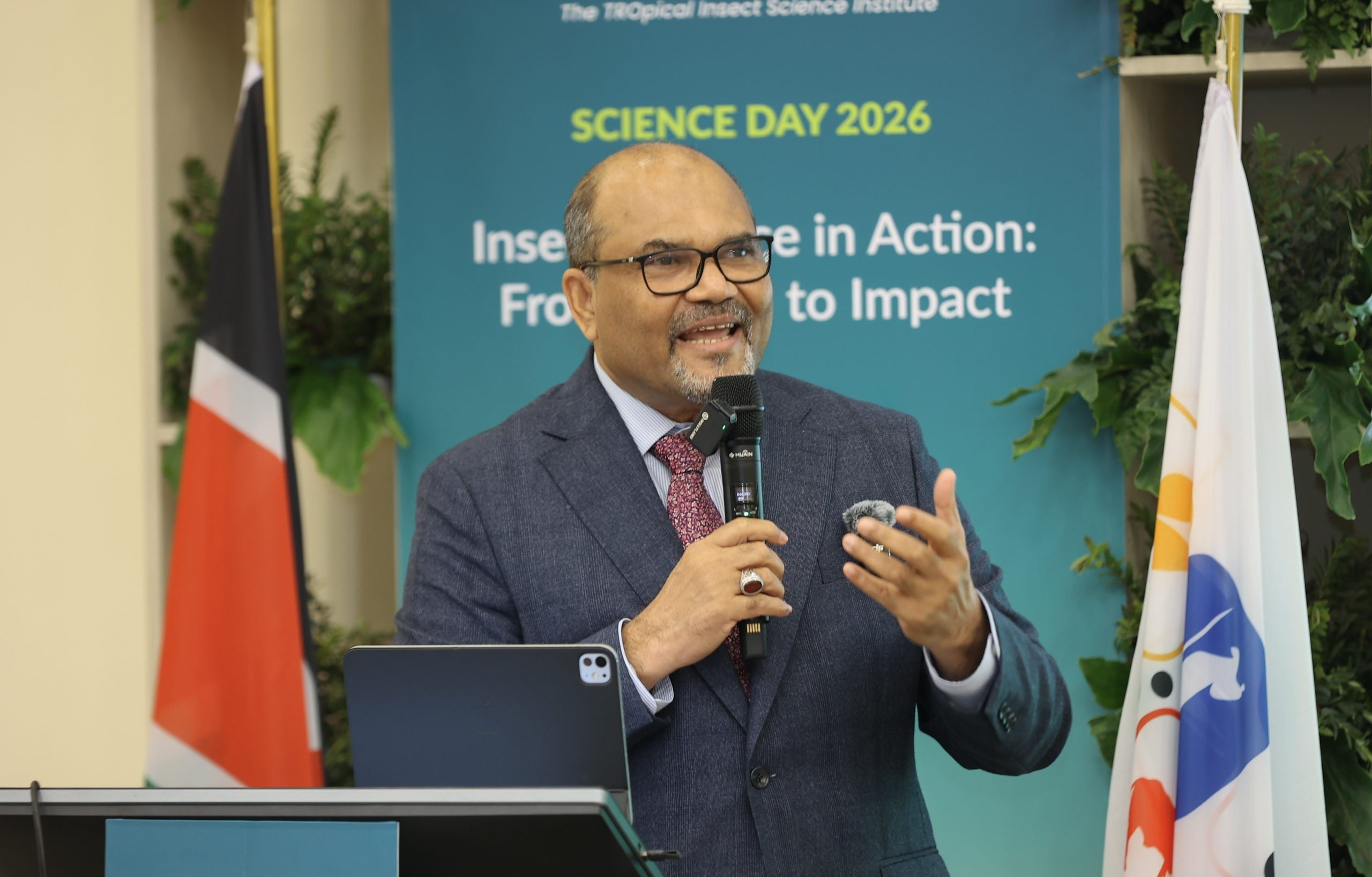
This was my central message as I delivered Keynote address during icipe Science Day 2026, held under the theme “Insect Science in Action: From Vision to Impact.” The occasion provided an opportunity to reflect on the strategic importance of insect science and the investments required to harness its potential.
Insect science is fundamental to agricultural transformation. Insects influence crop production through pollination, pest management, soil health, livestock nutrition and disease transmission. Harmful insects destroy crops, transmit livestock diseases and contribute to post-harvest losses. Beneficial insects, however, support pollination, natural pest control and ecological balance.
Proven Gains from Push-Pull and Black Soldier Flies
The International Centre of Insect Physiology and Ecology (icipe) demonstrates how scientific research can address these challenges. Its internationally recognised push-pull technology, developed with partners including Rothamsted Research and Kenya’s agricultural research institutions, uses companion plants to repel cereal stemborers and attract them away from maize. Desmodium also suppresses striga weeds, improves soil fertility and provides additional fodder.
The climate-adapted technology has demonstrated particularly impressive results against fall armyworm. A study involving 250 farmers in Kenya, Uganda and Tanzania recorded 82.7% fewer fall armyworm larvae, 86.7% less crop damage and maize yields 2.7 times higher than conventional monocropping plots. These results illustrate how biological knowledge can translate into increased food production and household resilience.
icipe’s 2022 impact assessment of push-pull and fruit fly integrated pest management technologies estimated that approximately 640,000 households had become food secure, while 445,000 had moved above poverty thresholds. The assessment also estimated a return of US$3.20 for every dollar invested. Such evidence demonstrates that agricultural research is not an expenditure without returns; it is an investment in livelihoods and economic development.
Also Read: Driving Kenya’s Food Security Jobs and Industrial Transformation Through Livestock
The Kenya Agricultural and Livestock Research Organisation (KALRO) complements this work through research on crop protection, livestock productivity, alternative feeds and agricultural biotechnology.
An emerging opportunity is black soldier fly technology. Black soldier fly larvae convert organic waste into protein-rich animal feed, while their residue can be processed into organic fertiliser. This offers opportunities to reduce dependence on imported feed ingredients, improve poultry and aquaculture production, manage organic waste and establish new enterprises for young people and women.
Closing Africa’s Research Funding Gap
Other institutions contribute to this broader agricultural innovation ecosystem. The International Livestock Research Institute (ILRI) undertakes research on livestock health, nutrition and production systems. The Kenya Plant Health Inspectorate Service (KEPHIS) strengthens pest surveillance, plant health and phytosanitary standards. Universities such as Egerton, Nairobi, Pwani, Chuka and JKUAT contribute through research, training and technology development. CIFOR-ICRAF supports sustainable landscapes and agroforestry, while the International Institute of Tropical Agriculture (IITA) contributes to crop protection and biological control.
Collectively, these institutions demonstrate that agricultural science must address the entire value chain, from production and processing to markets and exports.
The socioeconomic opportunities are substantial. Improved pest management reduces crop losses and production costs. Better pollination improves agricultural yields and quality. Insect-based feeds can support livestock and aquaculture industries, while biological control reduces excessive dependence on chemical pesticides. These interventions create employment, strengthen agribusiness and improve rural incomes. Insect science must therefore be recognised as an important pillar of Africa’s emerging bioeconomy.
Despite these opportunities, Africa continues to face serious research financing and human-capacity constraints. UNESCO’s 2026 R&D data release reports global research expenditure at 1.92% of GDP in 2023, compared with 0.38% in Sub-Saharan Africa. The region has only 88 researchers per million inhabitants, against a global average of 1,500.
Kenya’s R&D expenditure reached approximately 0.81% of GDP in 2024, still below its national ambition of 2%. In his November 2025 State of the Nation Address, President William Ruto identified a financing shortfall of about KSh180 billion and set a target to progressively grow research financing to KSh1 trillion over ten years. He emphasised domestic public resources, private investment and venture capital, observing that “no nation rises above the abilities of its citizens.”
This ambition must translate into predictable domestic financing. Development partners remain important, but Africa must increasingly finance its own scientific priorities.
Connecting Science to Commercialisation and Impact
We must also strengthen multidisciplinary research clusters linking icipe, KALRO, universities, industry and government. The State Department for Science, Research and Innovation is spearheading A Kenya Grand Challenges Research Programme that will mobilise these institutions around various clusters – food security, climate resilience, biodiversity, livestock health and emerging technologies. Artificial intelligence, genomics, bioinformatics and remote sensing can further improve pest identification, disease surveillance and agricultural forecasting.
I advocated for research to be connected to commercialisation through technology transfer, innovation incubation, intellectual property management, industrial partnerships and patient capital.
Also Read: Africa’s Technology Ambitions Must Translate into Strategic Advantage
The world has become a global village; hence, science diplomacy and international partnerships must strengthen African research leadership, technology transfer and local manufacturing capabilities. Above all, we must measure scientific success by improved agricultural productivity, food security, healthier livestock, increased incomes, enterprises created, jobs generated, and restored ecosystems.
As the late Professor Thomas Risley Odhiambo understood, scientific institutions are ultimately built around people and their capacity to generate solutions to society’s challenges.
The challenge before us is to move from fragmented research to collaborative innovation, from research dependency to domestic scientific capability, and from scientific excellence to measurable socioeconomic impact. The state department is committed to strengthening the ecosystem. Africa’s agricultural transformation will not be achieved through land and natural resources alone. It will require sustained investment in science, technology and innovation.
Our future will be secured not by importing solutions, but by investing in the knowledge, institutions and people capable of creating them.
Follow our WhatsApp Channel and X Account for real-time news updates and subscribe to our YouTube Channel for in-depth interviews.