
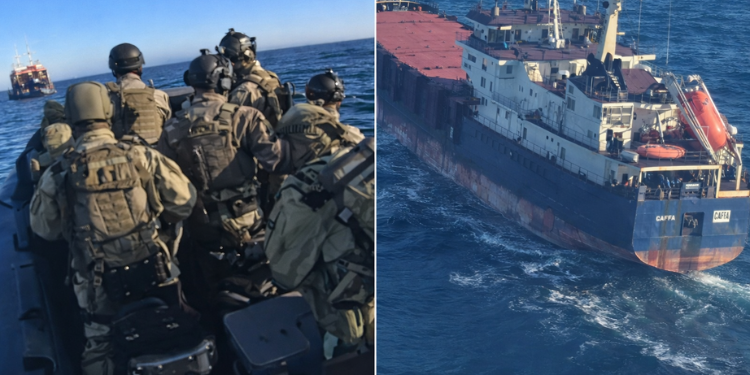
A cargo vessel suspected of violating maritime law and attempting to evade sanctions has been intercepted and seized by Swedish authorities while transiting to Russia in the Baltic Sea.
Police, special forces, and coast guard personnel boarded the Guinea-flagged cargo ship Caffa on Friday, March 7. The coordinated operation happened near the southern Swedish city of Trelleborg.
Officials said the vessel was sailing under a false flag and displayed signs of serious safety violations.
The operation, dubbed “Svart kaffe” (Black Coffee), involved Sweden’s elite tactical unit Nationella insatsstyrkan, police aviation, and the Swedish Coast Guard.
Swedish police said the vessel is suspected of breaching both national maritime regulations and international shipping laws.
Johan Andersson, deputy head of the police’s National Operations Department, during a press conference Saturday said:
“Our investigation so far strengthens our suspicions and our opinion that this ship has extensive sea safety deficiencies.”
Authorities took control of the ship after determining that its flag status was unclear, raising suspicions that it may effectively be operating as a stateless vessel.
One member of the crew has already been formally notified of suspected legal violations related to maritime safety regulations and the Swedish Ship Safety Act.
Vessel bound for Russia linked to sanctions
Officials also said they have information suggesting the ship appears on Ukraine’s sanctions list.
Ukrainian intelligence previously reported that the 96-meter cargo vessel loaded with grain in July 2025 was from the occupied Crimean port of Sevastopol. The cargo was believed to be part of exports originating from Ukrainian territories under Russian control.
According to Swedish Minister of Civil Defence Carl-Oscar Bolin, the ship switched its flag from Russia to Guinea last summer to conceal its activities.
At the time of interception, the vessel was reportedly sailing from Casablanca toward the Russian port of St. Petersburg.
Most of the ship’s 11 crew members are Russian nationals, according to Swedish authorities.
Investigators are now conducting searches on board and questioning crew members as part of an ongoing probe.
Also Read: Trump Unveils $20 Billion Insurance Shield for Ships Crossing Vital Oil Route
European authorities have increasingly targeted ships suspected of helping Russia bypass sanctions through opaque ownership structures, flag changes, and falsified shipping documentation.
These vessels are often linked to illicit cargo shipments, including oil and agricultural products originating from occupied Ukrainian territories.
The Swedish seizure follows a similar high-profile operation earlier this month when Belgian and French military forces intercepted an oil tanker believed to belong to Russia’s shadow fleet near the port of Ostend.
That vessel, the 180-meter tanker Ethera, was boarded during a helicopter-supported nighttime operation and escorted to Zeebrugge for arrest after intelligence indicated it was sailing under a false flag.
Belgian authorities said the tanker was connected to networks used to evade Western sanctions.
Maritime incidents raise security concerns
The crackdown also comes amid a series of maritime incidents involving vessels linked to sanctioned Russian energy shipments.
In February, the Russian-flagged LNG tanker Arctic Metagaz caught fire in the central Mediterranean after a reported explosion while sailing between Malta and Libya.
The Armed Forces of Malta (AFM) on March 3 confirmed that all crew members were found safe.
Also Read: Another Win for Putin? U.S. Considers Sanctions Relief for Russian Oil Amounting Billions
In a press release, the AFM explained that its Rescue Coordination Centre Malta had been informed of a distress situation involving the merchant vessel MT Arctic Metagaz while it was transiting the central Mediterranean, outside Malta’s designated Search and Rescue (SAR) area.
“Earlier this afternoon, the Rescue Coordination Centre Malta of the Armed Forces of Malta was informed of a distress situation outside its Search and Rescue area involving the merchant vessel MT ARCTIC METAGAZ while transiting the central Mediterranean. Upon receipt of the alert, RCC Malta initiated verification procedures and efforts to establish the exact position of the vessel,” the statement read in part.
Authorities indicated that environmental damage was unlikely because the vessel was carrying LNG rather than crude oil, providing some reassurance amid the incident.
The tanker, which is subject to sanctions by the United States, the European Union, and the United Kingdom, may have been struck by a Ukrainian naval drone, according to maritime security sources cited by Reuters, although the claim has not been officially confirmed.
All crew members survived the incident, and authorities said environmental damage was unlikely because the vessel was transporting liquefied natural gas rather than crude oil.
Follow our WhatsApp Channel and X Account for real-time news updates.