
United States Secretary of State Marco Rubio said President Donald Trump would be willing to meet Iran’s Supreme Leader Ali Khamenei if the chance comes up, as tensions between Iran and the U.S. continue to rise.
In an interview with Bloomberg on Saturday, February 14, Rubio, while outlining Trump’s approach to diplomacy, signalled Washington’s willingness to engage directly with Tehran.
The Secretary of State pointed out that President Trump favours negotiations and views a possible meeting with Khamenei as a way to settle disputes.
“I’m pretty confident in saying that if the Ayatollah said tomorrow, he wanted to meet with President Trump, the President would meet him, not because he agrees with the Ayatollah but because he thinks that’s the way you solve problems in the world.”
Secretary Rubio speaks on Trump meeting Khamenei amid tensions with Iran
Rubio However pointed out that Trump does not see meetings as giving anything away. “He doesn’t view meeting someone as a concession,” Rubio said, adding that the United States remains determined to stop Iran from getting nuclear weapons.
“It’s pretty clear that Iran will never be allowed to have a nuclear weapon, that that poses a threat not just to the United States, to Europe, to world security, and to the region. There’s no doubt about it.”
Also Read: Trump Readies to Topple Another World Leader
Further, Rubio defended the U.S. military presence in the Middle East and Trump’s choice to send another aircraft carrier near Iran.
“The second is we obviously want to have forces in the region because Iran has shown the willingness and the capability to lash and strike out at the United States presence in the region. We have bases because of our alliances in the region, and Iran has shown in the past that they are willing to attack us and/or threaten our bases. So, we have to have sufficient firepower in the region to ensure that they don’t make a mistake and come after us and trigger something larger.”
Later at the Munich Security Conference, Rubio said the United Nations has not been able to limit Iran’s nuclear program and argued that strong U.S. action is needed to deal with the threat.
“It was powerless to constrain the nuclear program of radical Shia clerics in Tehran. That required 14 bombs dropped with precision from American B-2 bombers,” he said.
Trump’s willingness to talk directly comes as senior advisers reportedly cautioned him that making a nuclear deal with Iran could be very difficult.
Israeli journalist Barak Ravid of Channel 12 said Trump asked special envoy Steve Witkoff and his son-in-law Jared Kushner about the likelihood of reaching an agreement.
The advisers told Trump that history shows making a deal with Tehran is “difficult to impossible,” but promised to keep a tough stance in talks. “If they agree to what we are asking for, we will give you the option and you decide,” they reportedly said.
U.S. prepares for sustained military operations
This comes as the United States continues trying to limit Iran’s nuclear program and prevent a larger conflict. The first round of talks in Oman did not lead to progress, and a second round is planned for Geneva.
Trump earlier this week warned that not reaching a deal could mean serious consequences for Iran, calling the alternative a “very traumatic” outcome.
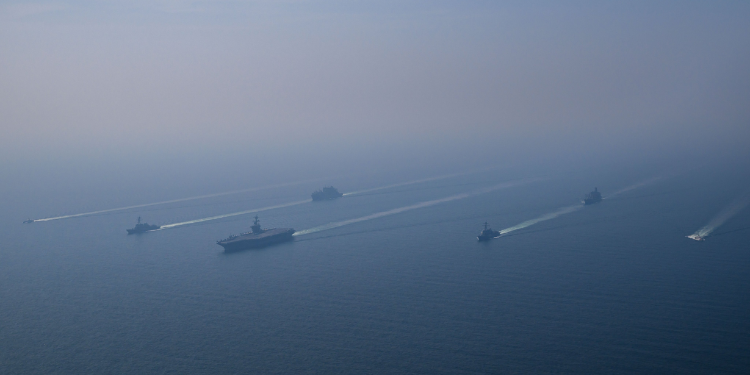
He went on to confirm that the USS Gerald R. Ford is being sent back to the Middle East, joining the USS Abraham Lincoln strike group already in the area.
Also Read: On the Brink? Trump Advisers Warn Iran Deal ‘Difficult’ Amid U.S. Military Preparations
Two U.S. officials later told Reuters that the U.S. military is reportedly getting ready for possible operations against Iran for a campaign lasting several weeks, which would be much more serious than past actions.
White House spokesperson Anna Kelly said, “President Trump has all options on the table with regard to Iran. He listens to a variety of perspectives on any given issue, but makes the final decision based on what is best for our country and national security.”
Last year, the United States sent two aircraft carriers to the region during rising tensions, including for the June “Midnight Hammer” strikes on Iranian nuclear sites.
Stealth bombers flew from the U.S. for that operation, and Iran responded with a limited strike on a U.S. base in Qatar.
In the past month, about 150 C-17 and C-5 transport planes have brought military equipment, and fighter jets have been moved to bases in the region.
Follow our WhatsApp Channel and X Account for real-time news updates.