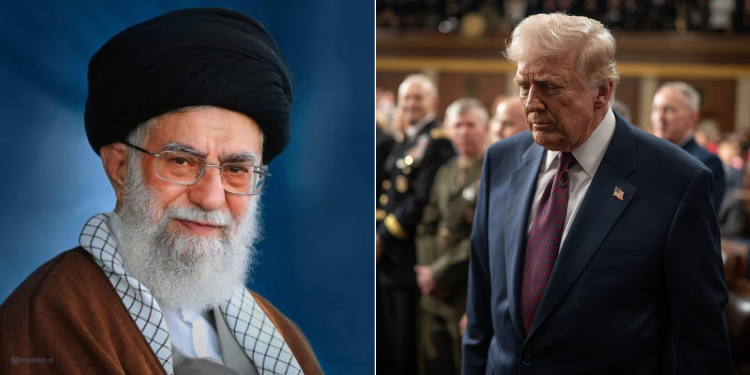
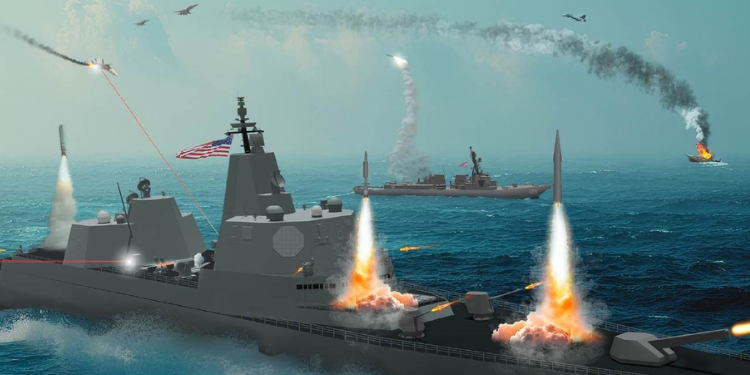
The United States has reduced staffing at a key naval headquarters in the Middle East to “mission critical” levels as Washington prepares for possible military action against Iran, amid rising regional tensions and ongoing nuclear negotiations.
According to U.S. officials who spoke to Fox News, the headquarters of the U.S. Navy’s Fifth Fleet in Bahrain has been scaled back to fewer than 100 personnel, with only essential staff remaining at the facility.
The move mirrors similar preparations carried out ahead of Operation Midnight Hammer in June 2025, when the United States launched strikes on Iranian nuclear sites.
Also, the reduction in staffing comes as the U.S. military intensifies preparations across the Middle East while diplomatic efforts continue to prevent a wider conflict.
Naval vessels stationed at U.S. Fifth Fleet headquarters moved into open waters
The Fifth Fleet operates from Naval Support Activity Bahrain and coordinates American naval operations across roughly 2.5 million square miles of strategically important waterways, including the Arabian Gulf, Gulf of Oman, Gulf of Aden, Red Sea, and Arabian Sea.
Its operational zone includes several of the world’s most critical maritime choke points and routes vital to global trade and energy shipments. They include the Strait of Hormuz, the Suez Canal, and the Bab al-Mandeb Strait.
Satellite imagery in a Wednesday report by the Associated Press indicated that all U.S. naval vessels stationed at the Fifth Fleet headquarters have been moved out of port into open waters, leaving the harbor at the Bahrain facility empty.
The scaling down of personnel and repositioning of ships comes as the United States has surged military assets into the Middle East in recent weeks amid ongoing discussions with Iran over the future of Tehran’s nuclear program.
U.S. Central Command (CENTCOM) in a statement on February 24 said sailors and Marines aboard the USS Abraham Lincoln carrier strike group have been performing continuous maintenance operations to “keep aircraft mission ready.”
“Sailors and Marines aboard USS Abraham Lincoln (CVN 72) regularly perform maintenance to keep aircraft mission-ready. Their experience and skills allow Abraham Lincoln to sustain continuous airpower and conduct over 100 sorties per day.”
Also, reports indicate that five KC-46 aerial refueling aircraft were dispatched to Israel from Portsmouth International Airport in New Hampshire. At the same time, another tanker departed Seymour Johnson Air Force Base in North Carolina.
Increased military activity
Earlier this week, the guided-missile destroyer USS John Finn entered the U.S. Central Command area of responsibility, bringing the number of American warships in nearby waters to 12.
The total number of American warships in the region does not include destroyers currently deployed as part of carrier strike groups led by the USS Gerald R. Ford and the USS Abraham Lincoln.
Also Read: All US Navy Ships Moved from Foreign Base Amid Tensions with Iran
Naval monitoring has identified U.S. destroyers operating in the eastern Mediterranean near the Souda Bay naval facility. At the same time, additional vessels have been tracked in the Red Sea and the Persian Gulf.
The United States has also reinforced its air power alongside naval deployments.
Twelve F-22 stealth fighter jets departed Royal Air Force Lakenheath in the United Kingdom and are being deployed to an Israeli air force base as part of the expanding military buildup.
The aircraft had remained temporarily in Britain due to issues with aerial refueling before continuing their deployment.
Additional aircraft entering the region in recent weeks include F-35, F-15, and F-16 fighter jets, as well as aerial refueling tankers and transport aircraft.
Open-source flight analysts have tracked hundreds of military cargo flights into the Middle East since mid-February.
Six U.S. military cargo planes departed from a German airbase toward the Middle East on Wednesday evening, bringing the number of American cargo flights to the region since mid-January to more than 300.
The military buildup comes as diplomatic efforts between Washington and Tehran continue to prevent a new Middle East conflict.
Diplomacy
Iran’s Foreign Minister Abbas Araghchi arrived in Geneva on Wednesday, leading a political and technical delegation for the third round of indirect nuclear negotiations with the United States.
The talks, hosted by Oman, are focused on Iran’s nuclear program and the potential lifting of sanctions.
Also Read: Is U.S. Diplomacy Stalled by Iran’s Missile Program?
The Iranian delegation is also scheduled to meet Oman’s Foreign Minister Badr Al-Busaidi to discuss Tehran’s positions ahead of the negotiations.
Officials from the United States and Iran began the latest round of indirect nuclear talks in Switzerland on Thursday before temporarily breaking for consultations, with discussions expected to resume later in the day.
The two sides have remained locked in a tense standoff over Iran’s nuclear activities for months, with senior U.S. officials warning that Iran may be attempting to rebuild its nuclear weapons capability.
U.S. Vice President JD Vance, while speaking on Wednesday, February 25, said Washington has seen indications that Tehran is attempting to restart its nuclear weapons program.
“The principle is very simple. Iran cannot have a nuclear weapon if they try to rebuild the nuclear weapon, that causes problems for us. And in fact, we’ve seen evidence that they have tried to do exactly that. So, the president is sending those negotiators to try to address that problem,” Vance said.
President Donald Trump had also warned earlier this week of possible military action if diplomatic efforts fail.
In his State of the Union address on Tuesday, Trump said that Iran has “sinister ambitions” with its nuclear program and that the U.S. has not yet heard from Tehran that it will “never have a nuclear weapon.”
Follow our WhatsApp Channel and X Account for real-time news updates.