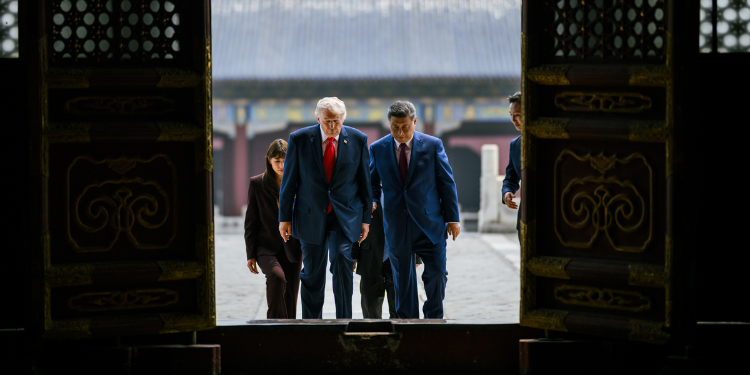
President Donald Trump delivered a sharp warning to Taiwan on Friday, May 15, telling the self-governing island not to pursue formal independence while expecting American military backing.
“I’m not looking to have somebody go independent,” Trump said in an interview with Fox News at the conclusion of his two-day summit with Chinese President Xi Jinping in Beijing.
Trump’s comments came after extensive discussions with Xi, who made it plain that Taiwan remains the most sensitive issue in U.S.-China relations.
President Xi Issues Warning
According to Chinese state media, Xi warned that mishandling the matter could lead to direct conflict between the two powers.
Trump echoed that tension, noting Xi “feels very strongly” about preventing any independence movement and “doesn’t want to see a war.”
The U.S. president emphasized that maintaining the current uneasy status quo serves everyone’s interests.
“If you kept it the way it is, I think China’s going to be OK with that,” he said. “But we’re not looking to have somebody say, ‘Let’s go independent because the United States is backing us.'”
Taiwan’s President Lai Ching-te has pushed back against such pressure in the past, insisting his country already functions as a sovereign nation and doesn’t need a formal declaration of independence.
Most ordinary Taiwanese agree with keeping things as they are, de facto independence without provoking Beijing into military action.
Also Read: Xi Jinping Set for White House Visit After Trump’s Beijing Summit
China, however, views any step toward formal separation as a red line and has never ruled out the use of force to prevent it.
Trump made clear his administration isn’t interested in testing that line. He revealed that he and Xi spent considerable time discussing Taiwan, but he stopped short of committing the U.S. to defending the island in every scenario.
“We’re supposed to travel 9,500 miles to fight a war. I’m not looking for that,” he said. “I want them to cool down. I want China to cool down.”
The summit also touched on a major pending arms package to Taiwan worth around $11 billion, which includes advanced rocket launchers and missiles.
Trump said he discussed the sale “in great detail” with Xi and plans to speak directly with Taiwan’s leadership before making a final call. Beijing has already condemned the potential transfer.
Washington maintains unofficial but robust ties with Taipei, including legal obligations under the Taiwan Relations Act to help the island defend itself.
Also Read: Trump Stunned After Exclusive Tour of Xi’s Secret Zhongnanhai Compound
At the same time, the U.S. officially subscribes to a One China framework with Beijing and does not endorse formal Taiwan independence.
Tensions have escalated in recent years as China ramps up military drills around Taiwan, sending fighter jets and warships into the waters and airspace near the island regularly.
Taiwanese officials accuse Beijing of aggressive intimidation and authoritarian pressure, while positioning themselves as defenders of regional stability and democracy.
Taiwan’s Foreign Minister Lin Chia-lung said his government has been closely monitoring the summit and maintains open communication with Washington to protect Taiwan’s interests.
Trump Believes Conflict Can Be Avoided
He reiterated that Taipei has no intention of rocking the boat but expects continued U.S. support.
For his part, Trump projected confidence that conflict can be avoided. When asked if he sees war with China over Taiwan on the horizon, he replied, “No, I don’t think so. I think we’ll be fine.”
This clearly shows the tricky diplomatic tightrope the United States continues to walk. On one hand, Taiwan represents a thriving democracy and a critical player in global semiconductor production.
On the other hand, provoking China over its core interests carries enormous risks to trade, regional stability, and the risk of military confrontation.
No Commitments Made
During the Beijing talks, Trump said he made “no commitment either way” on Taiwan’s future status. That deliberate ambiguity appears intentional.
He aims to keep channels open with Xi while maintaining sufficient strategic flexibility to deter outright Chinese aggression against Iran.