
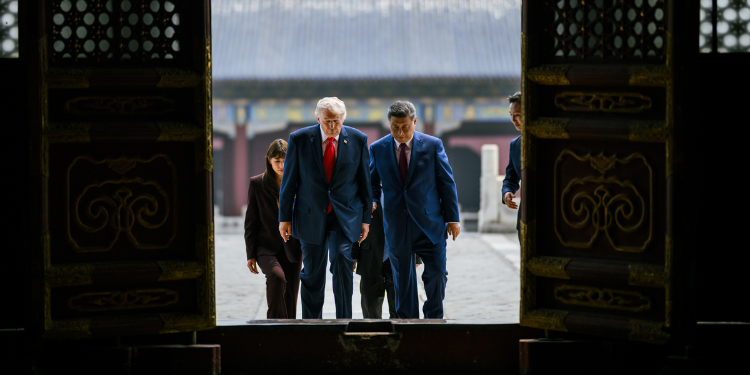
Chinese President Xi Jinping is expected to visit the United States later this year following a two-day summit in Beijing with U.S. President Donald Trump that focused heavily on trade, technology, tariffs, and geopolitical tensions.
China’s Foreign Minister Wang Yi confirmed on Friday, May 15, that Xi would travel to the U.S. in the autumn at Trump’s invitation, according to Chinese state media, marking what could become the next major phase in efforts to stabilize relations between the world’s two largest economies.
The announcement came shortly after Trump departed Beijing, describing the summit talks as “very successful” and claiming the two countries had reached “fantastic trade deals.” However, neither side publicly released detailed agreements.
According to the Chinese state news agency Xinhua, Wang said both sides had agreed to continue implementing previous understandings reached during earlier negotiations while also establishing new trade and investment coordination mechanisms.
“The delegations of the two countries reached overall positive results, including continuing to implement all the consensus reached in previous consultations and agreeing to establish a trade council and an investment council,” Wang said.
Trump hosted by Xi Jinping in Beijing
Trump’s visit to Beijing featured extensive ceremonial engagements, including an honor guard, a state banquet, and meetings at Zhongnanhai, the compound housing China’s Communist Party leadership.
Also Read: Trump Brags About China Ordering 200 Boeing Jets — Then Boeing Loses Billions in Market Value
The summit was also attended by several prominent American business leaders, including Tesla CEO Elon Musk and Nvidia chief Jensen Huang, highlighting the economic and technological stakes surrounding the talks.
Trump later invited Xi to Washington for a follow-up summit in September, with Friday’s announcement indicating preparations are now underway for Xi’s state visit.
While both leaders used notably warm rhetoric throughout the visit, many of the anticipated commercial breakthroughs remained unconfirmed publicly.
Speaking aboard Air Force One, Trump claimed China had agreed to purchase 200 Boeing aircraft, with discussions involving an additional 750 planes potentially underway. Boeing had not publicly confirmed the claims by the time of publication.
Trump also said China would purchase “billions of dollars” worth of American soybeans, a major issue for U.S. farmers affected by previous tariff disputes between Washington and Beijing.
However, China’s Foreign Ministry stopped short of confirming specific purchase agreements, instead emphasizing what spokesperson Guo Jiakun described as “mutual benefit and win-win co-operation.”
Trade truce and tariffs
The summit came against the backdrop of a temporary tariff truce reached last October after both countries imposed steep duties on each other’s goods during a prolonged trade war.
Under that arrangement, Washington suspended planned tariff increases while Beijing eased restrictions on exports of rare earth materials critical to global manufacturing and technology industries.
Despite expectations that tariffs would dominate the summit, Trump told reporters the issue was not discussed directly during his meetings with Xi.
Instead, the White House said the two leaders agreed to establish a “Board of Trade” mechanism to manage economic disputes without repeatedly reopening tariff negotiations.
U.S. Treasury Secretary Scott Bessent later told CNBC that discussions were ongoing regarding mechanisms to support future bilateral investment.
Technology and AI competition
Technology emerged as another central issue during the Beijing summit, particularly regarding artificial intelligence and access to semiconductors.
The presence of Nvidia’s Jensen Huang fueled speculation that export controls on advanced AI chips formed part of the discussions. However, U.S. Trade Representative Jamieson Greer later downplayed suggestions that chip restrictions were a primary topic.
Nvidia and Tesla both maintain major business interests in China, with Tesla heavily reliant on its Shanghai Gigafactory and Nvidia seeking renewed access to the Chinese market amid ongoing U.S. export controls.
Trump also revealed that he and Xi discussed potential AI “guardrails.”
“We talked about possibly working together for guardrails,” Trump told reporters, without elaborating on specific proposals.
Taiwan and Middle East tensions
Alongside trade, the summit also touched on several geopolitical flashpoints, including Taiwan and the conflict in Iran.
According to Chinese state media, Xi warned Trump that Taiwan remains “the most important issue in China-U.S. relations,” cautioning that mishandling the matter could lead to confrontation.
The ongoing conflict involving Iran and disruptions around the Strait of Hormuz also featured prominently during the talks.
Trump said Xi expressed a willingness to help efforts to reopen and stabilize the key maritime corridor.
“President Xi would like to see a deal made,” Trump told Fox News. “He said, ‘If I can be of any help whatsoever, I would like to help.’”
China’s Foreign Ministry later called for a “comprehensive and lasting ceasefire” while urging the reopening of global shipping lanes.
The two countries are expected to continue negotiations ahead of Xi’s planned visit to Washington later this year, with officials on both sides signaling hopes for broader agreements on trade and economic co-operation.