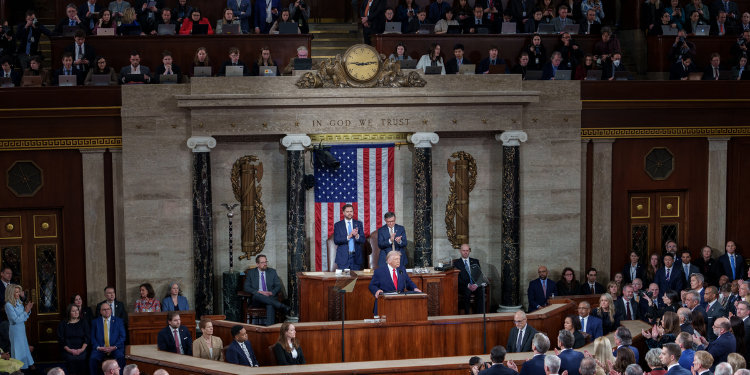
The Republican-led U.S. Senate has handed President Donald Trump a significant political victory, voting down a measure that would have forced him to seek congressional approval before continuing military strikes against Iran.
The procedural motion on Wednesday, March 4, failed 48–52, largely along party lines, marking the first formal test of lawmakers’ willingness to check Trump’s authority as commander in chief amid an escalating conflict that began without prior congressional authorisation.
Introduced by Sen. Tim Kaine of Virginia, the resolution invoked the 1973 War Powers Resolution in an effort to reclaim Congress’s constitutional authority to declare war. It would have required the administration to halt U.S. involvement in hostilities against Iran unless lawmakers explicitly approved further action.
All Senate Democrats voted in favor of the measure except Sen. John Fetterman, who argued that limiting the president’s authority mid-conflict would send the wrong signal. Sen. Rand Paul was the lone Republican to support the resolution alongside Democrats.
At least four additional Republicans would have needed to cross party lines for the measure to advance. None did.
Republicans rally behind President Trump
Republican leadership defended Trump’s actions, framing the strikes as necessary for national security and regional stability.
Senate Majority Leader John Thune said the president is “acting in the best interest of the nation,” arguing that he already possesses sufficient constitutional authority to conduct the operations.
“We should let him finish the job,” Sen. Lindsey Graham said earlier this week, expressing support for the ongoing U.S.-Israeli air campaign.
The Senate vote came a day after lawmakers received a classified briefing from administration officials outlining the rationale behind the military action.
Even if the resolution had cleared both chambers of Congress, Trump was widely expected to veto it. Overriding a presidential veto would require a two-thirds majority in both the House and Senate — a threshold Congress has never met in the case of a war powers resolution.
As a result, Wednesday’s vote was viewed largely as a symbolic test of Republican unity rather than a practical attempt to halt military operations.
Also Read: Thousands of Americans Offered Free Chartered Flights as US Identifies Troops Killed in Kuwait
The vote comes amid mounting Democratic frustration over what they describe as a pattern of unilateral military actions during Trump’s second term.
During the current term, the U.S. military has reportedly struck seven other countries without Trump seeking explicit authorization from Congress, with the administration arguing that the president’s inherent constitutional authority as commander in chief allows such action within statutory limits.
The War Powers Resolution, passed in 1973 following the Vietnam War, requires the president to notify Congress within 48 hours of introducing U.S. forces into hostilities and prohibits armed engagement beyond 60 days — with a possible 30-day extension — without a declaration of war or specific authorization.
Kaine said the issue transcends party politics.
“We shouldn’t be at war without a debate and a vote. That was what the framers intended,” he said.
Senate Democratic Leader Chuck Schumer framed the vote as a defining moment.
“Today every senator — every single one — will pick a side,” Schumer said on the Senate floor. “Do you stand with the American people who are exhausted with forever wars in the Middle East, or stand with Donald Trump?”
Escalation
The Senate’s rejection of the resolution comes as the U.S.-Israel campaign against Iran intensifies.
White House Press Secretary Karoline Leavitt said Wednesday that U.S. forces have struck more than 2,000 targets inside Iran, destroying hundreds of ballistic missiles and drones and 20 naval vessels.
Trump, speaking from the White House, praised the operation, saying Iran would have developed a nuclear weapon had he not scrapped the Obama-era nuclear deal.
“We’re making tremendous progress,” Trump said. “It’s a great display of military strength.”
Iran’s Foreign Ministry has accused the United States and Israel of striking civilian sites, including hospitals, schools, residential neighborhoods, and historic landmarks such as the Golestan Palace complex in Tehran.
Iranian officials say hundreds have been killed since the air campaign began, including civilians.
The conflict has also resulted in American casualties. According to figures cited in congressional debate, six U.S. service members have died in the fighting so far.
Follow our WhatsApp Channel and X Account for real-time news updates.