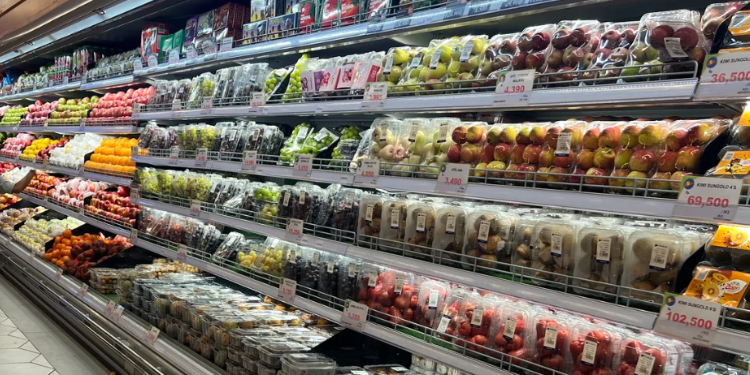

Kenya’s rapidly expanding supermarket sector is changing how millions of households access food. However, a new assessment by the Access to Nutrition Initiative (ATNi) finds that leading grocery chains are not adequately promoting healthier diets.
ATNi, in its Kenya Retail Assessment, which examined Kenya’s three largest supermarket chains, Naivas, Quickmart, and Carrefour Kenya, concluded that systematic efforts to create healthier food environments remain limited, even as supermarkets gain influence over what millions of households eat.
The evaluation found that nutritious options are often limited, under-promoted, and priced out of reach for many consumers.
Commenting on the affordability gap, ATNi Executive Director Greg Garrett said the findings highlight structural barriers to accessing healthy diets.
According to him, this could mean that healthier food baskets account for more than 64% of the daily per capita income.
“At ATNi, we work at a systems level to create healthier food environments. Retailers are critical. We have provided several ways retailers could demonstrate their commitments to nutrition in Kenya.”
The assessment found that 85% of private-label products sold by major grocery chains are high in fat, sugar, or salt. Healthier food baskets cost nearly two-thirds of the average daily income.
The report found that, based on the companies’ publicly available information, there appears to be minimal recognition of the need to improve nutrition and limited evidence of proactive measures being taken to address it, especially among two of the largest retailers.
“Active efforts to create healthier food environments and improve consumers’ diets are, overall, largely absent among Kenya’s largest grocery retailers. From the companies’ publicly available information, there appears to be minimal recognition of this role and limited evidence of proactive measures being taken to address it, especially amongst two of the largest retailers,” the report states.
Expanding influence in Kenya’s food system
Kenya’s supermarket sector has grown steadily over the past decade. ATNi reports that sales from modern outlets grew at a Compound Annual Growth Rate (CAGR) of 5.2% from 2010 to 2019, with the number of outlets increasing from 102 to 225 and the number of hypermarkets increasing from 9 to 39.
As of early 2026, the three largest Kenyan supermarket chains operated 214 modern grocery outlets, primarily in Nairobi, Mombasa, and Kisumu. Quickmart operated 66 outlets, and Carrefour Kenya operated 34.

Over the past decade, leading chains have expanded into smaller towns and secondary cities, increasing their geographic reach. The report indicates that the number of outlets increased substantially since 2020.
While growth remained subdued immediately after the pandemic (CAGR 2.7%, 2020–2024), the modern grocery sector is projected to accelerate over the next five years with a CAGR of 4.0%, slightly outpacing the 3.3% projected for registered small local grocers.
Dr. Brenda de Kok, Research Lead at ATNi, warned that this expansion could reshape dietary patterns if not aligned with health priorities.
“As retailers expand into smaller towns in Kenya, the findings suggest this may increase access to less healthy foods and potentially accelerate shifts away from traditional diets toward more highly processed dietary patterns, if retail practices are not aligned with public health goals,” she said.
While informal markets continue to dominate fresh produce sales, supermarkets are now the main source of packaged and processed foods. Urban households purchase most of their food, and rural purchasing has also increased significantly.
Researchers warn that this shift, often called the “supermarketization” of food systems, gives retailers significant influence over dietary patterns through product selection, pricing, and promotions.
“While Kenyan supermarkets increasingly influence and shape the food environment in the country, they are not yet showing evidence of positively contributing to healthy diets through their policies and portfolio healthiness.”
Few healthy products are on the shelves
A key finding concerns the nutritional profile of supermarket private-label products. Of 232 private-label products assessed, only 13% met the ‘healthier’ threshold under the Kenya Nutrient Profile Model, a government-backed classification framework.
Providing insight into this, Dr. de Kok said the finding stood out strongly during the assessment.
“From a research perspective, two findings stood out: first, that only 13% of private-label products met the Kenya Nutrient Profile Model – underscoring how small the share of healthier private-label options currently is in modern supermarkets; and second, that active efforts to create healthier food environments were largely absent, with limited integration of nutrition into governance or strategy, especially given these retailers’ growing market influence,” the Research Lead notes.
According to current plans put forward by the Kenyan government, the remaining 87% of products will need to carry a warning label indicating that they the high in fat, saturated fat, or sugar.
Additionally, 89% of the assessed products were classified as high in fat, sugar, or salt, or as ultra-processed. Across all retailers, the average Health Star Rating, a type of nutrient profile model developed in the Australian region, used by ATNi to compare product healthiness across markets, was 2.9 out of 5 (188 products), below the 3.5 cut-off for healthier products.
Private-label goods are marketed as affordable alternatives to branded products, but the findings show they are not necessarily healthier.
Forty-eight percent of products met the 3.5 ‘healthier’ threshold, similar to the six-country average of 41% (18,652 products).
Researchers found little evidence that nutrition is integrated into corporate governance, product development, or core commercial strategy at these retailers.
Dr. de Kok further explained what meaningful integration would require in practice.
“Meaningful integration means treating nutrition as a core business priority. In practice, that includes board oversight and executive accountability, with remuneration linked to nutrition performance, plus time-bound targets, such as increasing sales of healthier products (measured by the Kenya NPM), and transparent annual public reporting.”
Also Read: ATNi Executive Director Greg Garrett On Nutrition Crisis and Silent Obesity in Kenya
This imbalance extends beyond product formulation to marketing practices. Across the three chains, over 75% of in-store and promotional materials featured products classified as less healthy. ATNi reported that Quickmart had the lowest share of healthy promotions at 5%.
Naivas promoted healthier items in about 10% of cases. Carrefour Kenya performed better but featured healthy products in only 23% of promotions.
Explaining the significance of this trend, Dr. de Kok said promotional strategies strongly influence purchasing behaviour.
“In Kenya, supermarket promotions mainly feature less healthy products – with only 5% to 23% of promoted items classified as healthy – and research shows that flyers strongly influence what people notice and buy,” she added.
“So when promotions are dominated by snacks, sweets, sugary drinks, and refined convenience foods, retailers steer purchasing toward these less healthy products rather than healthier options.”

The report found that across all three retailers, promotions were dominated by ‘unhealthy’ and ‘unhealthy in excessive amount’ categories, particularly refined grains, baked goods and snacks, sweets and ice cream, sugar-sweetened beverages (SSBs), juices, and sauces, dips, and condiments.
Overall, healthier food groups such as fruits, vegetables, and legumes were promoted infrequently and inconsistently, indicating that current promotional strategies continue to reinforce consumer exposure to less healthy, highly processed products.
Researchers note that promotions are powerful tools for influencing purchasing decisions. The focus on less nutritious options may shape consumer diets over time by encouraging purchases of cheaper, calorie-dense products.
Director Greg said retailers are central to shaping food environments and dietary outcomes.
“These include increasing share of healthier foods on the shelves; actively promoting these foods through their promotional materials and in-store design; and developing pricing strategies that make healthier foods truly affordable. Policy is also a critical lever, and we support new policies such as government-endorsed front-of-package labelling,” he said.
The report warns that pricing and marketing incentives are increasingly pulling dietary choices toward less healthy options.
Carrefour Kenya featured the highest share of healthy items (23%), followed by Naivas (10%) and Quickmart (5%).
Pricing analysis revealed a consistent cost gap between healthier and less healthy diets in modern retail outlets.
Using a standardized basket based on the EAT-Lancet reference diet, which considers both human health as well as planetary bountries, researchers found that at Naivas, a healthier food basket required 64.6% of daily per capita net income, compared with 48.8% of the available amount (Ksh1,895 in 2024) for a less healthy basket.
Even the less-healthy basket accounted for a significant share of disposable income, while healthier diets remained unaffordable for many households.
When adjusted for purchasing power, Naivas had the most expensive healthier food basket among nine retailers assessed globally, including those in the United States, France, Indonesia, South Africa, and the Philippines. However, this was based on a small sample size due to challenges in data availability.
“While these findings likely reflect that Naivas targets a higher-income segment of Kenyan consumers, and do not account for the fact that most consumers would buy products through other channels such as traditional markets, they nonetheless highlight that the retailer’s products are unaffordable for the majority of consumers, and those who shop at the supermarket may be pulled towards cheaper, less healthy products,” the report adds.
Retailers compared
According to ATNi, Carrefour Kenya demonstrated the strongest evidence of nutrition-related initiatives among the three retailers evaluated, including the launch of its “Choose Better” campaign in 2025 to highlight healthier products. However, the criteria used to classify products under the programme are not publicly disclosed.
Naivas, Kenya’s largest supermarket chain with an estimated 18–20% market share, showed limited evidence of a structured nutrition strategy despite its leading position.
Quickmart, with a 9–11% market share, recorded the weakest performance in several areas, including the lowest share of healthy promotions.
The report found that Carrefour Kenya focused primarily on legumes (10%), followed by vegetables (6%) and fruits (2%), and had a lower overall proportion of unhealthy promotions. Snacks (27%) featured more prominently in its flyers than in Naivas or Quickmart.
Also Read: Report Shows Eating a Healthy Diet Is a Luxury Most Average Kenyans Can’t Afford
For Naivas, the same category was most frequently promoted (19%), followed by juices (13%), sweets and ice cream (12%), and sugar-sweetened beverages (11%).
“In contrast, Quickmart most frequently promoted sweets and ice cream (18%), followed by refined grains, baked goods, and snacks (14%), and sauces, dips, and condiments (12%). High-fat dairy products (12%) were also more commonly promoted at Quickmart than at the other two retailers,” ATNi notes.

The Kenya Times contacted Naivas, Quickmart, and Carrefour Kenya for comment on the findings of the ATNi Kenya Retail Assessment, including their nutrition strategies, product mix, pricing approaches, and promotional practices. Their responses will be updated in this article upon receipt.
The assessment found no evidence that any retailer had adopted comprehensive marketing policies to restrict the promotion of unhealthy foods to children.
These findings come as ATNi notes that Kenya faces a growing “triple burden” of malnutrition: persistent undernutrition, widespread micronutrient deficiencies, and rising rates of overweight and obesity.
Undernourishment increased from 28.2% (2004–2006) to 36.8% (2021–2023), while anaemia affects 28.7% of adult women (2023). Over the past decade, adult obesity rose from 8.1% to 12.4%. Nearly 45% of women of reproductive age are now overweight or obese.
Public health experts attribute these trends to rapid dietary changes, urbanization, and increased consumption of processed foods.
Researchers note that modern retail outlets are more likely than informal vendors to sell packaged and ultra-processed products. As supermarkets expand, their influence over dietary patterns is expected to increase.
ATNi recommendations
The report argues that voluntary corporate action alone is unlikely to shift food environments at the necessary scale and calls for a stronger regulatory framework to rebalance incentives in modern retail.
ATNi recommends introducing measurable targets to improve the nutritional profiles of private-label products.
These could include commitments to increase the percentage of sales of healthier items versus less healthier items. ATNi’s overall ambition is that by 2030, 50% of all processed and packaged foods sold are healthier.
The assessment also calls for a fundamental shift in promotional strategies. Since over 75% of promotions currently favor less healthy foods, researchers argue that retailers should set internal benchmarks to increase the visibility and promotions of fruits, vegetables, and minimally processed products.
“Enhance in-store and online shopping environments to promote healthier choices through strategic product placement, shelf positioning, and distribution, ensuring healthier options are visible, accessible, and attractively presented across all store formats.”
Front-of-pack nutrition labeling is another area identified for reform. While Kenya uses nutrient profiling models for classification, the report urges policymakers not to delay in implementing the planned mandatory interpretive warning labels on products high in sugar, salt, or saturated fat, as adopted in countries such as Chile, according to the Global Food Research Program.
Researchers argue that such labels have been shown to shift consumer behavior and encourage product reformulation.
Marketing restrictions are also highlighted. The assessment found no evidence that the three retailers had comprehensive policies restricting the promotion of unhealthy foods to children.
ATNi recommends the introduction of mandatory safeguards to limit child-directed advertising and in-store placement strategies that disproportionately feature ultra-processed products.
Fiscal measures may also need to be redesigned. Kenya currently applies excise taxes to soft drinks and confectionery products, but the report notes these are not directly linked to nutrient thresholds and serve mainly as revenue tools rather than health-driven incentives.
“Adjust the design of the Kenya soft drinks tax to be based on the volume of sugar and sweeteners in the product. Evidence from multiple studies has shown a positive or neutral impact on the economy, with small declines in F&B company revenues offset by employment in other industries or the government.”
With healthier food baskets costing nearly two-thirds of average daily income in some cases, the report argues that without targeted interventions such as subsidies for nutrient-dense foods or price incentives for healthier reformulation, economic barriers will continue to undermine dietary improvement.
The researchers emphasise that responsibility does not lie solely with retailers. Government agencies, investors, and civil society actors all play a role in shaping incentives and accountability.
“Implement targeted strategies to narrow price gaps between healthier and less healthy products, including more affordable private-label options, offering discounts on produce, and designing loyalty incentives that encourage healthier purchases,” the report concludes.