
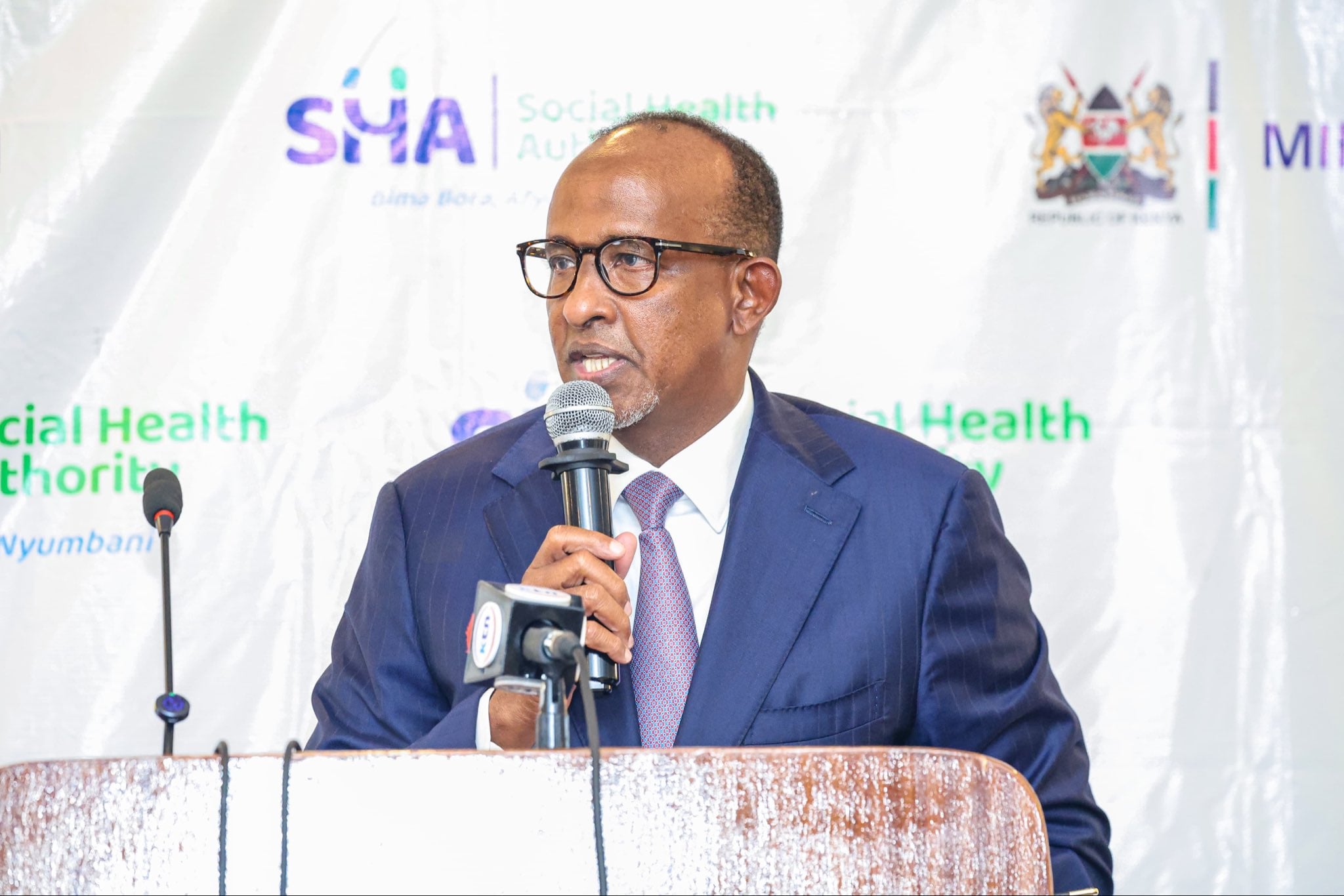
Health Cabinet Secretary (CS) Aden Duale has explained the government’s move to shift hospitals from the Social Health Authority (SHA) Provider Portal to the Health Management Information System (HMIS).
In a detailed statement issued on Friday, October 2, 2026, Duale clarified how hospitals will submit claims and manage patient information under the new arrangement, following confusion over the transition.
“There has been some miscommunication and confusion regarding the transition from the SHA Provider Portal to the Health Management Information System (HMIS),” Duale said in a statement.
“It is important to clarify what has been in place, what is changing, and how the transition is expected to improve healthcare delivery.”
Since the launch of SHA, hospitals have been using their own Health Management Information Systems to manage daily operations while also relying on the SHA Provider Portal to submit claims and handle related transactions.
The Ministry of Health (MoH) said having to use two separate systems has increased the administrative work for hospitals and, in some cases, contributed to longer processing and waiting times for patients.
CS Duale Explains What Is Changing
Duale explained that under the new arrangement, the hospital’s HMIS will become the main system for managing healthcare services and related information.
The system will be linked to SHA and other health-sector platforms, allowing information captured at the hospital to be shared with the relevant systems without staff having to enter the same details repeatedly.
“The broader objective is simple: one hospital system that can securely communicate with the different systems supporting healthcare delivery,” Duale said.
According to the CS, the change is not the introduction of a completely new hospital system but part of the ongoing rollout of Kenya’s digital health infrastructure.
Hospitals will continue using their HMIS while the system is connected to SHA and other platforms involved in healthcare services.
Also Read: SHA Issues New Dates for Hospitals With Pending NHIF Claims
What the Change Means for Patients
The government expects the new arrangement to reduce delays caused by repeated paperwork and data entry.
Patient information will be captured through the hospital’s system and made available to authorized healthcare workers who need it for a patient’s care.
The Ministry said this could make admissions, consultations, procedures, billing and claims easier to process.
It also expects patients to spend less time waiting as healthcare workers deal with fewer administrative tasks.
“The ultimate beneficiary should be the patient: less paperwork, fewer repetitive processes, reduced waiting time, better continuity of care and a more efficient healthcare experience,” Duale said.
Duale Outlines Impact on Hospitals
CS Duale said hospitals will no longer have to rely on separate systems for different parts of their operations in the same way they have been doing.
According to MoH, HMIS can bring together information relating to patients, staff, facilities, medicines, supplies, equipment and financial processes.
The Ministry said information entered at the point of care can be passed to the relevant systems without repeated manual entry.
This is also expected to reduce errors and inconsistencies caused by entering the same information more than once.
Hospital managers could also receive more timely information to help them plan staffing, supplies, and other resources.
Also Read: SHA Extends Deadline as 10,000 Hospitals and Clinics Seek New Deals
How SHA Claims Will Be Handled
The shift will also change how claims are generated and transmitted to SHA.
According to the Ministry, claims can be generated from information recorded during the actual delivery of healthcare services.
This could reduce manual processing and make it easier to match claims with the patient encounters and services provided.
The Ministry also expects the connected systems to help identify duplicate claims, inconsistencies and unusual transactions.
It said better electronic transmission of information could support faster claim processing and payment.
Duale said the move should not be viewed simply as replacing the SHA Provider Portal with another platform.
“The objective is not simply to replace one portal with another. The bigger objective is to connect the different components of the healthcare ecosystem,” he said.
The plan is for hospital systems to communicate with SHA, as well as platforms that handle medicines, medical supplies, equipment, and other health-sector services.
MoH Sets October 30 Deadline for Health Facilities to Complete HMIS Transition
MoH acknowledged that hospitals and healthcare workers will need time and technical support as they adjust to the new arrangement.
It said the focus during the transition will be on supporting facilities and ensuring that the change does not disrupt healthcare services.
Follow our WhatsApp Channel and X Account for real-time news updates.