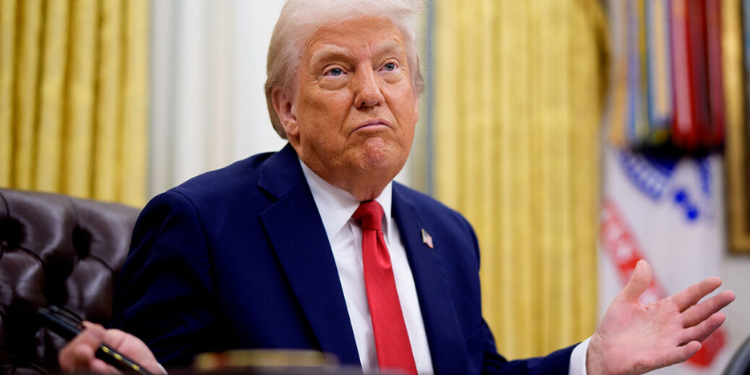
The Republican push for Trump-backed voter ID legislation faced both triumph and turmoil on Tuesday as the Senate moved forward with the Safeguarding American Voter Eligibility (SAVE) America Act.
While Senate Republicans succeeded in launching a procedural vote to advance the bill, internal divisions within the GOP highlighted the fragility of President Donald Trump’s legislative influence.
The floor action was designed to force Senate Democrats to publicly oppose the bill, which would impose stricter voter ID requirements and end most mail-in ballots, while also addressing controversial issues such as participation in women’s sports and transgender surgeries for minors.
Senate Minority Leader Chuck Schumer immediately signaled his party’s opposition. “Not a single Democrat will support the SAVE Act. It is a radical bill,” Schumer declared.
GOP Divisions Emerge Amid Procedural Victory
Senate Majority Leader John Thune, R-S.D., led Republicans in a multi-day debate aimed at securing the 51 votes needed to advance the legislation.
“Polling shows broad support for all of the issues included in the SAVE America Act,” Thune said before the procedural vote. “But never underestimate Democrats’ ability to get on the wrong side of what the American people want.”
Also Read: Top GOP Leader Reveals Hidden Strategy Republicans Will Use to Pass Voting Bill in Senate
Despite the initial procedural success, the GOP faced notable internal resistance. Sen. Lisa Murkowski, R-Alaska, joined all Senate Democrats in blocking the legislation, while Sen. Thom Tillis, R-N.C., declined to vote, signaling potential obstacles for the leadership.
Other Republicans, including Sens. Mike Lee, R-Utah, Rick Scott, R-Fla., and Ron Johnson, R-Wis., had lobbied for a talking filibuster to wear down Democrats and lower the threshold to a simple majority. However, without unanimous Republican support, the strategy risked becoming a political liability.
Sen. Lee pushed aggressively for party unity, even warning that dissenting senators could face replacement if they failed to back Trump’s priorities. “If your senators don’t support using the talking filibuster to pass the SAVE America Act, you might need to replace them,” Lee said. Such statements underscored the tension between Trump loyalists and more moderate Republicans who question the breadth of the legislation.
Amendments and Democratic Resistance Complicate Passage
Amendments to the bill remain a significant hurdle. Each provision must meet a 60-vote threshold, and Democrats are expected to use procedural tactics to slow the debate.
The bill’s measures to restrict mail-in voting, which have long been a flashpoint in election law disputes, are likely to encounter pushback even from within the GOP. Sen. Ron Johnson acknowledged that a full ban on absentee ballots was unrealistic, but argued for “reasonable restrictions” to ensure election integrity.
Meanwhile, Senate Democrats are preparing to leverage procedural maneuvers that could delay other priorities, including the confirmation of Sen. Markwayne Mullin, R-Okla., as the next Department of Homeland Security chief. The floor debate is expected to stretch over multiple days, with each amendment and procedural vote scrutinized for political leverage.
Also Read: GOP Eyes New Tactic to Push Trump’s Voter ID Bill Past Filibuster
The SAVE America Act represents both a symbolic and practical test of Trump’s influence over the Republican Party. While the procedural victory demonstrates the continued sway of Trump-aligned senators, the resistance from GOP moderates highlights fractures that could hinder future legislative agendas.
Why It Matters
The battle over the SAVE America Act is more than a fight over voter ID laws. It illustrates the ongoing struggle within the Republican Party between Trump loyalists and moderates and highlights the partisan divide over election access and voting reforms.
The outcome of this legislation could shape the political landscape heading into the 2026 midterms, influencing both party cohesion and public trust in election integrity. For President Trump, the fight underscores the limits of his influence: even when the party rallies around him, internal dissent can slow or reshape his agenda.