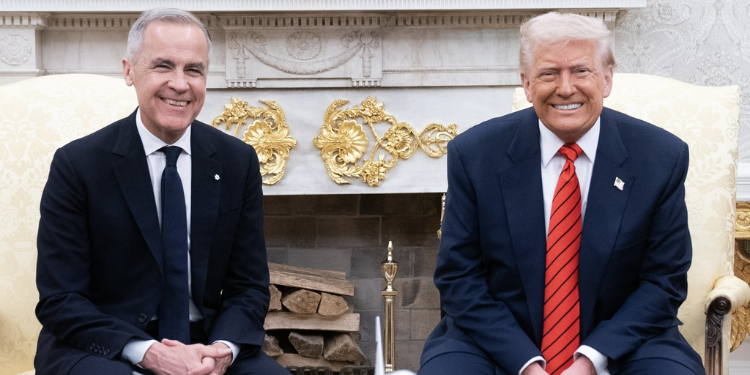
President Donald Trump has suffered a rare political setback after the Republican-controlled House voted to block his tariffs on Canada.
A group of GOP lawmakers on Wednesday, February 11, joined Democrats in a symbolic rebuke of the administration’s trade policy.
The House approved the resolution in a 219-211 vote, targeting the national emergency Trump declared last year to justify imposing tariffs on Canadian imports.
Although the measure is unlikely to dismantle the tariffs ultimately, the vote underscored growing unease within Congress over the president’s use of emergency powers to reshape U.S. trade policy.
Six Republicans — Reps. Kevin Kiley of California, Thomas Massie of Kentucky, Don Bacon of Nebraska, Brian Fitzpatrick of Pennsylvania, Jeff Hurd of Colorado, and Dan Newhouse of Washington — broke with their party to support the resolution. Rep. Jared Golden of Maine was the only Democrat to vote against it.
The measure now heads to the Senate, where bipartisan opposition to Trump’s tariff strategy has already surfaced.
The upper chamber has previously notably passed similar resolutions challenging the administration’s tariff actions.
However, any attempt to overturn the policy faces a likely presidential veto and steep odds of securing the two-thirds majority required in both chambers to override it.
Trump threatens Republicans over vote on tariffs
Ahead of the vote, Trump had issued a direct warning to Republican lawmakers, urging them to stand firmly behind his tariff agenda.
Writing on Truth Social, he cautioned that any Republican who opposed the policy would face political consequences.
“Any Republican, in the House or the Senate, that votes against TARIFFS will seriously suffer the consequences come Election time, and that includes Primaries!”
He defended tariffs as vital to both economic strength and national security, arguing they had reduced the U.S. trade deficit and strengthened America’s negotiating power globally.
The vote marks one of the first times the Republican-led House has directly confronted Trump over a cornerstone economic policy.
House Speaker Mike Johnson had attempted to prevent the vote altogether, urging lawmakers to wait for a pending Supreme Court ruling on whether the Head of State exceeded his authority by imposing tariffs through emergency powers.
The decision, centered on the International Emergency Economic Powers Act (IEEPA) of 1977, could shape the legal limits of presidential trade authority.
Johnson pushed a procedural maneuver to delay tariff-related votes until August, but his strategy collapsed late Tuesday when a handful of Republicans joined Democrats to defeat the move. The failure cleared the path for Wednesday’s vote, exposing fractures within GOP ranks.
“The president’s trade policies have been of great benefit,” Johnson had argued, calling for more time for the executive and judicial branches to resolve the issue.
But dissenting Republicans signaled concern about Congress relinquishing its constitutional authority over trade.
Rep. Don Bacon of Nebraska, one of the GOP lawmakers who supported the resolution, said Congress must assert its independence.
“Why doesn’t the Congress stand on its own two feet and say that we’re an independent branch?” Bacon said. “We should defend our authorities.”
Rep. Gregory Meeks of New York, the top Democrat on the House Foreign Affairs Committee and author of the resolution, framed the vote as a referendum on the economic impact of tariffs.
“Will you vote to lower the cost of living for the American family or will you keep prices high out of loyalty to one person — Donald J. Trump?” Meeks said during debate.
Also Read: Blow to Canada as Trump Terminates Trade Talks Over Reagan Tariff Ad
Democrats now plan to introduce additional resolutions targeting other tariff measures. Rep. Morgan McGarvey of Kentucky said the vote demonstrated growing bipartisan concern over rising costs.
“In forcing this vote, you’re seeing that the cost of everything is getting out of hand and it’s hard to ignore,” he said.
Debate over the national emergency
The resolution seeks to terminate the national emergency Trump declared last February, which allowed the administration to impose tariffs outside the framework of the United States-Mexico-Canada Agreement (USMCA).
The White House justified the emergency by citing illicit drug flows from Canada, particularly fentanyl, as an “unusual and extraordinary threat.”
Republican Rep. Brian Mast of Florida defended the administration’s position, arguing that the fentanyl crisis justified maintaining the tariffs.
However, experts note that most fentanyl entering the United States originates from Mexico, with far smaller volumes linked to Canada.
Critics of the tariffs also argue that evidence supporting the emergency declaration is limited, making the policy vulnerable to legal and political challenges.
Also Read: Kenya Among Countries Hit as Trump Signs Order Threatening Tariffs on Iran Trade
The House vote comes amid broader tensions over Trump’s trade strategy, including speculation that the administration could reconsider U.S. participation in the USMCA when the agreement comes up for renegotiation later this year.
Earlier, the White House signaled it would resist congressional efforts to roll back the tariffs. National Economic Council Director Kevin Hassett said the president would ensure lawmakers do not repeal the policy.
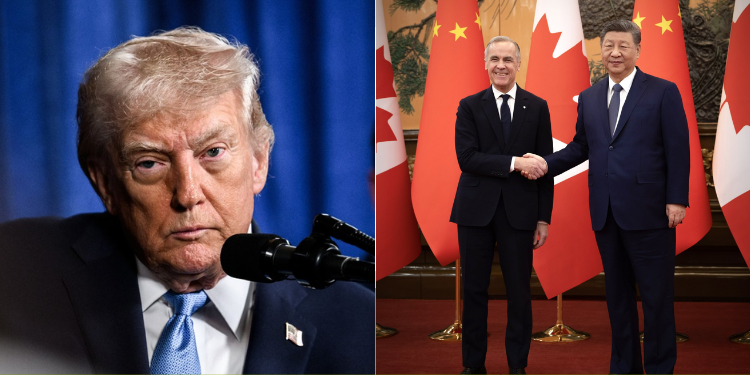
The House vote also comes after Trump last month threatened to impose a 100 percent tariff on Canadian goods over Ottawa’s proposed trade engagement with China.
Follow our WhatsApp Channel and X Account for real-time news updates.