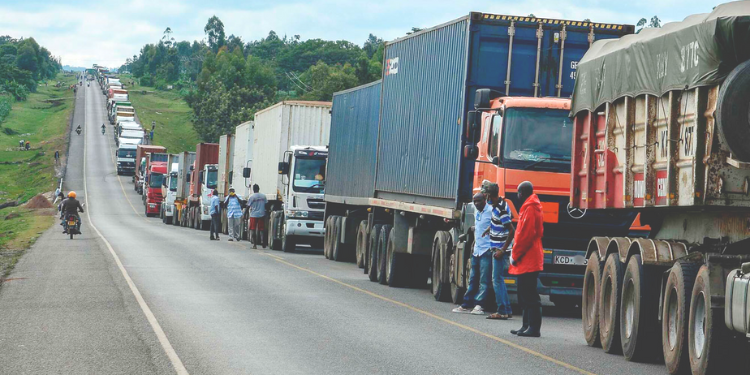
The government is considering reducing the number of police roadblocks along the Northern Corridor between Mombasa and Malaba to ease cargo movement.
Speaking to the media on April 21, the Principal Secretary in the State Department for East African Community, Caroline Karugu, said data from the past three years shows Kenya has lost between 8 and 10 percent of its transit cargo market share.
She further said the ongoing bottlenecks are weakening Kenya’s competitiveness as a regional logistics hub, as more cargo operators divert their shipments to the Central Corridor, which is anchored on the Port of Dar es Salaam as its primary entry point.
“We have seen, and we have looked at data over the last three years, the market share of transit goods has declined in the Republic of Kenya. We have seen a reduction of eight to ten percent of market share, and when I share the statistics further, you will see there is an increment of market share in the Central Corridor,” she said.
Govt Moves to Cut Roadblocks
Karugu attributed the decline to multiple checks by different agencies along the Mombasa-Nairobi–Malaba route, which have extended transit times, increased fuel consumption, and raised overall operational costs.
Transit time along the Northern Corridor currently averages between 76 and 80 hours, nearly double the target of 36 to 48 hours, largely due to the high number of roadblocks.
Deputy Inspector General Eliud Langat said the police will increase personnel along key transport routes to support smoother cargo movement.
Also Read: Govt Pressured to Build Truck-Only Highways
He also warned officers who may be found unnecessarily delaying cargo at various roadblocks, cautioning that those responsible for unjustified delays, particularly where personal gain is involved, will face disciplinary action.
In addition, the State Department for EAC is pushing to reduce police roadblocks to between five and six.
The government estimates that every $200 increase in transit costs due to non-tariff barriers results in a 5 percent loss in market share, while each additional day in transit time leads to a 3 to 5 percent diversion of cargo to competing routes.
Also Read: Export Trucks Face Long Queues and Missed Deadlines at Mombasa Port
About Northern Corridor
The Northern Corridor Transit and Transport Agreement (NCTTA) is a multilateral treaty designed to facilitate the smooth movement of transit cargo through the Port of Mombasa to landlocked member states, including Burundi, the Democratic Republic of Congo, Rwanda, Uganda, and South Sudan.
The agreement replaced earlier bilateral arrangements with a unified framework to standardize transit trade procedures across member states, improving efficiency and predictability in cross-border logistics.
It sets out key commitments on infrastructure management and policy harmonization, including the development of efficient and reliable transport systems, fair and non-discriminatory treatment of users, and coordinated investment in transport and transit facilities.
On free movement and non-discrimination, the agreement guarantees transit rights for citizens engaged in trade and prohibits discriminatory treatment based on the origin or destination of goods.