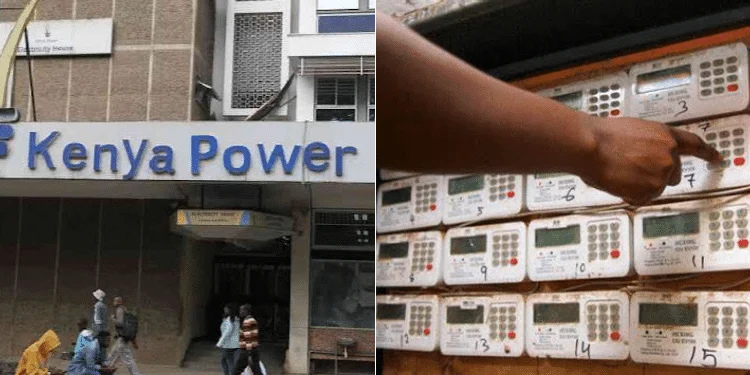
Kenya Power customers could be moved into different electricity tariff categories automatically under amendments introduced by the Energy and Petroleum Regulatory Authority (EPRA).
In a gazette notice dated September 18, 2026, EPRA amended the tariff schedule for the supply of electrical energy by Kenya Power and Lighting Company Limited (KPLC), including new rules on how customers move between tariff categories.
“IN EXERCISE of the powers conferred by Section 11 of the Energy Act, the Authority makes amendments and introduces additional provisions to the Gazette Notice No. 3899, Schedule of Tariffs – 2023 as follows,” the notice read.
According to Kenya Power, your tariff category is determined using a three-month moving average of electricity consumption, including the current billing cycle. If your average crosses the threshold for a higher category, you are automatically moved to that tariff band.
Kenya Power On How One High Bill Can Affect Your Tariff Category
For domestic consumers, EPRA has set three tariff categories: Domestic Consumer 1 (DC1), Domestic Consumer 2 (DC2), and Domestic Consumer 3 (DC3).
Movement between the three categories will be determined using a customer’s three-month moving average consumption, including electricity used during the current billing cycle.
“Movement between the categories shall be determined using the consumer’s three-month moving average consumption, including the current billing cycle.”
Under the amended tariff schedule, consumers using up to 30 kilowatt-hours (kWh) fall under DC1, the lifeline category.
Consumers whose three-month moving average is above 30 kWh but does not exceed 100 kWh fall under DC2, classified as the ordinary domestic category.
Those with a three-month moving average above 100 kWh and up to 15,000 kWh fall under DC3, also classified as an ordinary domestic category.
Kenya Power says it will automatically assign a consumer to the tariff category that matches their applicable three-month moving average consumption.
Also Read: Kenya Power Faces New Limits on Disconnecting Essential County Services
This means that a change in a household’s consumption can affect the category under which it is billed when the three-month average crosses the relevant threshold.
Small Businesses Also Covered
The notice also introduces three categories for small commercial customers: Small Commercial 1 (SC1), Small Commercial 2 (SC2), and Small Commercial 3 (SC3). The thresholds for these categories mirror those for domestic consumers.
Customers with consumption of up to 30 kWh fall under SC1, while those using more than 30 kWh but not more than 100 kWh fall under SC2.
Consumption above 100 kWh and up to 15,000 kWh falls under SC3.
As with domestic consumers, movement between SC1, SC2 and SC3 is determined using the customer’s three-month moving average consumption, including the current billing cycle.
Also Read: Kenya Power Offers Solution to Customers Whose Tokens Fail to Load
Kenya Power says the customer will automatically be assigned to the tariff category corresponding to the applicable average.
“Consumer shall automatically be assigned to the tariff category corresponding to the applicable three-month moving average consumption,” the notice stated.
New Consumption Threshold Rules
The notice also sets out how energy consumption thresholds will be handled for SC3 customers and other specified customer categories.
SC3, e-mobility (EM), and CI customers must meet their monthly Energy Consumption Threshold. Units consumed above the threshold will be billed under the discounted Time-of-Use (TOU) tariff, subject to the applicable conditions.
For new SC3 and CI1–CI7 customers, the Energy Consumption Threshold will be calculated using their average monthly consumption during the first three consecutive months.
The notice also provides for a 5% discount on the applicable energy rate for off-peak consumption for SC3 and CI1–CI7 customers operating at 100% production capacity during both on-peak and off-peak hours.
This discount is subject to Kenya Power’s satisfactory confirmation that the customer’s production is operating at 100% capacity.
Follow our WhatsApp Channel and X Account for real-time news updates.