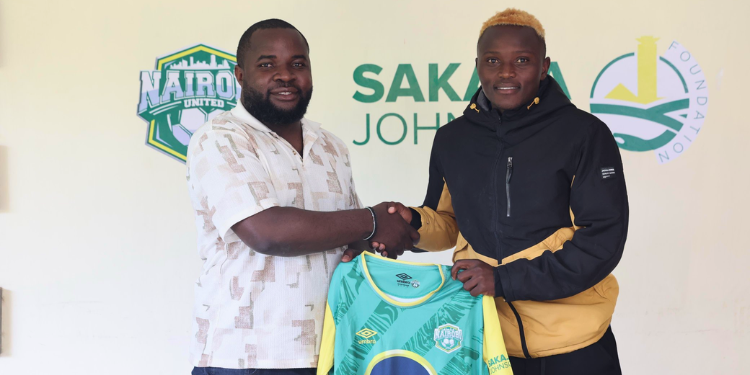
Nairobi United winger John Njuguna has become the latest Kenyan footballer to be banned for breaching anti-doping rules, in a decision that once again casts a shadow over the country’s top-flight league.
The Sports Disputes Tribunal handed Njuguna a two-year suspension, effectively barring him from all football activities sanctioned by the Football Kenya Federation (FKF), the Confederation of African Football (CAF), and FIFA until December 2027.
The ban has been backdated to December 2025, when he was provisionally suspended.
John Njuguna’s Whereabouts Failure
Unlike many doping cases that involve banned substances, Njuguna’s sanction stems from a “whereabouts failure,” a violation under the Anti-Doping Agency of Kenya (ADAK) regulations.
Under these rules, players listed in the Registered Testing Pool are required to consistently provide accurate location information for out-of-competition drug testing.
“These athletes are subject to focused In-Competition and Out-of-Competition Testing as part of our test distribution plan and are therefore required to provide whereabouts information as per Article 5.6.1 of the ADAK Rules,” the ADAK rules state.
This includes details of their residence, training venues, competition schedule and a specific one-hour daily window when they are available for testing.
Also Read: Inside the Life and Career of Dennis Oliech, Kenya’s Most Influential Striker
A whereabouts failure occurs when an athlete either misses scheduled drug tests or fails to submit the required information.
Accumulating three such failures within a 12-month period constitutes a doping violation, even in the absence of a positive test.
In John Njuguna’s case, the tribunal found that he had committed the required number of failures, leading to the two-year ban.
Before the tribunal’s final ruling, Njuguna had already been provisionally suspended in February 2026 by the Anti-Doping Agency of Kenya (ADAK), as part of a wider crackdown on whereabouts failures.
In that announcement, ADAK listed several affected players, including Benson Omala (Nairobi United), John Njuguna (Nairobi United), Charles Ouma (Kenya Police FC), Bonphas Mnyasa (KCB), and Johanna Mwita (formerly Bandari FC).
The provisional suspension meant the players were immediately barred from all football activity pending investigations and hearings.
The strict enforcement is part of growing efforts by Kenya’s anti-doping authorities to ensure compliance not only with substance use but also with testing procedures.
Doping in Kenyan Football
Kenyan football has faced repeated integrity challenges in recent years, with cases of doping and match-fixing exposing deep-rooted weaknesses in compliance and governance across the game.
Also Read: Kenyan Teams and Sports Heroes Who Starred in 2025
In 2019, former Harambee Stars defender George Owino Audi was handed a 10-year ban by FIFA after being found guilty of match-fixing in international matches.
One of the most high-profile cases remains that of former Harambee Stars defender George Owino Audi, who was handed a 10-year ban by FIFA in 2019 after being found guilty of match manipulation involving international matches.
Investigations revealed communication with a known global match-fixer.
In 2020, FIFA banned three Kenyan Premier League players, Moses Chikati, Festus Okiring, and Festo Omukoto, for four years after they were found to have influenced the results of domestic league fixtures.
The same investigation also led to a lifetime ban for Ugandan player George Mandela, who FIFA identified as central to the match-fixing conspiracy.
George Mandela was playing in the Kenyan league at the time for Kakamega Homeboyz.
Alongside match-fixing, doping-related violations have also emerged as a growing concern.
Former Harambee Stars midfielder Whyvonne Isuza was handed a four-year suspension after refusing to submit to a doping test, a decision that ultimately forced him into early retirement from the game.
Similarly, former Tusker midfielder Teddy Osok received a four-year ban after testing positive for a banned substance, with the case illustrating how even medical treatment can lead to violations if not properly declared.
Follow our WhatsApp Channel and X Account for real-time news updates.